Rate Your Hype
Hype Metrics
42
years old
Since 1984
82
nostalgia score
Multi-gen
440
Wikipedia views / week
Trend: flat
Rank History
About This Theme
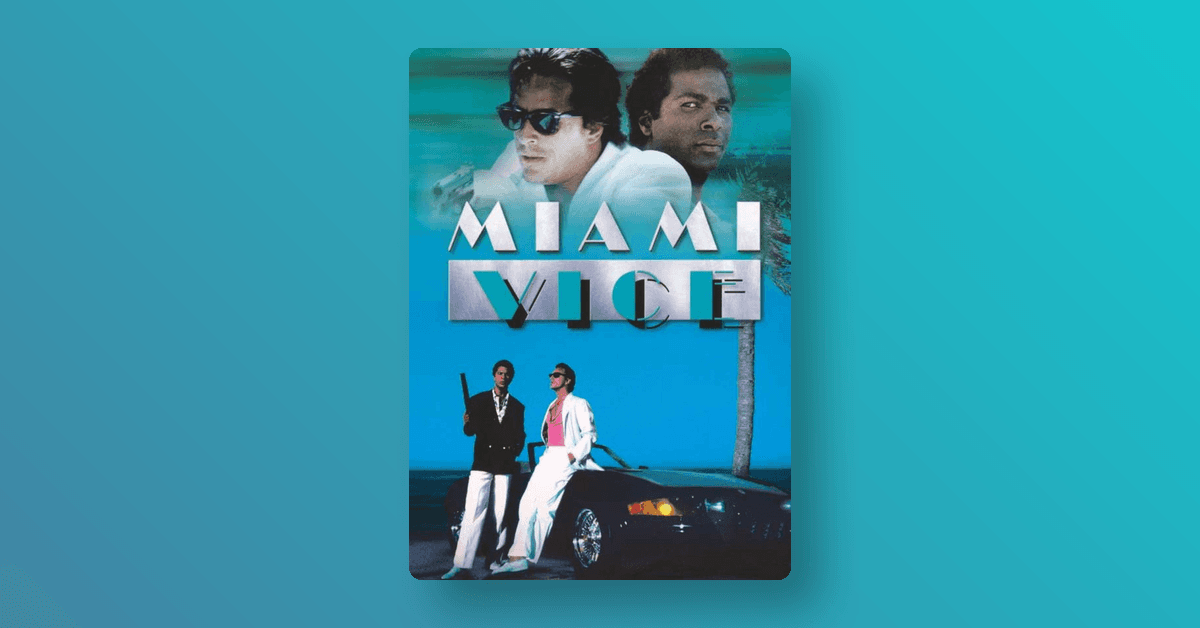
Miami Vice is an American television series that aired on NBC from 1984 to 1989, created by Anthony Yerkovich and produced by Michael Mann. The show followed undercover detectives Sonny Crockett and Ricardo Tubbs as they worked the drug trade in Miami, Florida, and became one of the most influential programs of its era. It was widely credited with redefining the visual language of American television through its use of pastel clothing, unshaven faces, no-socks loafers, and neon-lit Art Deco backdrops set against the Miami skyline and waterfront. The series also made a significant cultural mark through its music, incorporating contemporary artists like Phil Collins, Glenn Frey, and Jan Hammer, whose synthesizer-driven theme became one of the most recognizable instrumental pieces of the 1980s. A theatrical film adaptation directed by Michael Mann was released in 2006, further extending the franchise's reach. Miami Vice holds a 7.6 out of 10 rating on IMDb based on over 34,000 user votes and remains a widely referenced symbol of 1980s popular culture.
Within the pinball community, Miami Vice surfaces periodically in discussions about potential themes, particularly when conversations turn toward 1980s nostalgia properties. On Pinside, one of the primary online forums for pinball enthusiasts, users have cited it alongside properties like Knight Rider and The A-Team as a natural candidate for an 80s-era machine. One frequently referenced fan concept includes gameplay ideas such as spelling out Ferrari to start multiball, a crocodile bash toy modeled after the pet alligator seen in the show, an Uzi hurry-up mode, and a powdered sugar topper referencing the show's drug-trade storyline. A notable historical connection also exists in that Gottlieb produced a 1986 machine called Hollywood Heat, which many collectors and historians have identified as an unlicensed spiritual adaptation of the Miami Vice aesthetic, suggesting the theme has had an implicit presence in pinball even without an official release.
As a pinball machine theme, Miami Vice presents a strong combination of visual, audio, and mechanical possibilities. The show's iconic imagery, including Ferrari Testarossa sports cars, speedboats, South Beach architecture, neon lighting, and tropical color palettes, offers rich material for playfield artwork and cabinet design. Gameplay could draw on the procedural structure of undercover operations, with modes built around busting drug shipments, evading cartel enforcers, and climbing toward a kingpin confrontation. The show's use of contemporary pop and electronic music, along with Jan Hammer's original score, provides a ready-made soundtrack with high recognition value among players who grew up in that era. The combination of a visually striking aesthetic, a well-defined two-character dynamic between Crockett and Tubbs, and a narrative framework built on escalating criminal confrontations gives the property considerable structural compatibility with modern pinball machine design.