Magic Tricks: Pinball Magic Tutorial

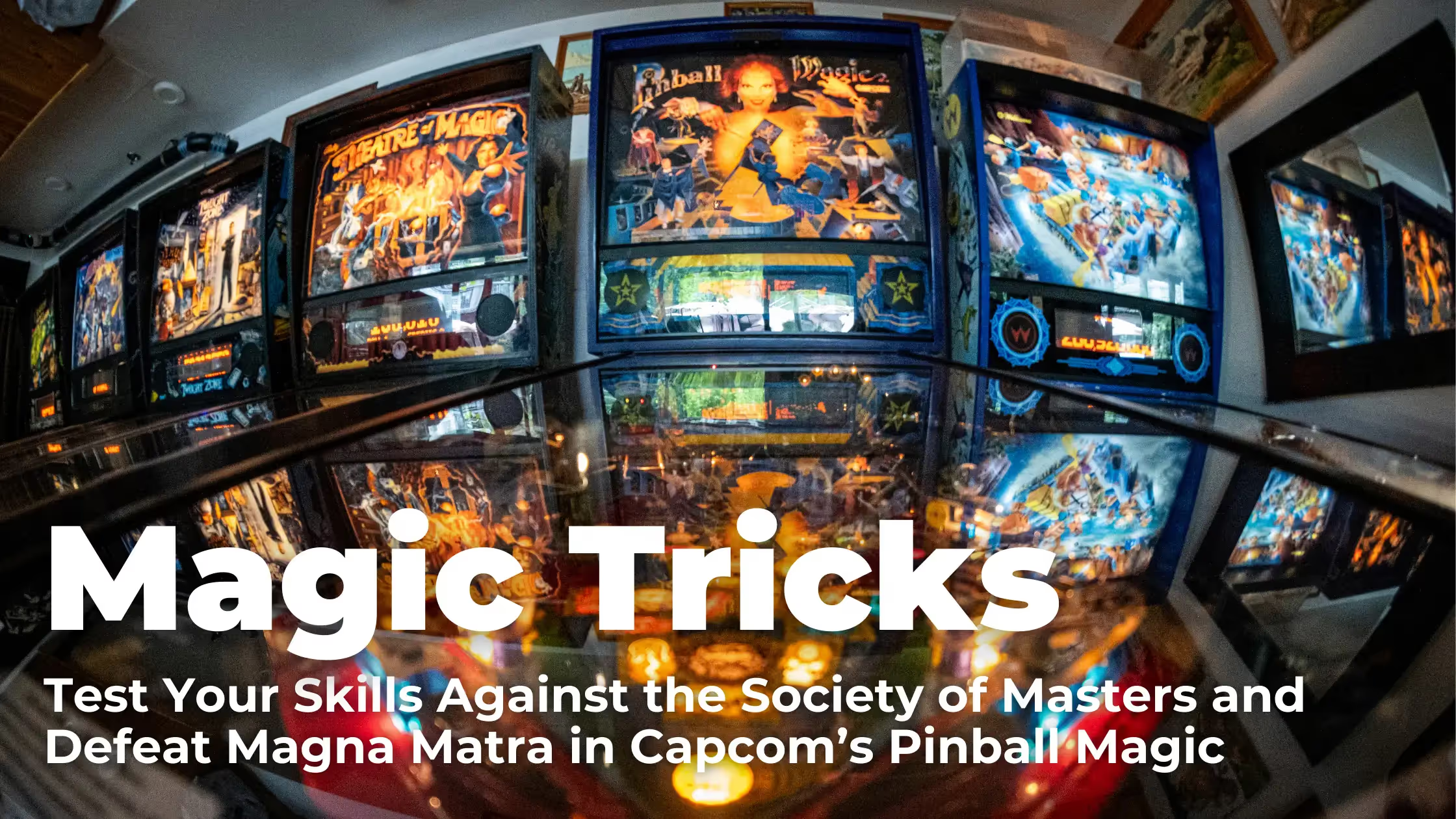
As pinball’s popularity increased in the early 90s, a new company was interested in joining the fold. GameStar – aka Capcom Coin-Op – was founded as a joint venture with Capcom’s US and Japan divisions, and Romstar, a video game distributor known for their arcade ports. The company hired former Williams pinball talent like Mark Ritchie, Python Anghelo, and Bill Pfutzenreuter to help out with their game design. After two years of preparation, Capcom would release their first pinball machine, Pinball Magic, at the tail end of 1995; coincidentally around the same time, Bally would release Theatre of Magic to more widespread acclaim and location play.
Pinball Magic is a unique pinball machine, not only for its gimmicks – some of which have never been attempted in a pinball machine before or since – but also for its linear rules compared to other tables of the era. Scoring on the game is largely dependent on completing tricks assigned by Matra Magna’s cabal of magicians, awarding increasing points for each set of seven tricks completed. The table also features two types of multiball or “magic mayhem”, a 2-ball multiball best used as a utility multiball, and a 3-ball multiball that should be used to build and collect as many jackpots as possible.
While the machine tries to communicate which shots correspond to which tricks, both visually and with audio callouts if the player is taking too long, the communication on Pinball Magic is a sore point of the machine and one I hope to rectify with this guide. I plan to discuss all 21 tricks and briefly discuss magic mayhem & the captive ball rules, both of which can help with scoring.
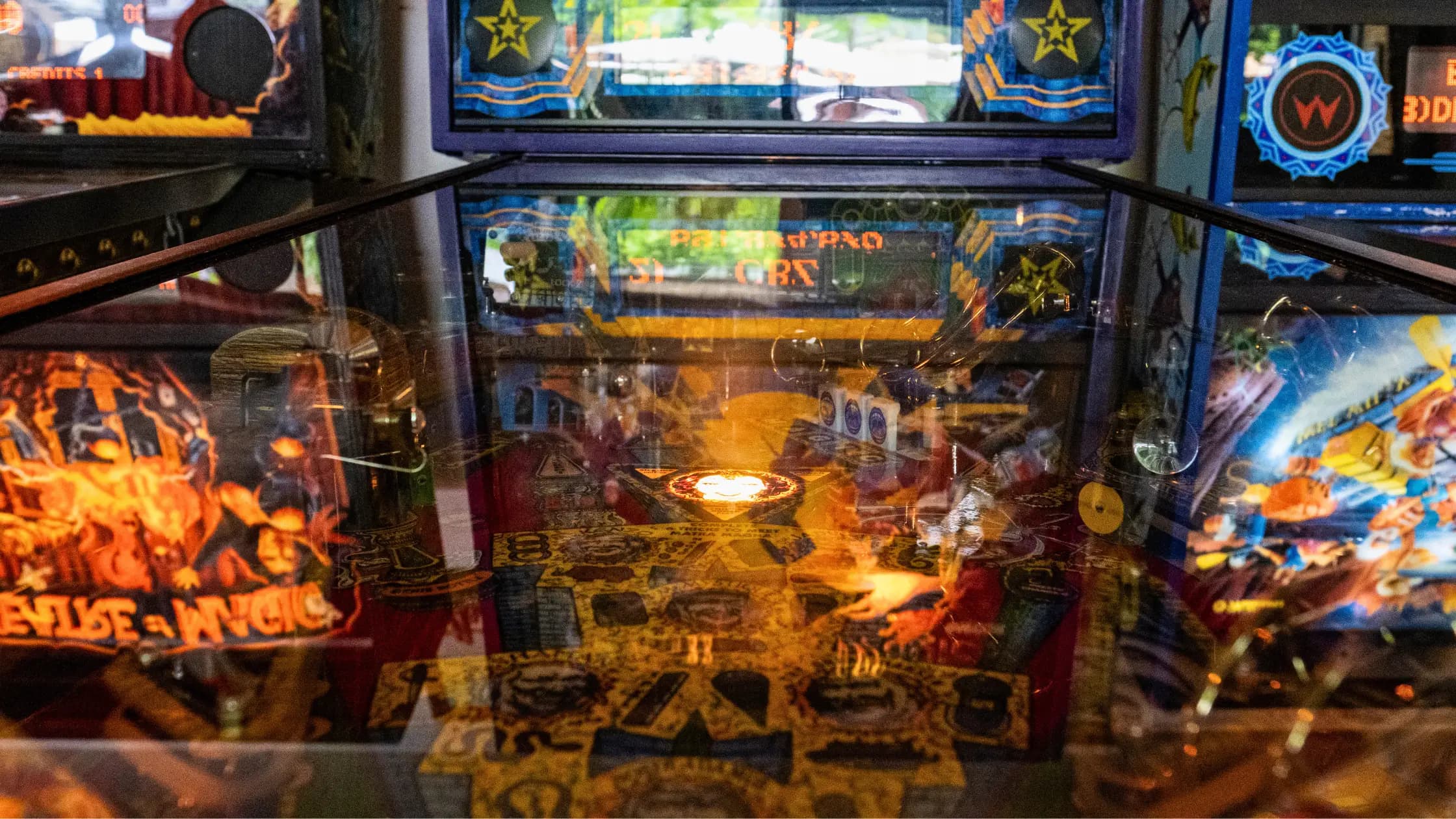
An ancient magician named Matra Magna, alongside her Society of Masters, has taken control of this pinball machine. Players must test their skills against the Society for a chance to defeat Magna herself.
About Capcom’s Pinball Magic Pinball Machine
Learn more about Capcom's Pinball Magic on the Kineticist pinball directory.
- Year: 1995
- Design: Bryan Hansen, Rob Hurtado
- Code: Sammy Zehr
- Mechanics: Michael Zhang, Rick Morgan
- Art: Hugh Van Zanten, Jeff Busch
- Animation: Scott Pikulski
- Music / Sound: Chris Granner, Jeff Powell
Pinball Magic Playfield Overview
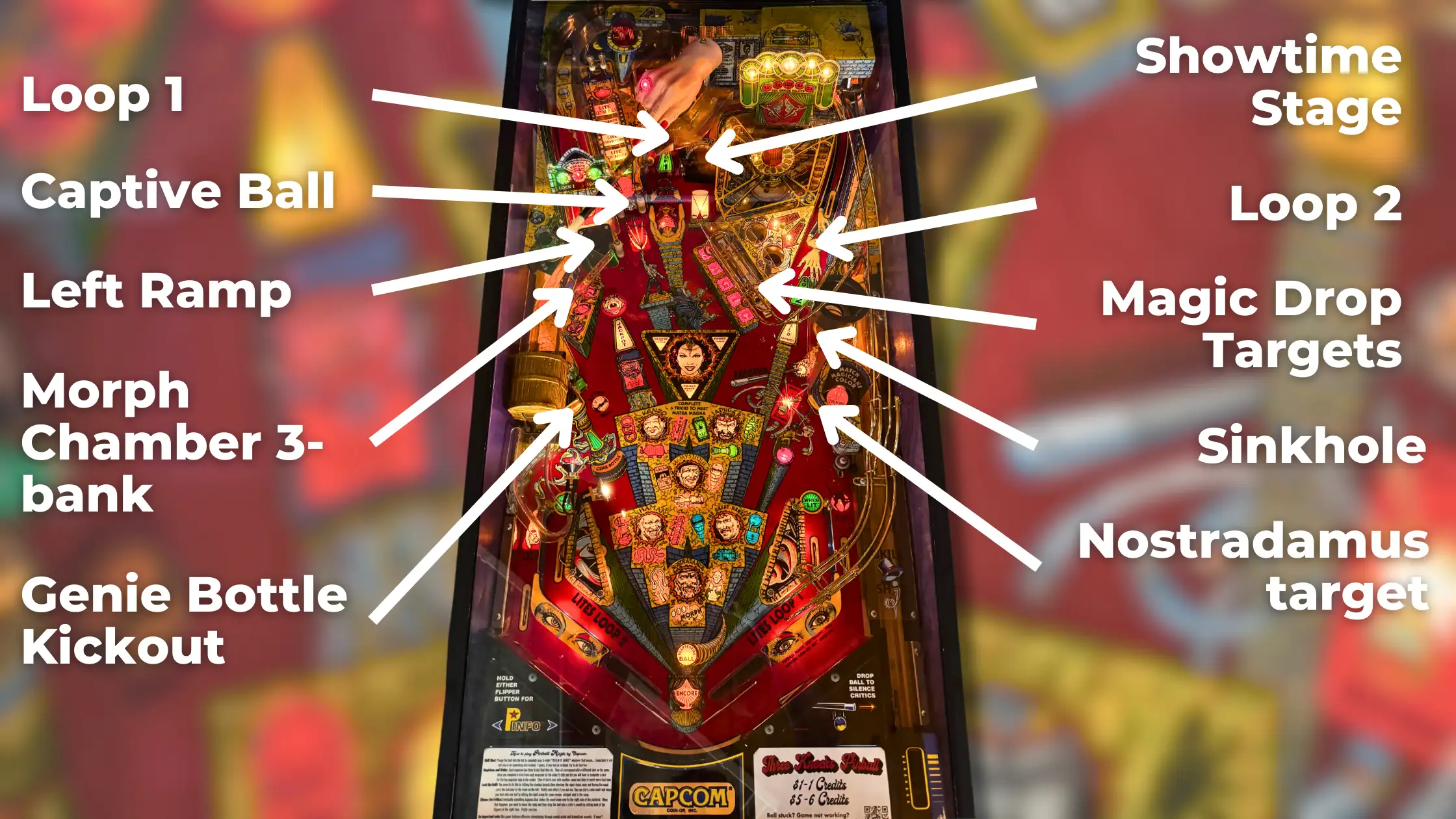
Shots on Pinball Magic are equally split between the top and bottom halves of the playfield. At the very far left is the “genie bottle” kickout. Similarly to the lost mine kickout on White Water, this kickout ejects the ball very quickly to the right flipper. Your best bet for survival out of this kickout is to hold up the right flipper, or dead bounce off the flipper and hope for the best. Above the green “extra ball” target flanking the kickout is the morph chamber 3-bank. Completing these standup targets, which change inserts with left flipper presses, will light the left outlane kickback if unlit, and light the lock if lock isn’t already lit.
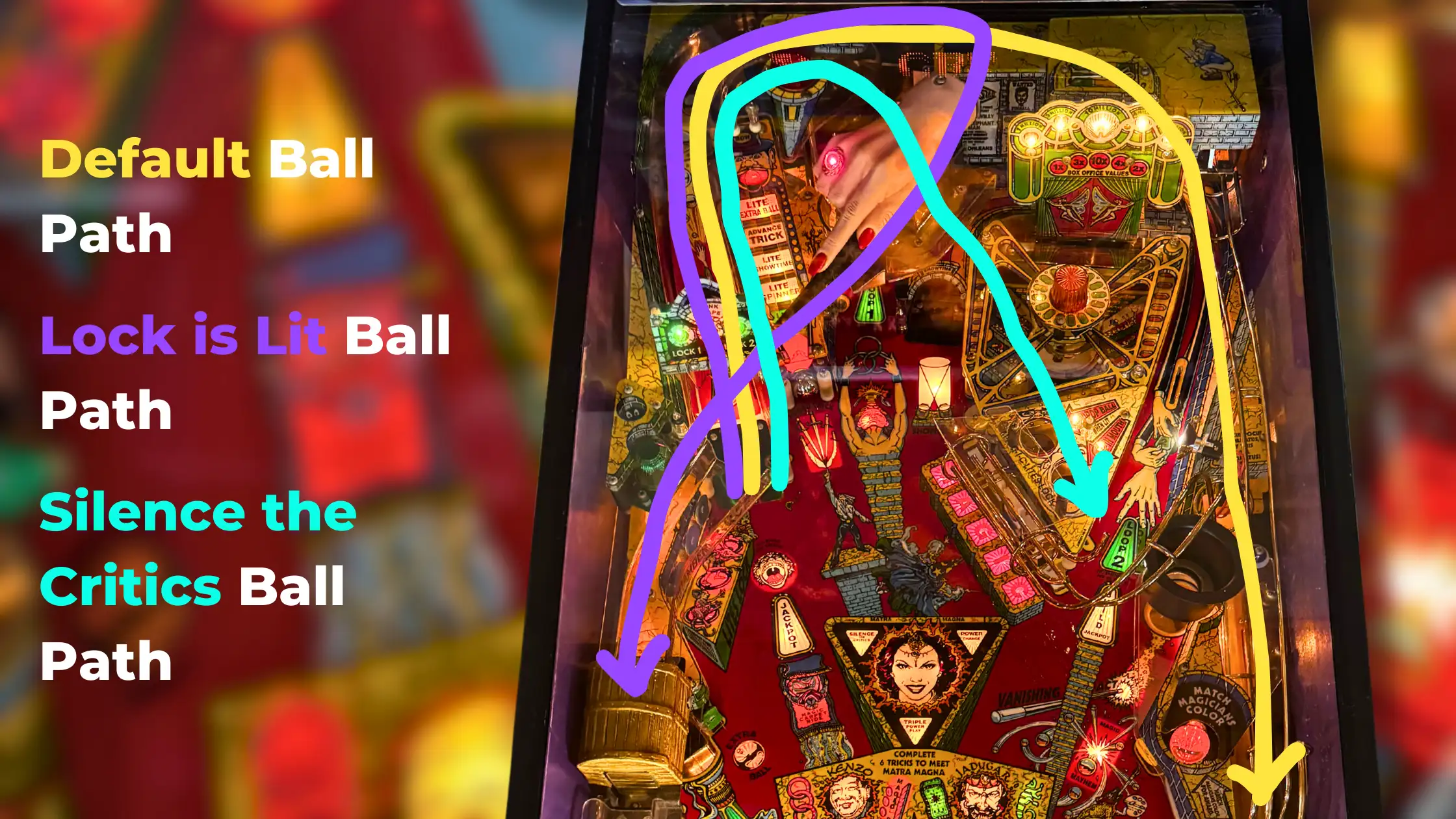
The left ramp has three different paths the ball can head down, thanks to Matra Magna’s magic wand diverter. The default path sends the ball flying to the right flipper, but if lock is lit, the ramp will divert to the trunk above the “genie bottle” to lock balls; and if silence the critics is available, the ramp will divert to their balcony. Right of the left ramp is a unique, “glowing” captive ball that must be sent up a ramp to collect the currently lit award from bottom to top. The captive ball can be hit from either flipper but is safest from the right flipper.
“Loop 1” is the left loop, in a similar position to Deadpool’s center loop, and can be hit from either flipper, while “Loop 2” is the right loop and the inverse of the same shot. Between these two loops are the MAGIC drop targets, which increase the bonus multiplier and light lock at the left ramp when completed; and the showtime stage, represented by a pair of moving doors with a single pop bumper below them. Typically, the ball will be sent into the bumper area upon shooting the showtime stage, but if the stage is lit (either for trick or by hitting the stage 4 times in a ball), the ball will float onto the default left ramp exit towards the right flipper.
The shots on the right side of the playfield are some of the toughest in the game but there are ways to handle shooting them. Beneath the hat where skill shots are collected is a sinkhole, used to start magic mayhem when flashing. Shots to this sinkhole can sometimes brick out, so mastery of the plunge is required to hit the sinkhole reliably. Just below the sinkhole is Nostradamus’ “color match” target. Each magician has a certain color of trick as seen on the playfield, and if the target is hit with that color flashing, 1M + 1M per match is scored. This target is ignorable for the most part but is very prominent during the penultimate “presto changeo” trick; your best bet will be to either collect “advance trick” off the captive ball or make late flips off the left flipper and try to recover with well-timed nudges and ball control.
Getting Started with Pinball Magic
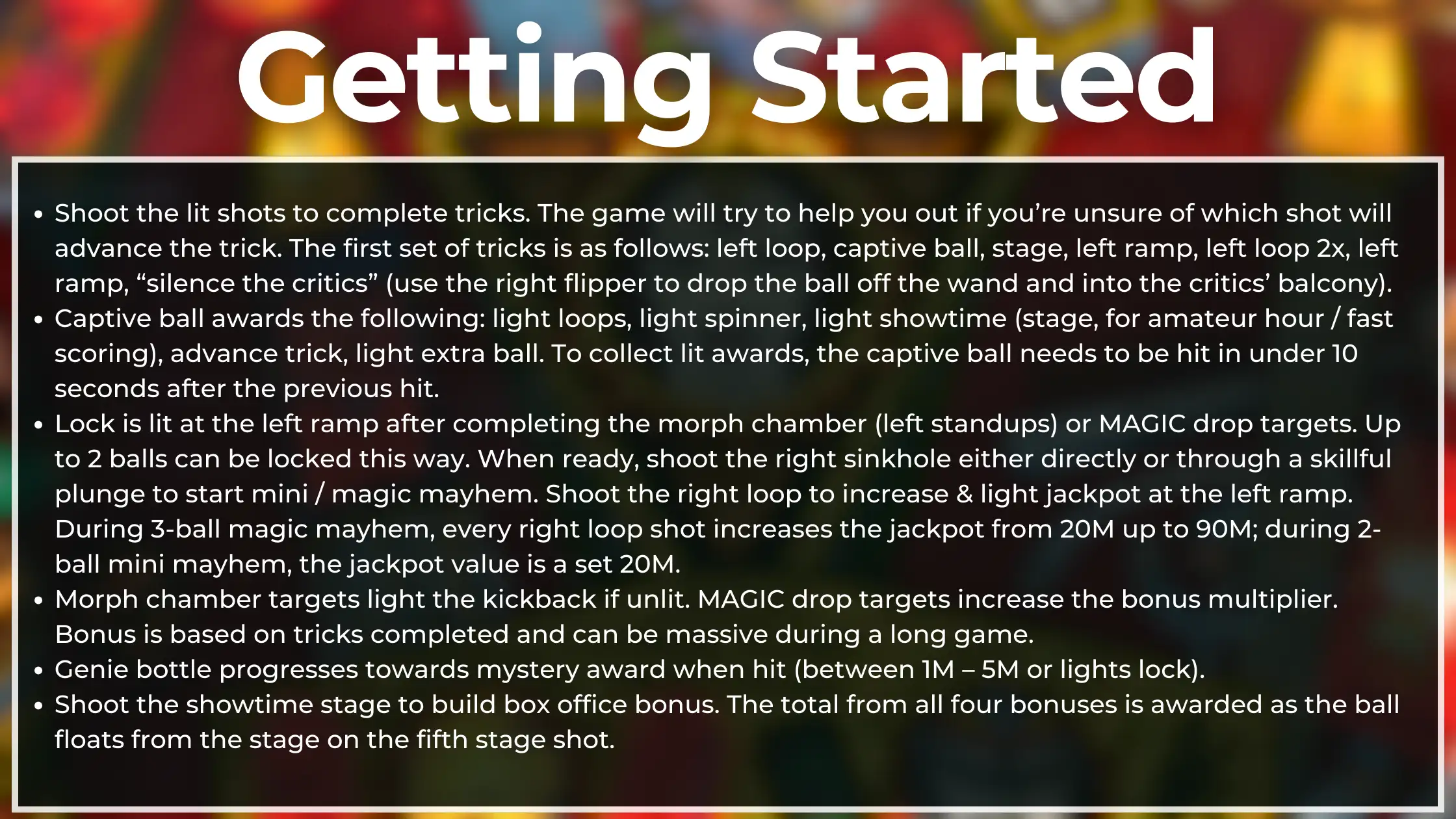
- Shoot the lit shots to complete tricks. The game will try to help you out if you’re unsure of which shot will advance the trick. The first set of tricks is as follows: left loop, captive ball, stage, left ramp, left loop 2x, left ramp, “Silence the Critics” (use the right flipper to drop the ball off the wand and into the critics’ balcony).
- Captive ball awards the following: light loops, light spinner, light showtime (stage, for amateur hour / fast scoring), advance trick, light extra ball. To collect lit awards, the captive ball needs to be hit in under 10 seconds after the previous hit.
- Lock is lit at the left ramp after completing the morph chamber (left standups) or MAGIC drop targets. Up to 2 balls can be locked this way. When ready, shoot the right sinkhole either directly or through a skillful plunge to start mini / magic mayhem. Shoot the right loop to increase & light jackpot at the left ramp. During 3-ball magic mayhem, every right loop shot increases the jackpot from 20M up to 90M; during 2-ball mini mayhem, the jackpot value is a set 20M.
- Morph chamber targets light the kickback if unlit. MAGIC drop targets increase the bonus multiplier. Bonus is based on tricks completed and can be massive during a long game.
- Genie bottle progresses towards mystery award when hit (between 1M – 5M or lights lock).
- Shoot the showtime stage to build box office bonus. The total from all four bonuses is awarded as the ball floats from the stage on the fifth stage shot.
Skill Shot
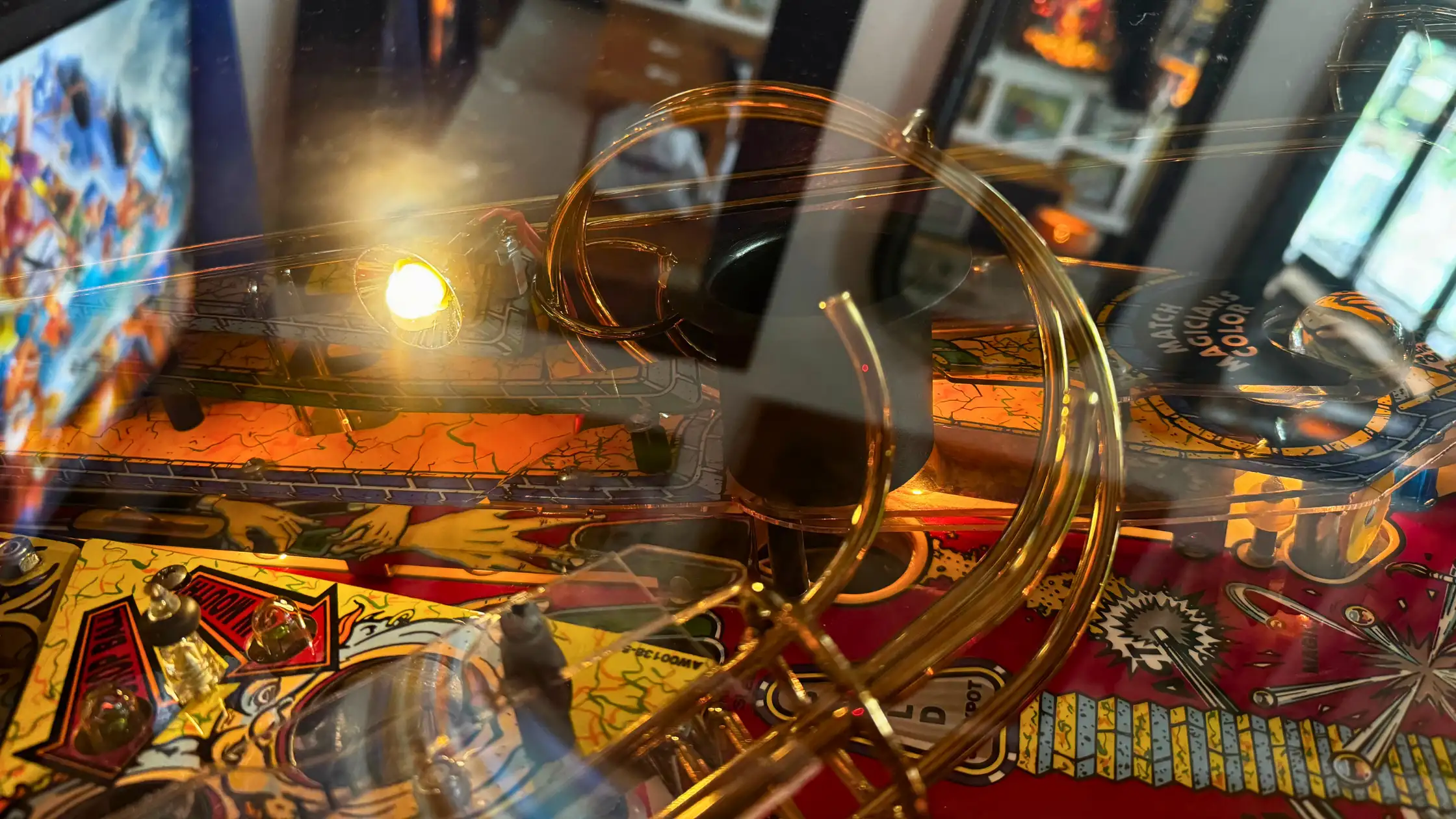
At the start of the game, you’ll be prompted to plunge the ball into the hat for skill shot. DON’T DO THIS. The first trick of the game is at the left loop, and with a strong plunge, you can complete this first trick at the left loop without a single flip!
Otherwise, the skill shot alternates at the start of each ball. For instance, in a 3-ball game balls 1 and 3 will have the skill shot at the hat for 5M; and ball 2 will light the spinner at the left loop for 100k a spin. If you have magic mayhem lit, your priority should always be plunging for the hat to start it.
Tricks
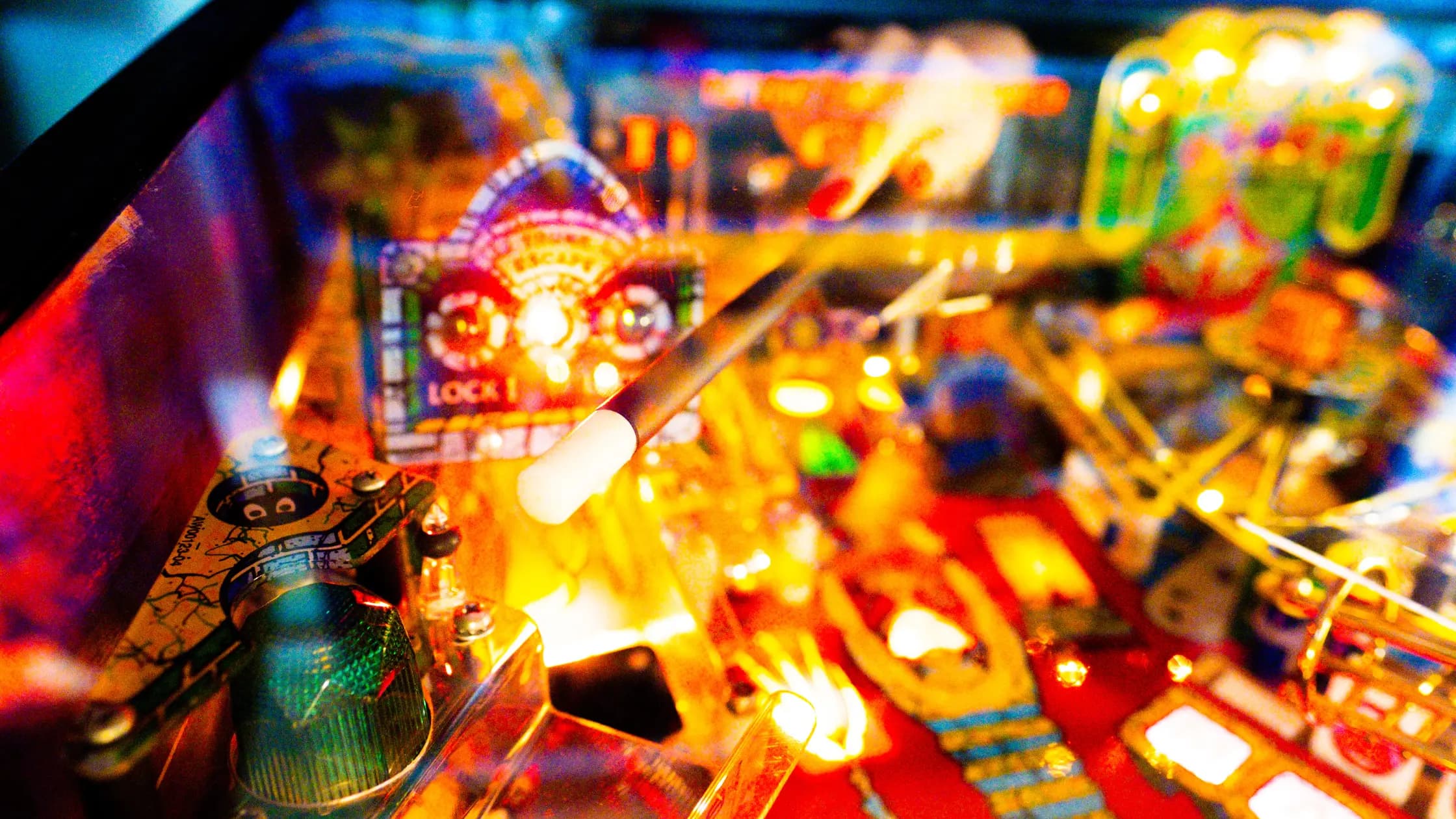
There are six members of Matra Magna’s Society of Masters. Over the course of the game, each member will assign a trick to you, which you accomplish by making whatever shot (or set of shots) they want you to make, or by collecting “advance trick” from the captive ball. Completing six tricks will enable access to a more difficult seventh trick for Magna herself. There are three total sets of tricks; so, 20 tricks before you can take on Magna’s wand.
The tricks, and sets, are given in the same order every game.
Trick Set 1 (tricks score 10M):
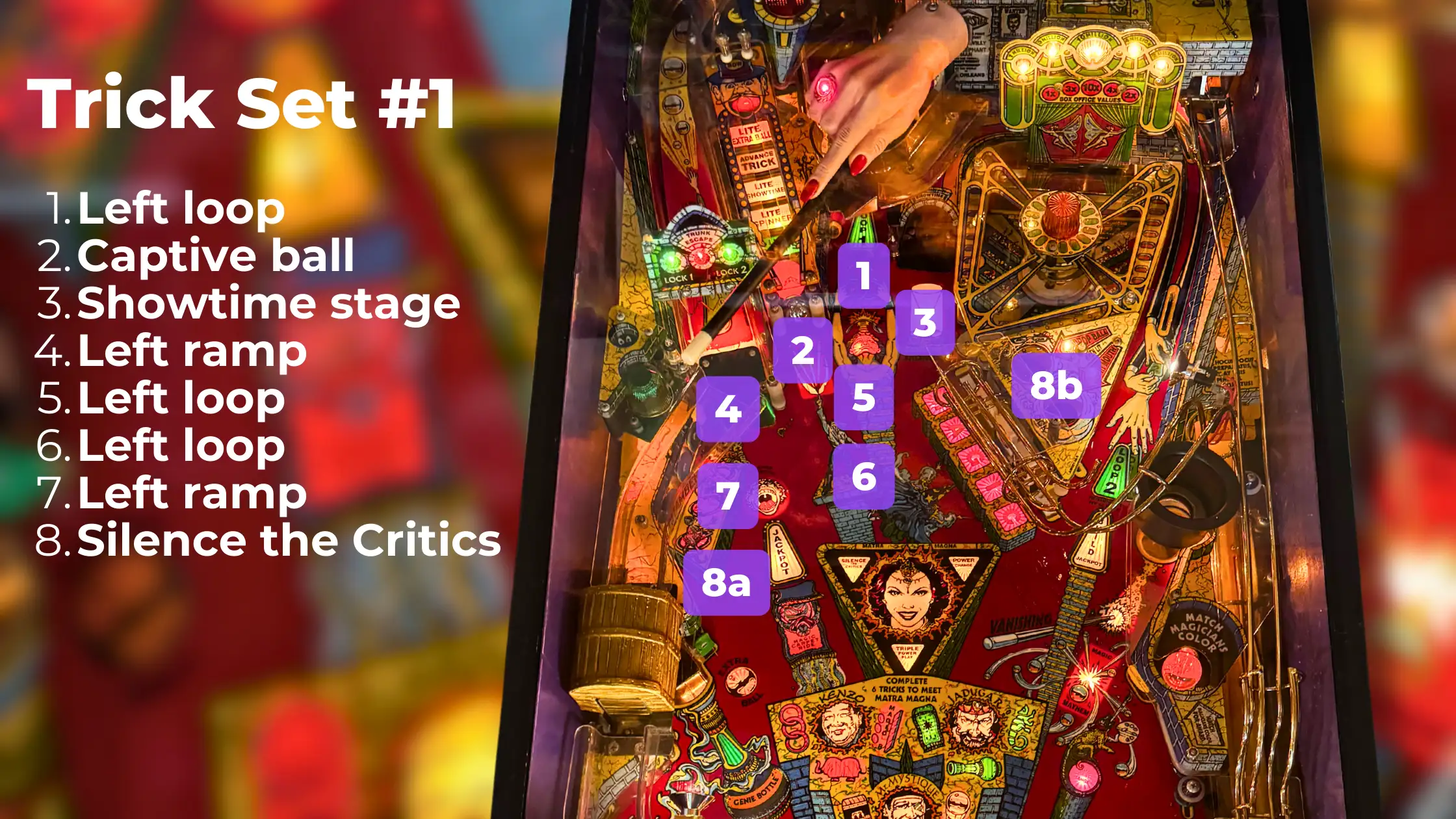
- Left loop (this can be full plunged at the very start of the game)
- Captive ball
- Showtime stage (ball will float towards right flipper)
- Left ramp (will divert towards trunk)
- Left loop, twice
- Left ramp (default path)
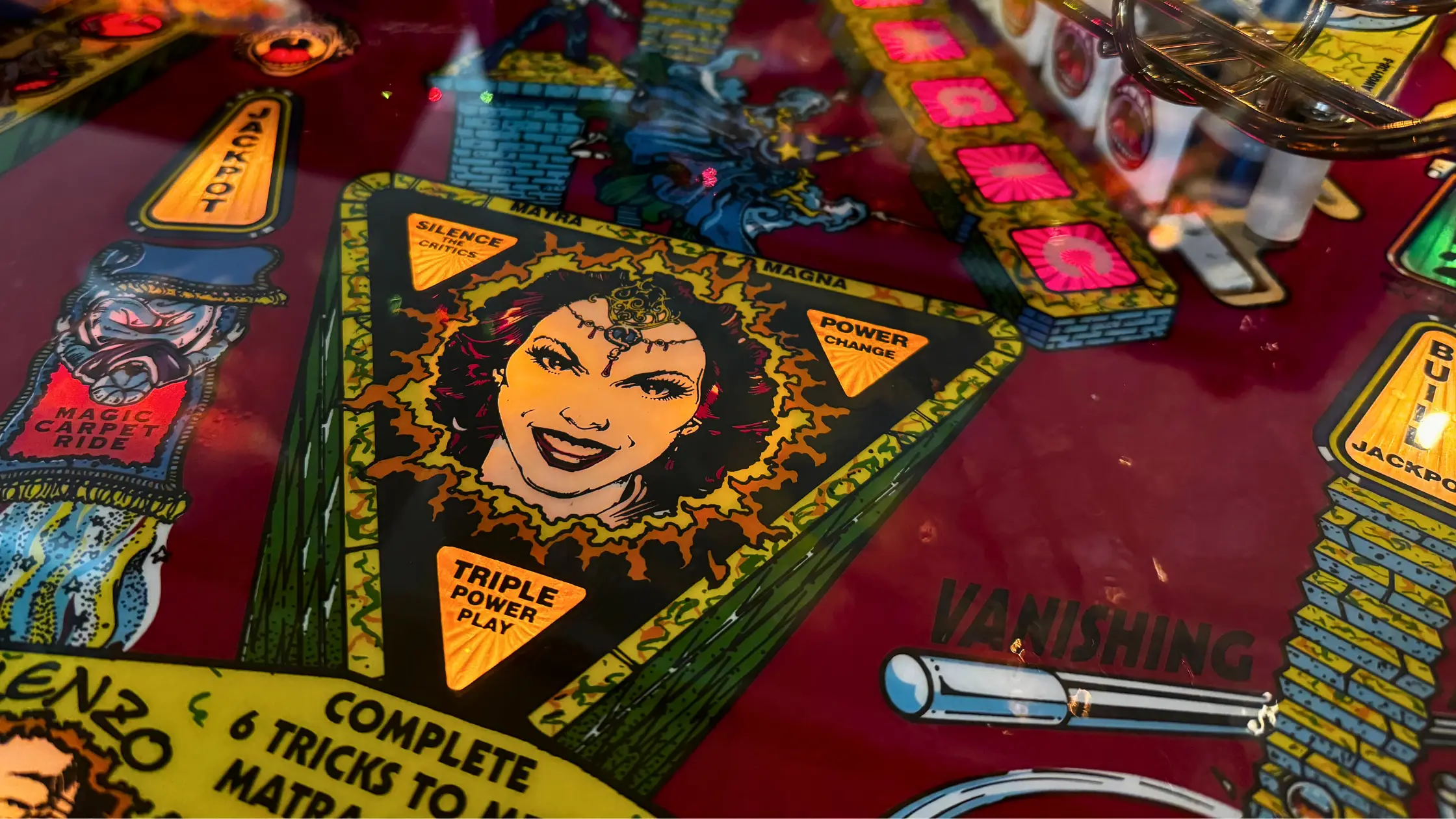
- Silence the Critics (shoot the left ramp and try to drop the ball into the critics’ balcony using the right flipper)
Trick Set 2 (tricks score 20M):
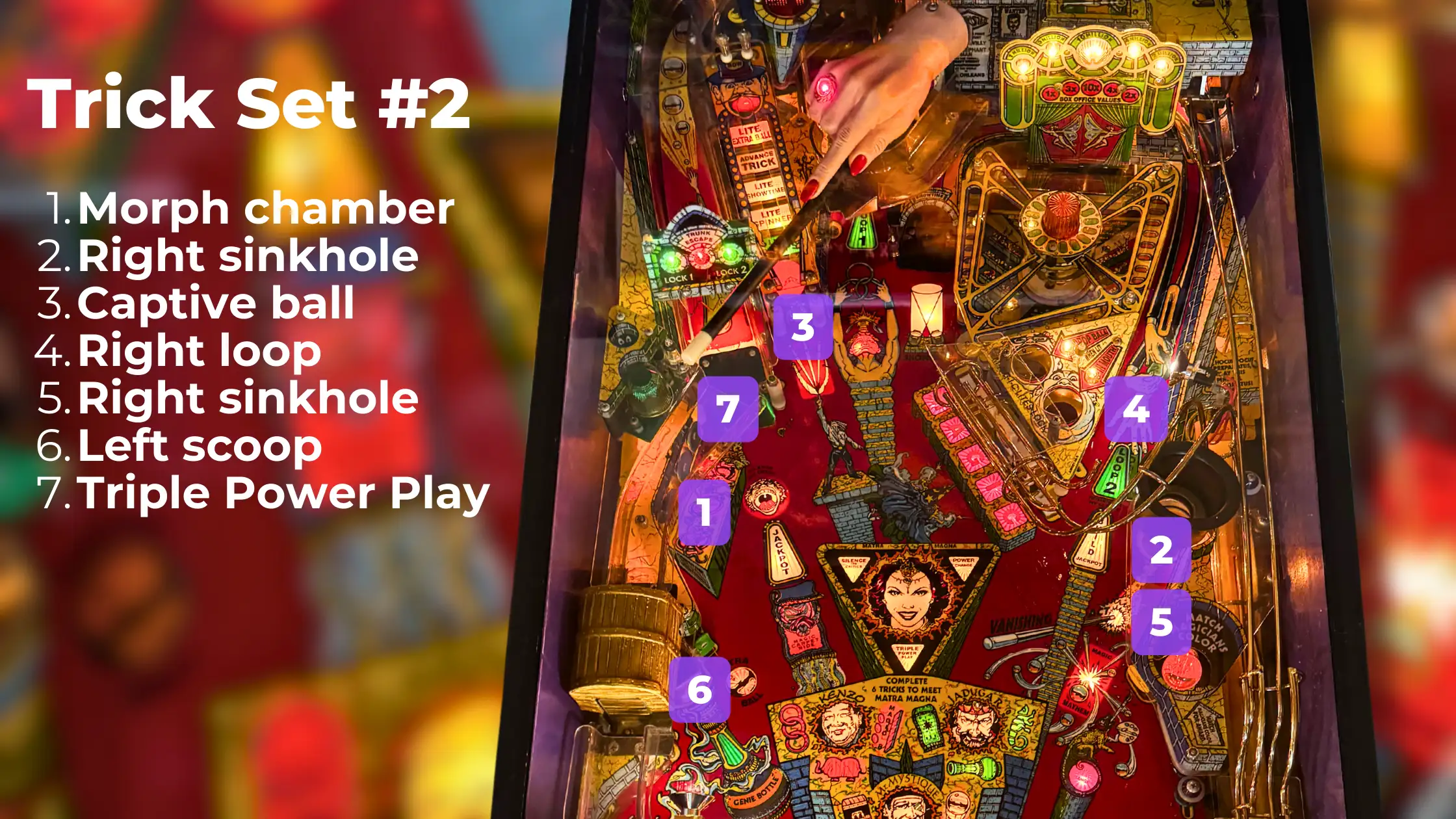
- Morph chamber targets (any left target)
- Right sinkhole
- Captive ball
- Right loop
- Right sinkhole
- Left scoop
- Triple Power Play (lock 3 balls at the left ramp – starts 3-ball magic mayhem when complete)
Trick Set 3 (tricks score 30M):
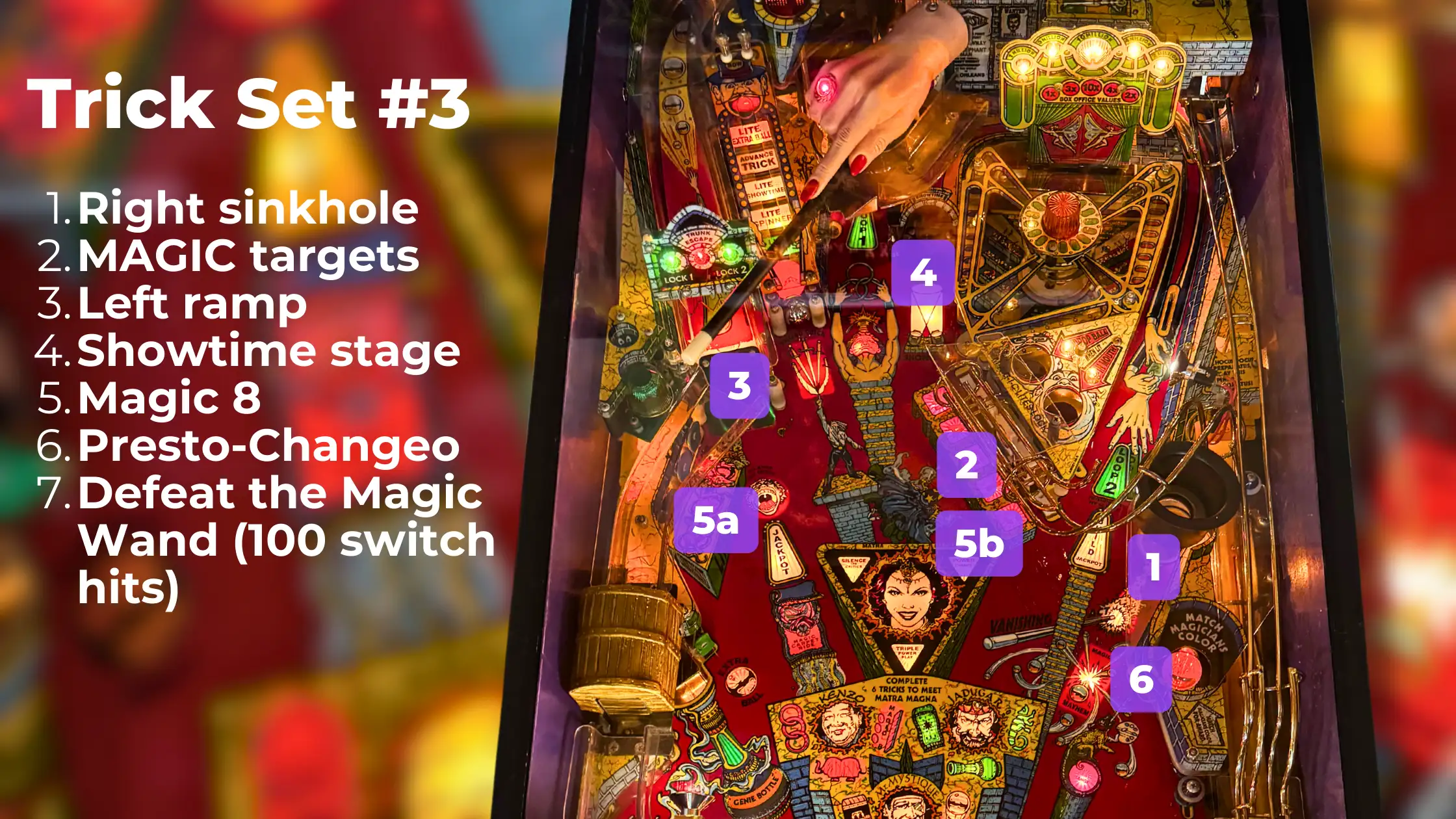
- Right sinkhole
- MAGIC targets (all five)
- Left ramp (locks a ball in the trunk)
- Showtime stage (ball will float towards right flipper)
- Magic 8 (complete all three left standups, and all five MAGIC targets)
- Presto-Changeo (hit the color change target on the far right six times, once per color)
- Defeat the Magic Wand (hit 100 switches to banish Magna to her home dimension for 500M)
Once all three sets have been completed, the trick sequence resets from the start of set 1, with slight increases to the difficulty of earlier tricks.
You can also complete tricks by shooting the captive ball until “advance trick” is lit. This award instantly completes the current trick and moves onto the next one and is my preferred method of completing the Presto-Changeo trick in set 3. Captive ball shots can be dangerous, however, and are best attempted while magic mayhem is running for safety. "Advance trick" will also not give credit for Silence the Critics or Triple Power Play, as Matra Magna expects better from you...
Critics Got You Down?
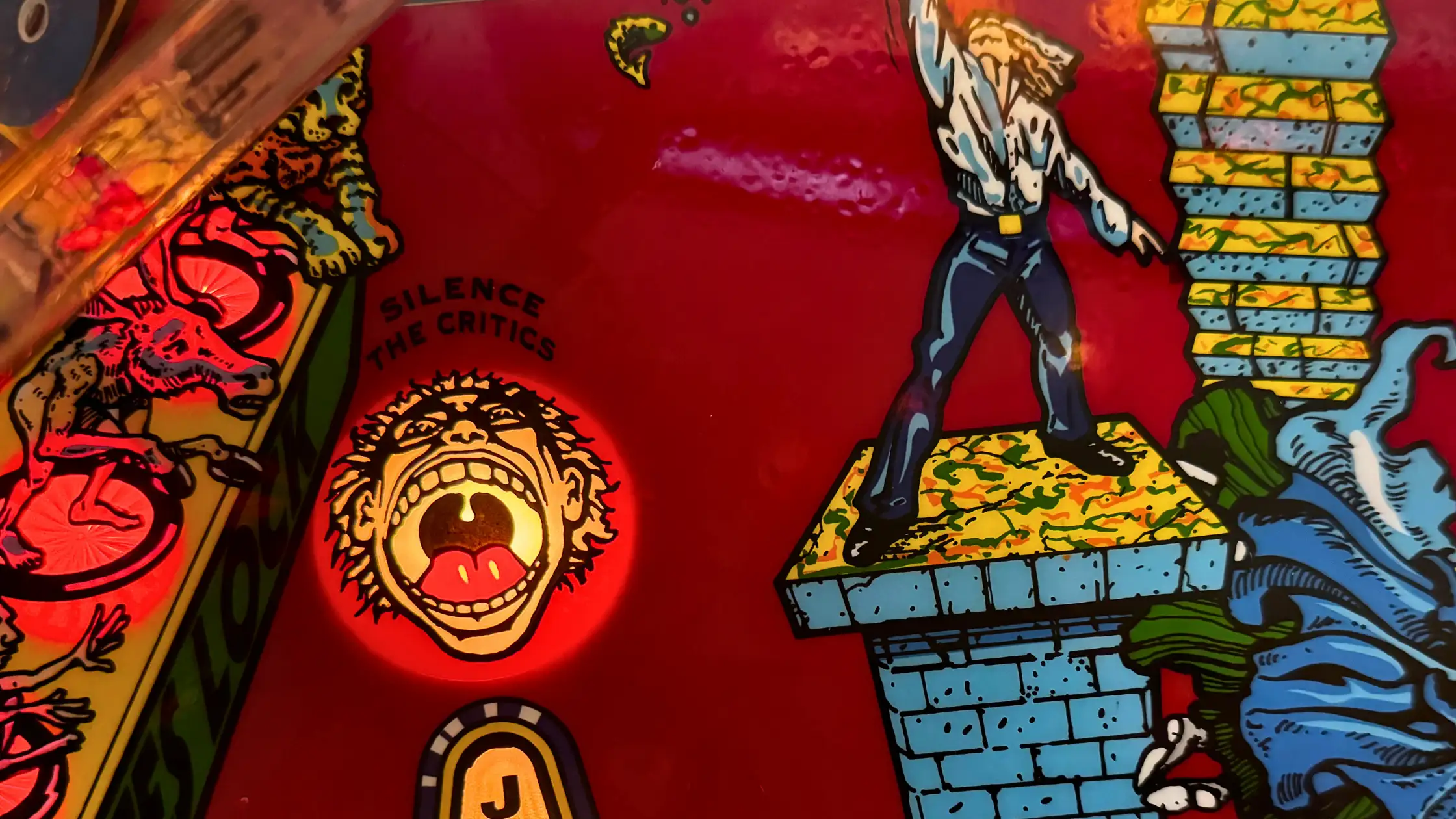
Silence the Critics, the final trick of the first trick set, is infamous for giving players a lot of trouble – the timing for dropping the ball into the balcony is very tough to find. The strategy I’ve found to best handle them is to press the right flipper and drop the ball “one ball’s length” away from the second critic. Doing this with the first critic I find to be less reliable.
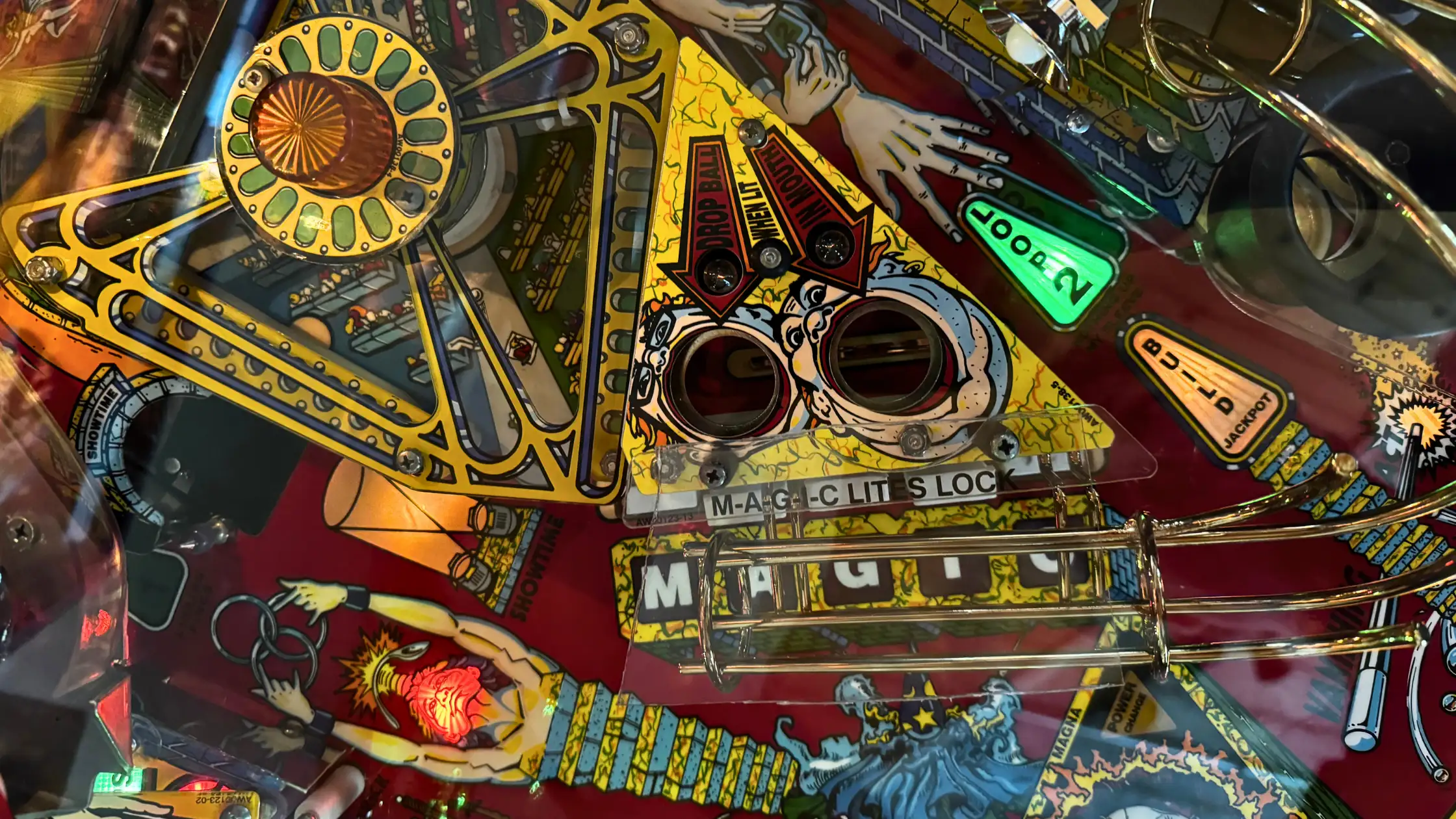
If you can’t reliably silence the critics, and you need to beat an opponent’s score, then your best bet will be to change strategies from trick sets entirely. Try going for 3-ball magic mayhem earlier during the first set of tricks and building up the jackpot. You could also try going for the captive ball and collecting “advance trick” to bypass silence the critics, but this requires five dangerous captive ball shots.
Captive Ball Awards
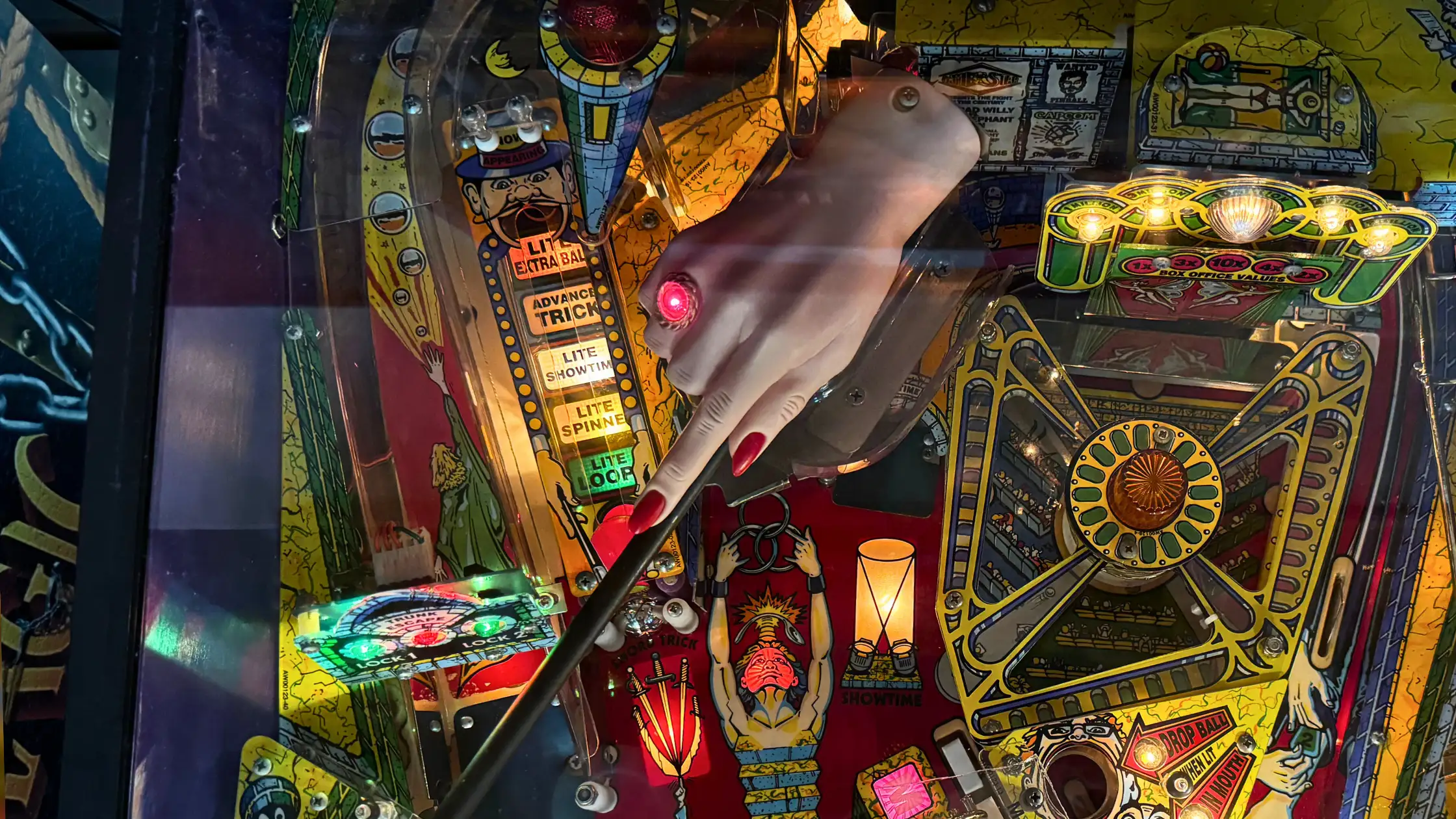
The captive ball might look like a dangerous shot but can lead to substantial points and progression. To collect awards the player must hit the captive ball once to start the award flashing, then again within 10 seconds to collect the award. You can also “chain” captive ball awards by hitting the captive ball within 10 seconds of the previous award. The award sequence only resets once the ball drains, or a lit extra ball has been scored.
Awards are given in the following order:
- Light loops (each loop now awards 250k per hit. You can also light them normally by rolling through the inlane on the opposite side.)
- Light spinner (spinner spins score 100k for the rest of the ball.)
- Light showtime (stage is lit for amateur hour. During amateur hour, all switches score 250k for the next 20 seconds. 40 switches maximum.)
- Advance trick (completes the currently active trick.)
- Light extra ball (at the green target near the genie bottle. Can be lit on a timer on more difficult settings.)
Magic Mayhem (Multiball)
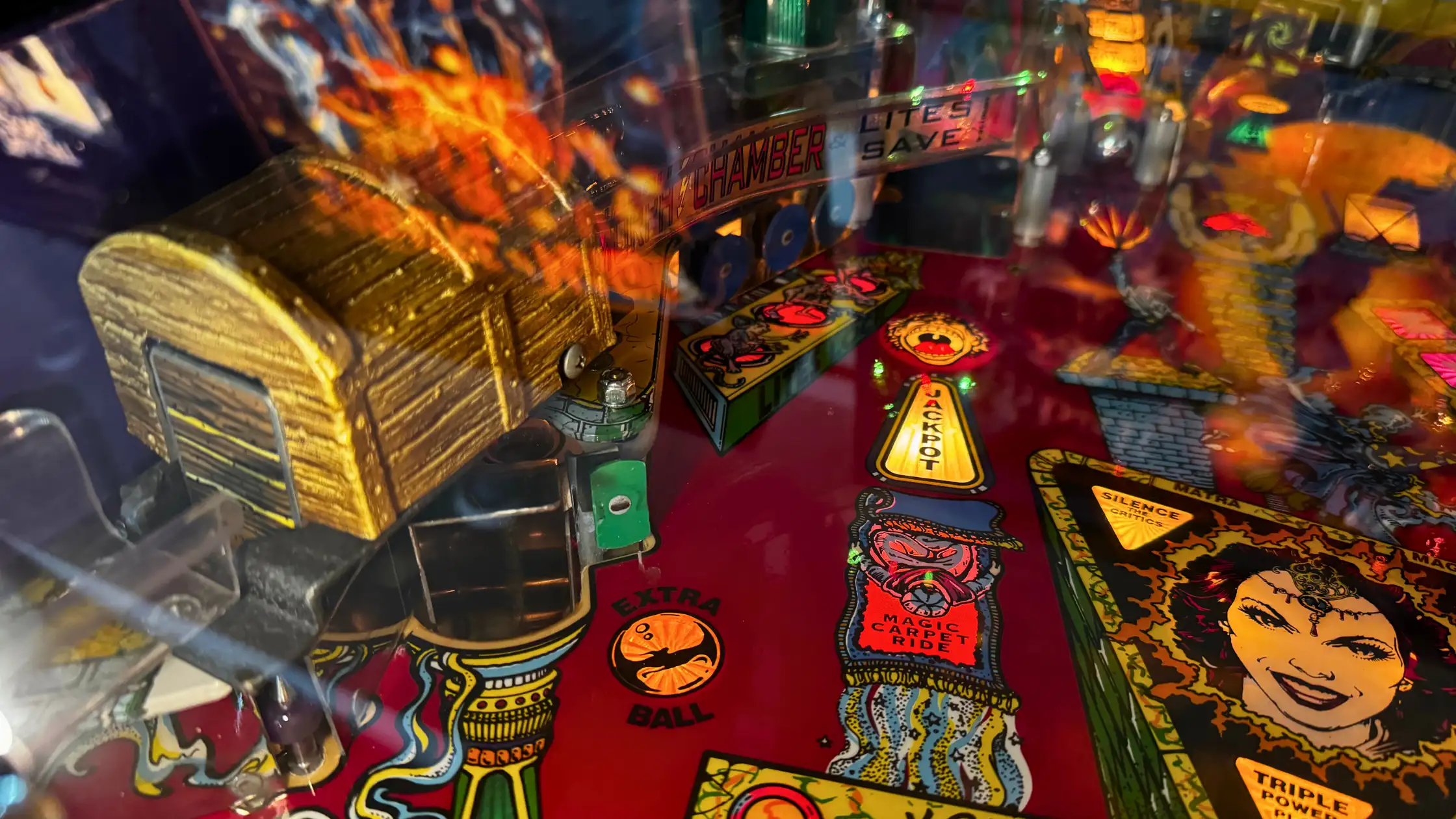
The trunk above the left scoop is where balls are locked for mini / magic mayhem, or multiball. To light the lock at the left ramp, complete either the morph chamber targets on the left side, or MAGIC drop targets on the right side of the playfield. The right sinkhole will start mini mayhem 2-ball multiball if only one ball is locked, or magic mayhem 3-ball multiball if 2 balls are locked. Send the ball into the hat off of the plunge to start it instantly!
During magic mayhem, get under control as quickly as possible (no ball save here!) by shooting the released balls from the trunk towards the stage, and holding up the right flipper to deflect the released ball from the left scoop. From here, light the jackpot at the left ramp by shooting the right loop. The jackpot starts at 20M and is locked to this value during 2-ball mini mayhem, but during 3-ball play, the right loop continuously increases the jackpot by 10M up to 90M per jackpot! You can then start subsequent 2-ball mini mayhems with the built-up jackpot value.
Depending on the copy, a good way to handle the feed off the lit jackpot ramp could be to hold the right flipper, slowing the ball down, and then making a reflex flip to the right loop to relight the jackpot. Of course, you can also cradle the ball on the right flipper and hit the right loop from the left flipper.
Kickback (Miraculous Save)
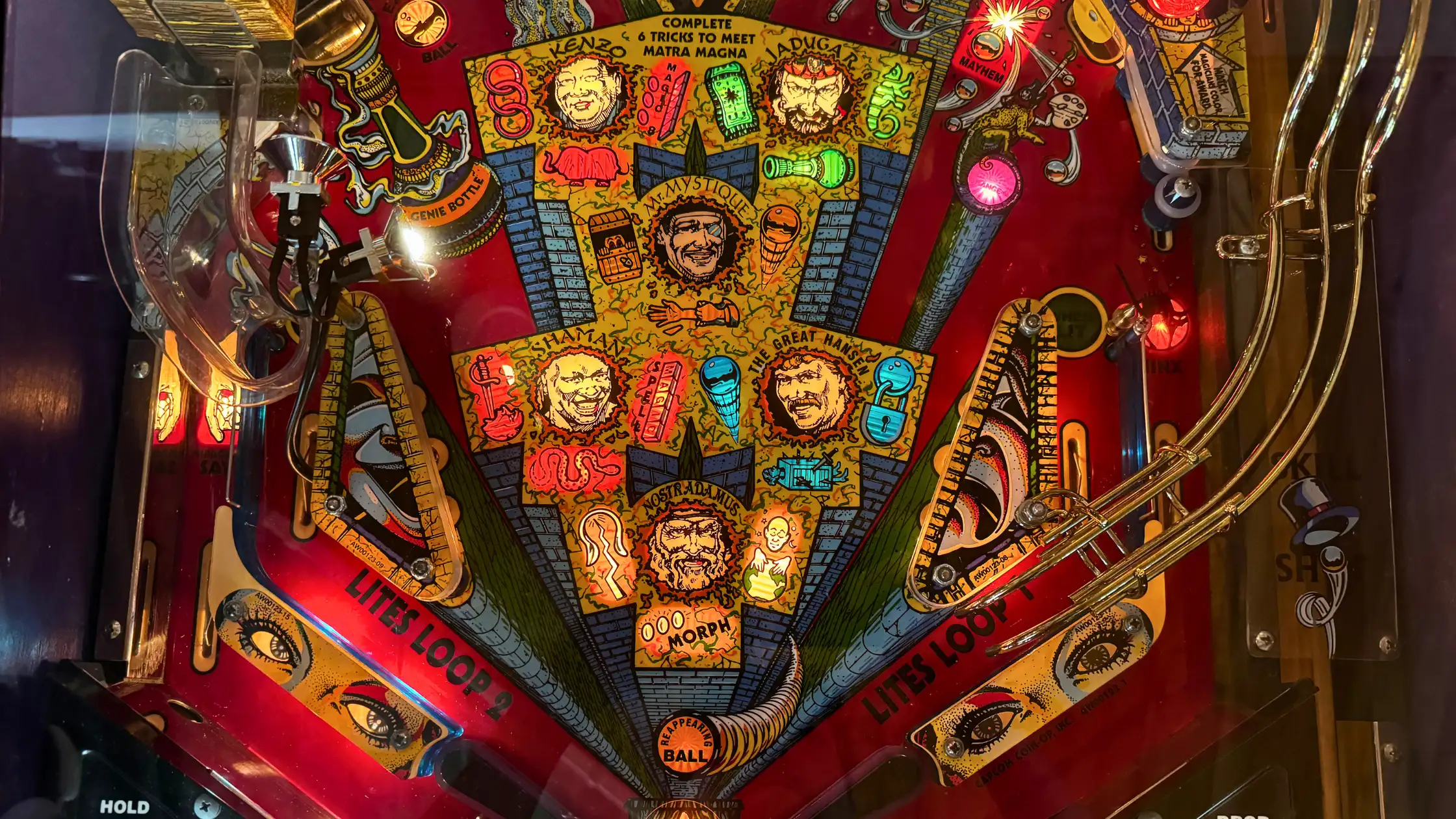
The outlanes on Pinball Magic are vicious and lighting the kickback can help negate them. The kickback is exclusive to the left outlane, and if it isn’t lit, it should be relit right away by completing the morph chamber left target bank. These targets will also light lock for you when completed.
I like to view the kickback on this game like the corner kick on World Cup Soccer. Lighting it isn’t the most fun thing in the world on a table full of fun shots, but it’s essential for survival. Progressing towards magic mayhem is a nice bonus alongside lighting the kickback, too.
Noah’s Strategies
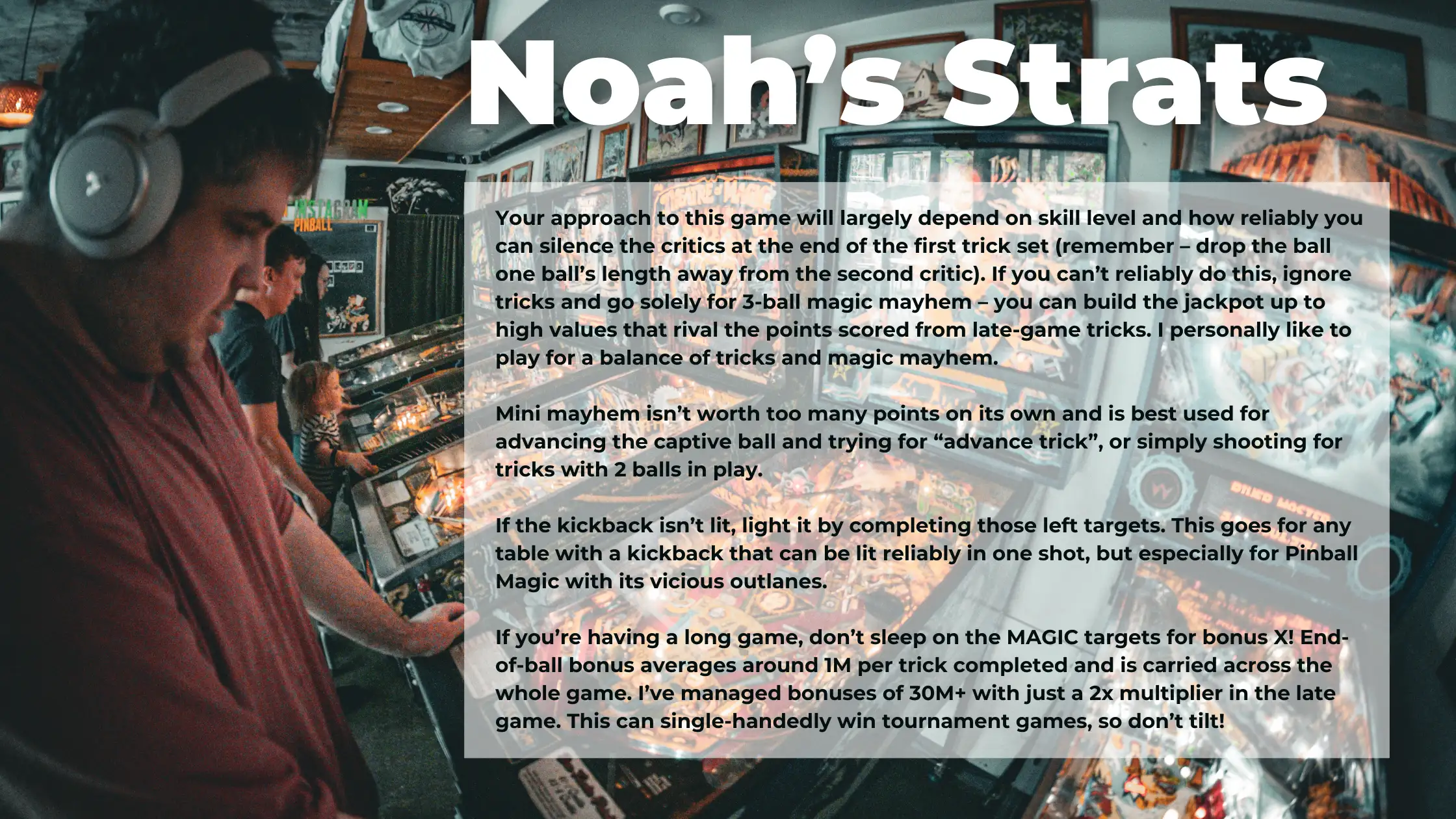
- Your approach to this game will largely depend on skill level and how reliably you can silence the critics at the end of the first trick set (remember – drop the ball one ball’s length away from the second critic). If you can’t reliably do this, ignore tricks and go solely for 3-ball magic mayhem – you can build the jackpot up to high values that rival the points scored from late-game tricks. I personally like to play for a balance of tricks and magic mayhem.
- Mini mayhem isn’t worth too many points on its own and is best used for advancing the captive ball and trying for “advance trick”, or simply shooting for tricks with 2 balls in play.
- If the kickback isn’t lit, light it by completing those left targets. This goes for any table with a kickback that can be lit reliably in one shot, but especially for Pinball Magic with its vicious outlanes.
- If you’re having a long game, don’t sleep on the MAGIC targets for bonus X! End-of-ball bonus averages around 1M per trick completed and is carried across the whole game. I’ve managed bonuses of 30M+ with just a 2x multiplier in the late game. This can single-handedly win tournament games, so don’t tilt!
In case you read the whole guide, congrats! Try entering the following initials for pictures, sounds, and other treats from the people who worked on the game: SAM, DIO, DAN, PFZ, JEF, C G, BRY, BWL, NTD.
VHS collector, media archivist, and pinball rules aficionado, Noah has been invested in the hobby since he was a teenager - much to the surprise of his parents and others his age. As an expert on brand new machines he’s the guy to call if you’re new to the hobby, or an experienced player who wants some help. Noah hopes to participate in and perhaps even win major tournaments like INDISC as his skills improve and desires for pinball to become a more inclusive hobby.
Like what you're reading?
Get pinball news, analysis, and deep dives delivered to your inbox.
Related Posts
More in Pinball Tutorial or browse all topics.