It's Alive: Learn to Play Gottlieb's Genesis Pinball Machine
In the mid-1980s, there was a short-lived trend where Gottlieb attempted to make pinball machines with similar themes (even mechanics in some cases) to the ones that Williams & Bally were creating. Monte Carlo was Gottlieb’s answer to Williams’ Millionaire, for instance, and Gottlieb cashed in on the Top Gun craze by releasing Gold Wings while Williams released F-14 Tomcat. The Gottlieb machines of this era have their dedicated fans, and a few of them are on par with their competition. But the biggest outlier to the rule is the two science fiction pinball machines of 1986: Gottlieb released Genesis a few months before Bally’s Strange Science, but I vastly prefer the former machine, and fully understand why it has the following it does.
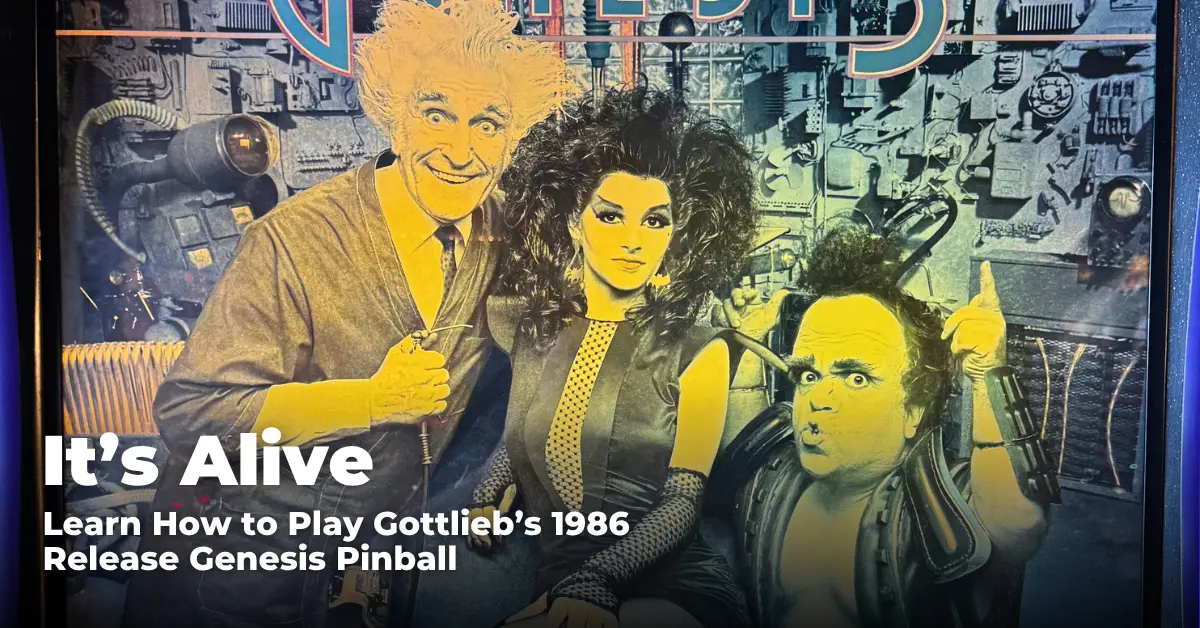
Though Genesis shares similar concepts to the 1927 film Metropolis, both involving the creation of a robot, the art is symptomatic of 1980s Gottlieb trends with a live-action photograph backglass and startling color contrast throughout the playfield. The layout and its rules, however, are startlingly ahead of their time, strongly resembling the “hit each shot 3 times” idea later popularized by Brian Eddy’s Attack from Mars. While the rules are simple, scoring constantly increases over the course of the game as body parts are completed, and starting multiball compounds the playfield multiplier to result in even higher scores. Genesis is a standout 1980s Gottlieb pinball machine and one that sees frequent use in tournaments as a result.
About Genesis Pinball
Assemble a robot by collecting four body parts and then shoot the lifeforce generator to witness its creation. Very loosely inspired by the 1927 silent film, Metropolis.
- Manufacturer: Gottlieb (Premier)
- Release Year: 1986
- Design: John Trudeau
- Code: John Buras
- Art: Don Marshall, Ken Hale, Larry Day
Genesis Playfield Overview
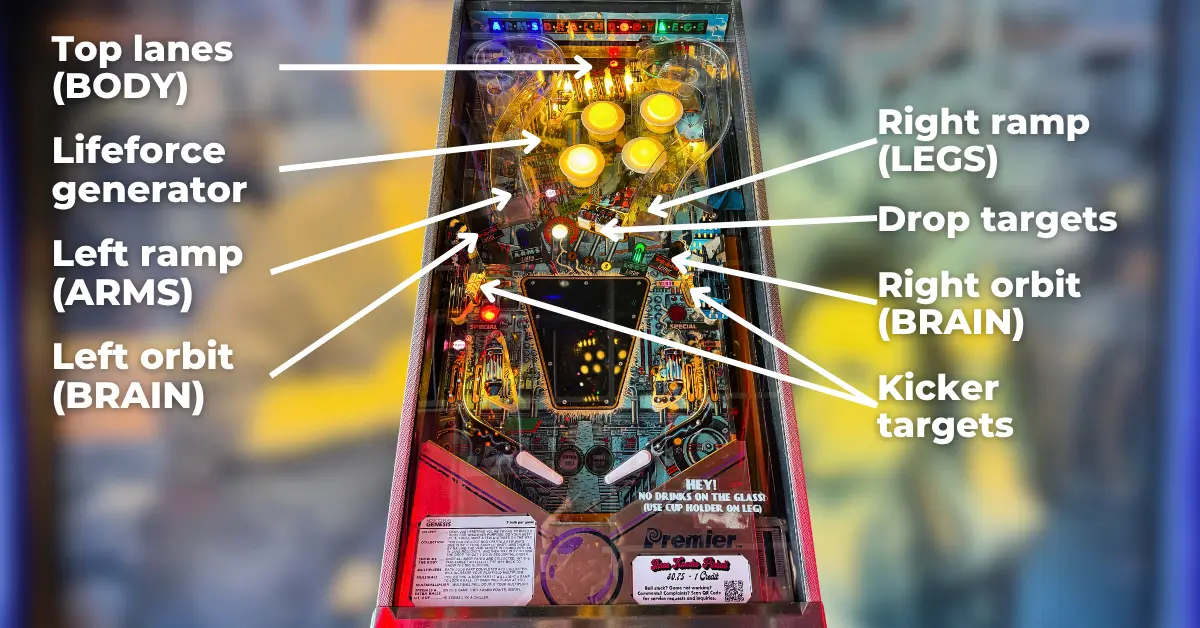
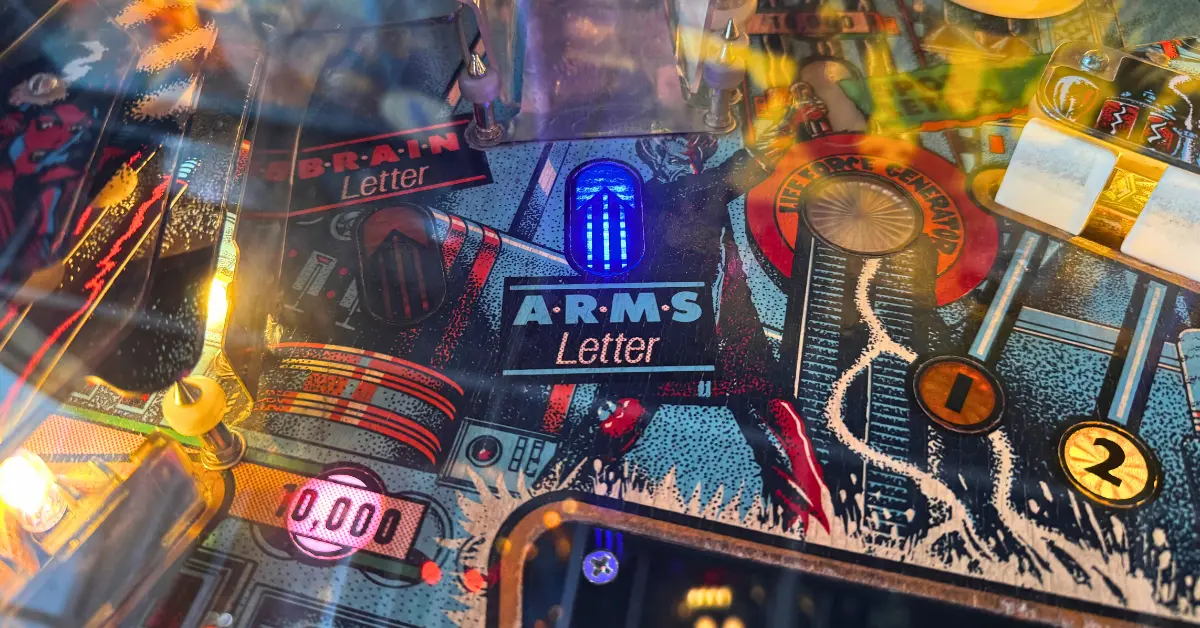
The playfield of Genesis has two orbits and two ramps, one on each side of the playfield, with the center occupied by top lanes, bumpers, a vari-target, and a 3-bank of drop targets. The left orbit can be lit to collect a BRAIN letter and alternates with the right orbit on slingshot hits, and is the most consistent way of sending the ball to the top lanes besides plunging the ball. The left ramp collects ARMS letters and sends the ball to a saucer that releases the ball shortly below the vari-target into the bumpers; the saucer is where left ramp shots are registered.
The vari-target is also called the lifeforce generator on the playfield and accounts for four positions, awarding increasing points (up to 40k) based on how hard it was shot, and the inlanes can light the vari-target for “spot letter” with a strong shot (one letter in all parts if they are at equal amounts of progress, otherwise one letter in the part that is closest to being completed). A strong shot to the vari-target is also required to activate the lifeforce generator when the white light in front of it is flashing.
Game Over - Genesis (pinball music)
The center drop targets are another method of collecting body parts, but must be completed in order from left to right. Completing the drop targets will always award one letter in all body parts but returns from these targets can be dangerous. Behind the drop targets are four pop bumpers, which score 1k per pop, and three top lanes that collect letters in BODY once the three lanes are unlit (being a Gottlieb table, the goal is to unlight the lanes, not light them all up).
The right side of the playfield is occupied by the right ramp, which collects LEGS letters and is in a mirrored position to that of the left ramp, sending the ball into the right side of the bumpers, where it is generally more likely to hit them. The right orbit collects BRAIN letters when lit by hitting the slingshots, and, unlike the left orbit, sends the ball directly into the bumpers, bypassing the top lanes. Balls that exit the bumpers out of this lane also give credit for the right orbit shot.
Along with the standard slingshots and flippers, Genesis features two kicker targets above the inlanes that can cause ball control to be slightly more difficult on this machine than others of its era. One kicker target is lit at a time for 10k and changes with slingshot hits. These are also where the special is collected, once the robot has been successfully assembled and brought to life.
Scoring on Genesis is very balanced but increases over the course of the game as more and more body parts are completed. Players who complete at least one full body part set typically average a minimum of 2M, and as the game goes on, it becomes easier to score large amounts of points quickly, upwards of 20M if you’re willing to put in the patience and effort.
Getting Started with Genesis
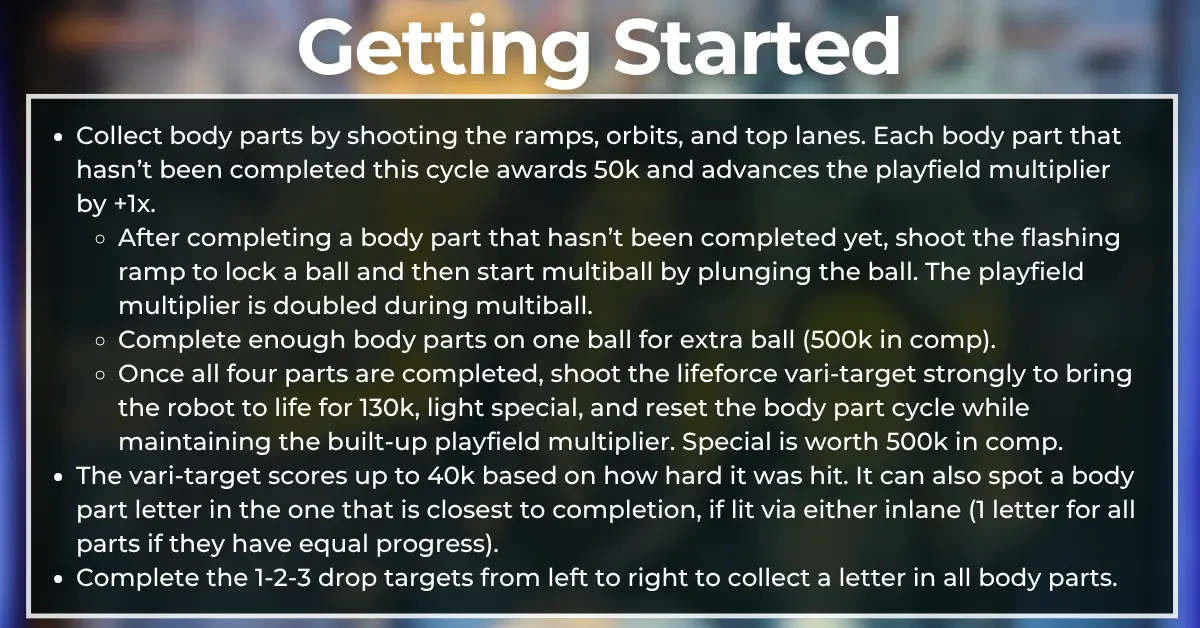
- Collect body parts by shooting the ramps, orbits, and top lanes. Each body part that hasn’t been completed this cycle awards 50k and advances the playfield multiplier by +1x.
- After completing a body part that hasn’t been completed yet, shoot the flashing ramp to lock a ball and then start multiball by plunging the ball. The playfield multiplier is doubled during multiball.
- Complete enough body parts on one ball for extra ball (500k in comp).
- Once all four parts are completed, shoot the lifeforce vari-target strongly to bring the robot to life for 130k, light special, and reset the body part cycle while maintaining the built-up playfield multiplier. Special is worth 500k in comp.
- The vari-target scores up to 40k based on how hard it was hit. It can also spot a body part letter in the one that is closest to completion, if lit via either inlane (1 letter for all parts if they have equal progress).
- Complete the 1-2-3 drop targets from left to right to collect a letter in all body parts.
Collecting Body Parts
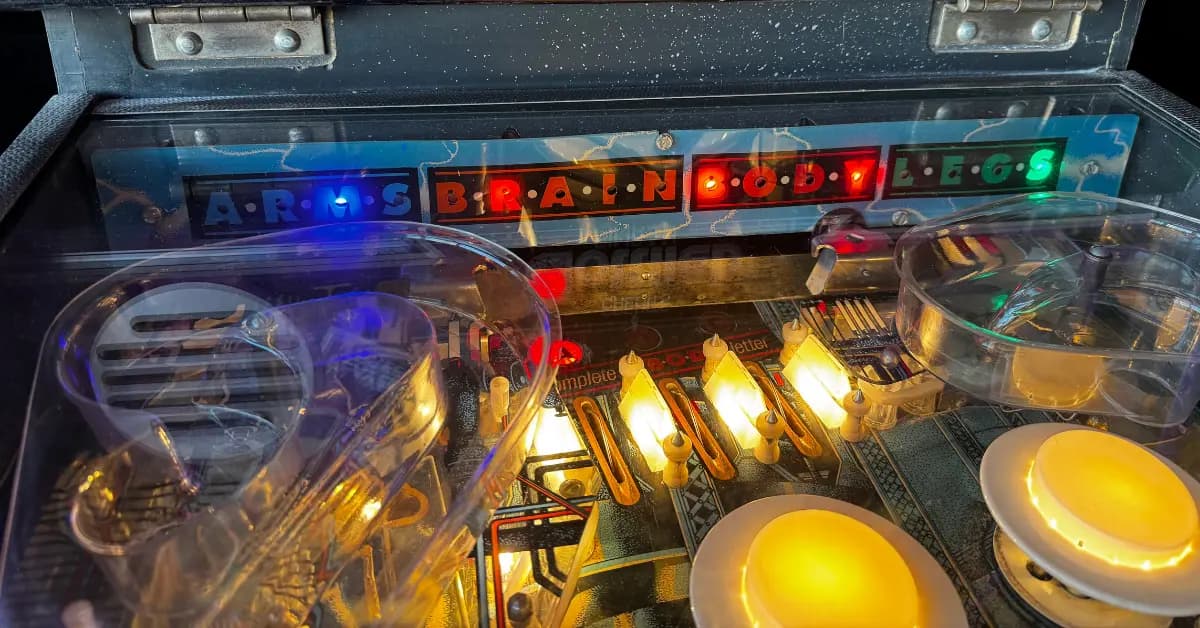
Body parts are the main source of scoring on Genesis as they increase the playfield multiplier with each one completed in the current robot cycle. The cycle consists of four parts that are collected by hitting different playfield shots:
- BRAIN – the left and right orbits. The lit orbit is toggled with slingshot hits.
- ARMS – the left ramp.
- BODY – the top lanes. All three lanes must be completed (unlit) for a letter, and the right flipper changes the lit lanes.
- LEGS – the right ramp.
Duplicates of the same body part can be scored, but only award 50k points instead of advancing the robot cycle. Duplicate letters also don’t apply to the end-of-ball bonus.
Collecting three (or four) unique body parts in a cycle, on the same ball, will award an extra ball. The background music also changes with each body part completed, when multiball starts, or when the lifeforce generator is lit.
Once all four body parts have been completed by spelling them out, the lifeforce insert at the vari-target will be lit. Shooting the vari-target with a strong shot will collect the end-of-ball bonus at its max of 130k, and bring the robot to life with a stunning light show as it is revealed on the panel above the flippers. Then, special will be lit at the kicker targets (alternating with slingshot hits) and a new cycle will start, but the player will keep their playfield multiplier from before!
Spot Letter
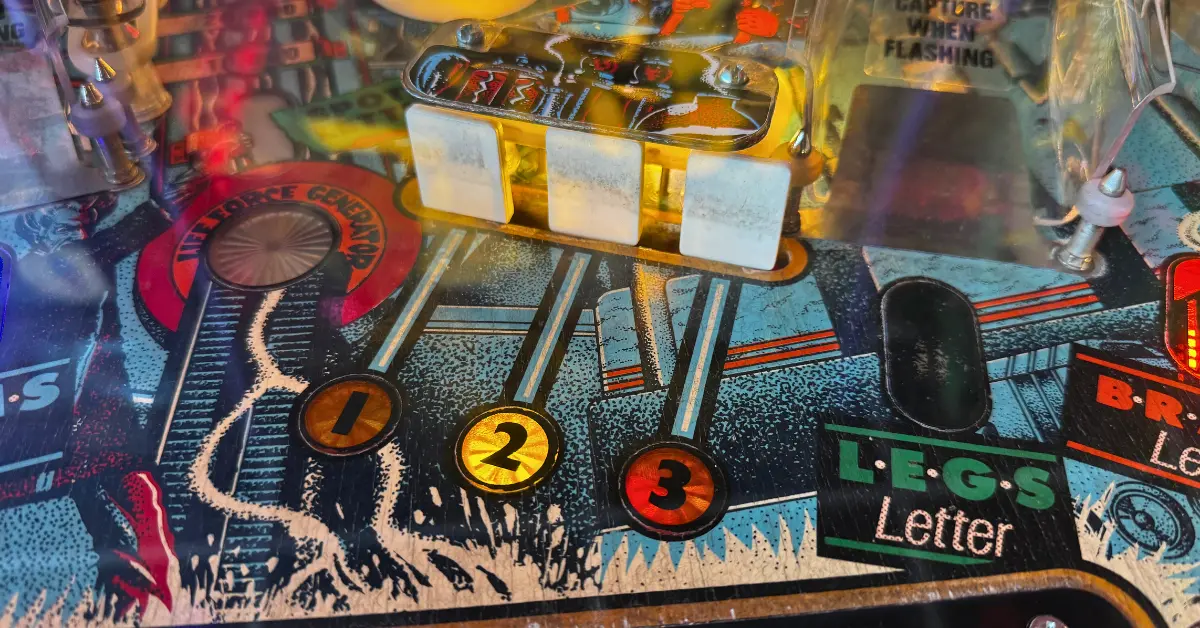
There are two ways to spot letters in body parts on Genesis without aiming for their respective shots as described above:
- The inlanes light the vari-target for “spot letter” for 10 seconds. If a strong shot is made to the vari-target within the time limit, a letter will be spotted in the body part that is closest to being completed, or if all body parts have equal progress, a letter will be spotted in all four body parts.
- Completing the drop targets from left to right will always award a letter in all four body parts, regardless of progress. Unlike the similar rule on Bally’s Fathom, the drop target progress does not reset if one is hit out of order: the progress will continue until either 1-2-3 is completed or the ball drains.
Multiball
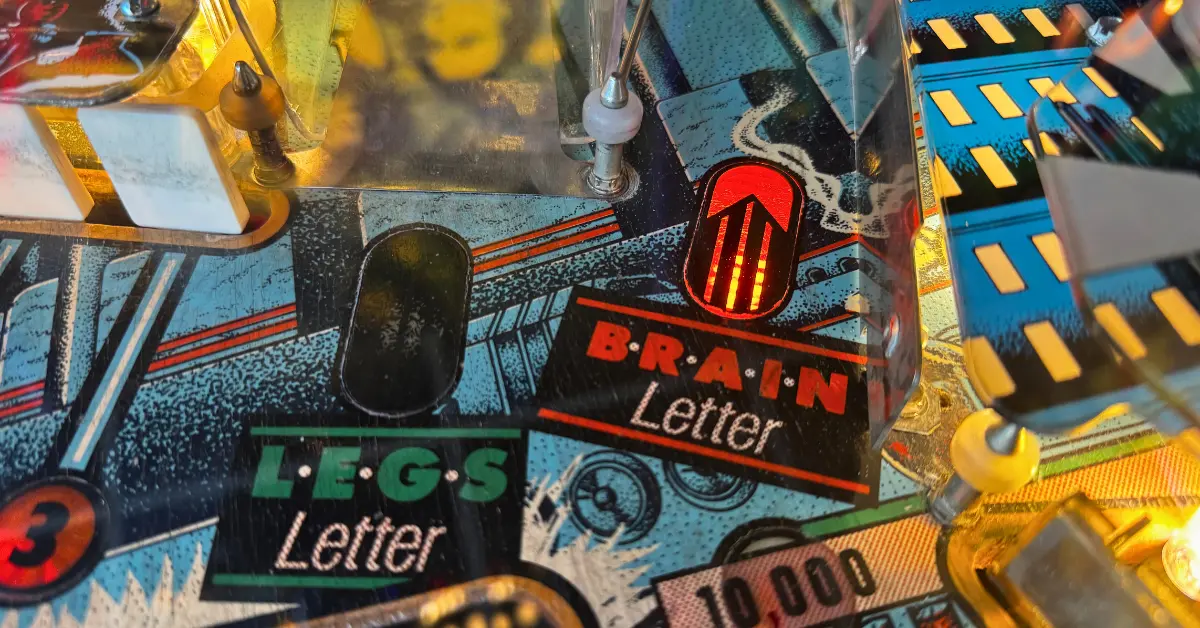
Starting multiball on Genesis has a bit of luck to it as it can start at either the left or right ramp, and which ramp is chosen by the machine has no known rhyme or reason to it. Lighting the lock is thankfully simple – just complete a body part in the cycle that hasn’t been collected yet, then shoot whichever ramp has flashing lights surrounding it. Plunge the ball to start multiball; while a ball is in the plunger, electricity will start coursing throughout the table as represented by the light show and sounds.
The lock can’t be lit during multiball, and if the left or right ramp shot that completed ARMS or LEGS also happens to be the lock shot, the ball will automatically be locked. More than one ramp can be lit for lock at a time if two body parts are completed before hitting either ramp to lock the ball.
The biggest benefit of multiball is the “multi-multiplier” which doubles the playfield multiplier described below. Repeatedly sending balls to the bumpers and vari-target during multiball can result in massive points in the late-game, even though their values seem comparatively low during single-ball play. Multiball can also make it safer to aim for the center drop targets and collect body part letters.
Playfield Multiplier & Misc. Points
Every new body part that is completed during the current robot cycle increases the playfield multiplier, to a max of 16x (32x applying the multi-multiplier described above to it). The playfield multiplier won’t increase when the player collects duplicates of the same part during the robot cycle where one was collected.
The playfield multiplier doesn’t quite apply to everything – it won’t apply to the 50k scored for completing a body part, end-of-ball bonus (even when it is scored by completing the robot), or the compensation scores for extra ball or special. However, it will apply to the scores for the following:
- Top lanes (5k)
- Bumpers (1k, these add up faster than you’d think!)
- Ramps (10k)
- Orbits (10k)
- Vari-target (between 10k to 40k based on the strength of the shot)
- Drop targets (5k)
- Kicker targets (1k or 10k when lit)
- Inlanes (1k)
- Outlanes (5k or 50k when lit)
Extra Ball & Special
Both extra ball and special are worth 500k if they are disabled. Though these compensation scores can’t be multiplied by the playfield multiplier, they are worth going for and present themselves naturally over the course of the game if the player is focused on completing robot cycles.
The extra ball lights are slightly confusing as there are two of them, so I’ll do my best to explain them. The left light has an outline around it saying, “next part awards extra ball”, and this light starts flashing when you’re one body part away from collecting the extra ball. Once the next body part is collected (that hasn’t been scored in the current cycle), extra ball will instantly be awarded and the right “shoot again” light will start flashing.
Special lights at the left kicker target when the robot is completed with a shot to the lit lifeforce target, or on some settings it lights as soon as the four body parts are completed. The special alternates between kicker targets with slingshot hits and disappears if the ball drains before collecting it.
End-of-Ball Bonus
The end-of-ball bonus resets as soon as you complete the current robot cycle, but 10k is awarded for all body part letters that have been collected in the current cycle, meaning the maximum bonus is 130k. This negligible bonus is also scored when the lifeforce target is hit to complete the current robot cycle.
Noah's Strats
- Survival out of the bumpers is integral to success on Genesis as every new ball starts out there, and shots to the ramps feed them. If the ball is about to exit out the left side of the playfield, try bumping the table slightly to the right to prevent the risk of a SDTM drain. Balls can also exit out the right orbit, in which case, prepare to dead bounce the ball over to the left flipper or hold up the right flipper if the ball is exiting the orbit slowly.
- I always go for the left and right ramps for ARMS & LEGS letters during the early game – I find these to be the easiest shots on the table and there’s a chance of getting into multiball as soon as either set is completed. I personally find the feed from the left ramp to be safer than the more active bumper feed from the right ramp.
- Alley passing or “shatzing” by making a late flip to the ball and sending it through either inlane helps with the above strategy. It can be tough to post pass with Gottlieb flippers of this era, and not only does alley passing help transfer the ball between them, but it will also often light the vari-target for spot letter making it easier to progress the body parts.
- During multiball, keep sending balls to the bumpers with shots to any orbit or ramp. Though they only award 1k per bump, the multi-multiplier adds to this score fast and can result in upwards of 4k per bumper hit as early as the first body part is completed. Multiball can also help with completing the center drop targets without the risk of draining by hitting them due to their placement in the center of the playfield.

VHS collector, media archivist, and pinball rules aficionado, Noah has been invested in the hobby since he was a teenager - much to the surprise of his parents and others his age. As an expert on brand new machines he’s the guy to call if you’re new to the hobby, or an experienced player who wants some help. Noah hopes to participate in and perhaps even win major tournaments like INDISC as his skills improve and desires for pinball to become a more inclusive hobby.
Like what you're reading?
Get pinball news, analysis, and deep dives delivered to your inbox.
Related Posts
More in Pinball Tutorial or browse all topics.