Competing in pinball tournaments can be fun, but it can often be equally as stressful. For all of the enjoyment we tournament players get out of smacking a metal ball around a wooden box, there's always a lingering seriousness. If you play well enough over time, you might have enough WPPR points to qualify for the state championships. Then, if you're good enough to beat out the best players there, you'll wind up at the national championship, where there are even bigger fish to fry. It's a far-fetched goal for many, but for those players who have the skills and patience, it's all but an eventuality.
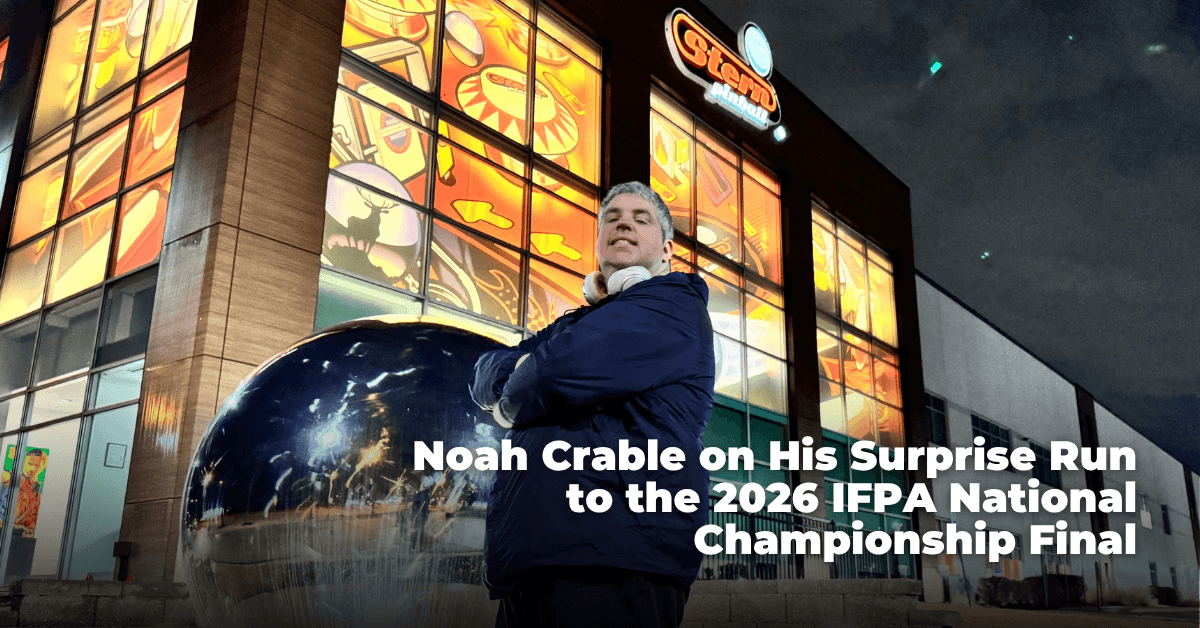
Such was the case for Noah Crable, an exceptionally skilled player from Massachusetts, who, despite his noted pinball prowess, rarely competes on the Stern Pro Circuit. So, when he popped up at the 2026 IFPA North American Pinball Championship and started defeating some big-name players, it was unexpected for most, but for those who have played with him before, it was anything but a surprise. If you've checked out any of our pinball tutorials and guides, there's a good chance you've read Noah's work, as he's a master of digesting rules and making them easy for us to understand. Coming off his big second-place finish, I had the chance to chat with Noah about a bit of everything: training, virtual pinball, learning rules, and even VHS tapes. So, let's take a moment to get to know the man behind the rulesheets and how he prepared for his performance on one of competitive pinball's biggest stages.
Note: This interview has been edited for content, clarity, and length.
Matt Owen: First off, congratulations on your second-place finish in the 2026 IFPA Nationals! Let's start with your introduction to pinball. How long have you been playing pinball, and what first made you interested in it?
Noah Crable: I first discovered pinball at around age 6. I was big into video games and got the Nintendo GameCube port of Pinball Hall of Fame: The Gottlieb Collection as a birthday present one year. I was especially entranced by Victory (Gottlieb, 1987) and Tee’d Off (Gottlieb, 1993) with the goals of having to hit shots in a certain order to progress through the game.
A few years later, I learned by chance that the developer of that game planned to do an updated version that accounted for tables from other manufacturers, as well as the older Gottlieb ones. The Pinball Arcade was what fully got me into pinball and especially learning how each machine worked, with Twilight Zone (Bally, 1993) and Star Trek: The Next Generation (Williams, 1993) being the machines that fully got me into the hobby. Though The Pinball Arcade isn’t available for purchase anymore, Pinball FX still releases digital versions of a lot of the Williams machines and I hope to see people get into pinball through that game.
As for real-life pinball, my earliest memories of playing physical pinball with the mindset I do now were at the launch parties for Game of Thrones (Stern, 2015) and Ghostbusters (Stern, 2016) at a now-closed location called Lanes and Games in Cambridge, MA. Both games were at a new level of complexity to me and taught me that if I were to approach physical pinball the same way I do digital pinball, I would need to retain as much rules knowledge as I could.
Matt: On the topic of rules, you write a ton of tutorials and rulesheets, both for Kineticist and other pinball sites. In your opinion, how important is rules knowledge versus flipper skills when it comes to tournament play?
Noah: It depends on the machine. On a lot of older tables, rules knowledge is a very low priority for me outside of knowing what results in the highest ratio of points per minute (ie, shooting a lit spinner, and how to light that spinner). Newer tables are more comparable to a video game in that they offer lots of ways to get a potentially high score, or on some machines, offer a few options and encourage the player to create their own, which assumes that the player is willing to learn the rules anyway. For instance, Godzilla (Stern, 2021) has a fairly straightforward early game (light a battle at the ramps and then start it at the scoop), but later in the game, you get deeper into the rules, having to travel to different cities to progress to the next battle and find ways to boost your powerup meter. The main mistake I make in tournaments is feeling that I’ve mastered flipper skills on a game and ignore them when I really shouldn’t.
For the record, I love both old and new machines about equally, it just depends on what I’m in the mood for. Frontier (Bally, 1980) and Flash Gordon (Bally, 1981) are two of my favorite older games and they feel quite a bit different from each other, with the former being a standard knock down the drop targets and rip the spinner game, and the latter having quite a few shots that require accuracy and timing as well as a 2x/3x playfield rule that can greatly impact scoring.
Matt: So, when it came time to compete in IFPA States and Nationals, did you have any specific training or preferred ways to practice?
Noah: I just approached States/Nationals the same way I always do with any other tournament: by playing on location. However, I also love watching tutorials, especially for the older machines that I’m not as familiar with. Bowen Kerins’ PAPA Pinball tutorials taught me how to play some of these machines long before I ever actually encountered them, and recently I’ve been using the Pinball Primer github page to learn rules for older machines and ones that don’t have guides already. And of course, part of the reason why I write the guides on Tilt Forums and Kineticist is so that I can write them down and understand the intended progression of the game.
Matt: What locations do you frequent for these sessions? Any preferred arcades/pinball spots you'd like to shout out?
Noah: The Boston area is thankfully a gold mine when it comes to pinball, especially compared to about 10 years ago when I first started. I enjoy locations where I can hear the machine at a good volume, as I feel that pinball audio goes really underappreciated and helps with my enjoyment of the game. Lately, my #1 location has been Acton Bowladrome, which, after years of being a fairly ignored location, gained new ownership in 2024, serving as a Stern showroom and has a lot of their newest releases. I also play at both of the Pop’s Pinball Parlor locations which specialize in older machines (and are incredibly well maintained), as well as Flat Top Johnny’s and Double Bull which have a mix of old and new machines.
Matt: After 10 years of playing, what keeps you coming back to pinball again and again?
Noah: Well, there’s Stern Insider Connected, of course. But outside of that, I feel that there is a physicality to pinball that is unmatched by other video games or game-adjacent hobbies. Even when I first started out playing digital pinball, I always wondered how the machines worked and was fascinated by what their designers intended to accomplish with the game mechanics. I distinctly remember being absolutely hyped a few years ago when Foo Fighters (Stern, 2023) released, seeing the playfield design and especially the right orbit shot, as someone who loves some of the more experimental pinball layouts. Every game that releases is another chance to learn new rules, new strategies, and new shots to make (or recover from).
Matt: This year, all that practice put you on the roster for the IFPA States Championship. Tell me a bit about that experience. How did those matches go? How did it feel to win it all?
Noah: I played States at Funspot in New Hampshire against quite a few incredible players from the New England area, not because I found New Hampshire to be “easier” (it’s States, it’s guaranteed to be difficult!) but just because it was easier for me to access than the Massachusetts location. Funspot has made some exceptional strides in pinball over the past year or so and the game list for finals proved that: I put a lot of faith into Indiana Jones The Pinball Adventure (Williams, 1993) and of course Star Trek: The Next Generation for my mid-aged picks, and used King Kong: Myth of Terror Island (Stern, 2025) as the ace up my sleeve in case anything went wrong.
The final match was insane! I went 3-3 against my opponent and got to choose the final machine, Fire! (Williams, 1987), a slightly less common game that I had practiced on during the hour before the tournament began. I had learned that shatzing/alley passing the inlanes could result in massive scores and progress, and used that rule knowledge to win the game. I was frankly shocked to learn that I had won - though I looked quiet on the outside, I was thinking to myself, “Oh man, what’s next?! I can’t believe I did it!” But I don’t think I would’ve won if it weren’t for the help of all the people I’ve played against in the past, including those whom I won against during States (quite a few of which also had to result in tiebreakers).
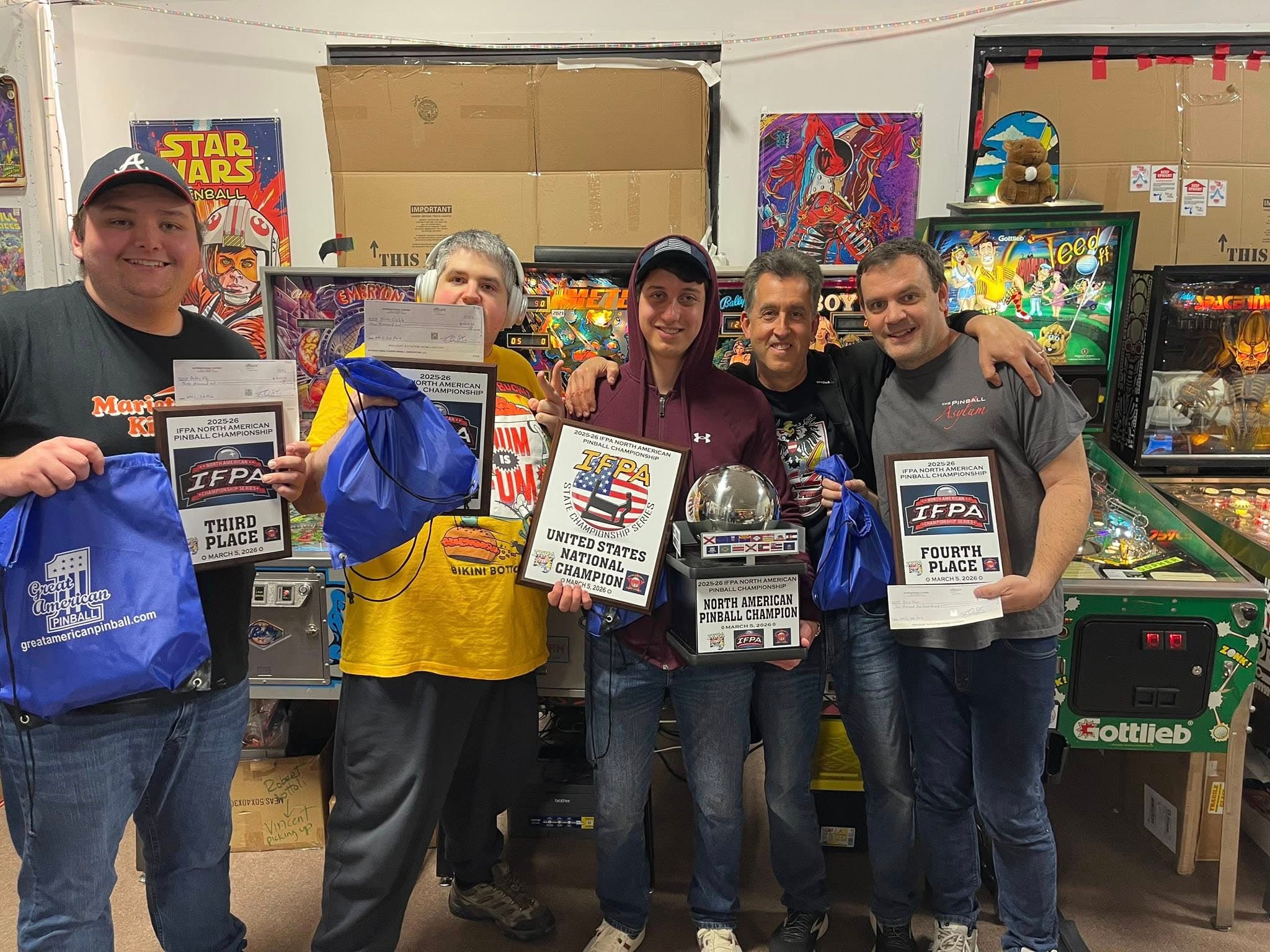
Matt: Of course, your performance and first-place win at States earned you a ticket to the 2026 IFPA North American Pinball Championship. How was it traveling to Chicago to play on the big stage?
Noah: The trip to Chicago was also my very first time travelling by myself, so it was a little stressful, but the stress quickly faded once I learned how everything worked. Chicago was fairly comparable to the Boston area from what I saw of it, but the pinball scene felt very different down there from what it was like in Boston. Up in Boston, a lot of the players that I encounter are players who might put one game on a machine and leave, while in Chicago, the players seem way more dedicated. Interestingly, I noticed quite a few of the games in Chicago felt easier to play than the machines I’ve played up here in Massachusetts, but having played on such difficult copies, it was like I had an advantage when I joined the tournament. I enjoyed my trip a lot and wouldn’t mind travelling to play in tournaments more often.
Matt: During the NA Championship, you played against a lot of very strong players and came out on top. Were there any players you were looking out for in particular?
Noah: I was dreading having to play against Eric Stone, Dalton Ely, and Jason Zahler. All three are amazing players and great friends who have inspired my play style in a few different ways and I knew that if I were paired up against any of them, it would be incredibly difficult to beat them. They also have a much more aggressive play style on average compared to myself, and that’s something I’m still trying to learn, being able to nudge a game without risking a tilt and knowing at all times where the ball might be heading.
Matt: Obviously, you played very well. From your perspective, how do you feel like matches went? Anything you would change or any moments you're proud of?
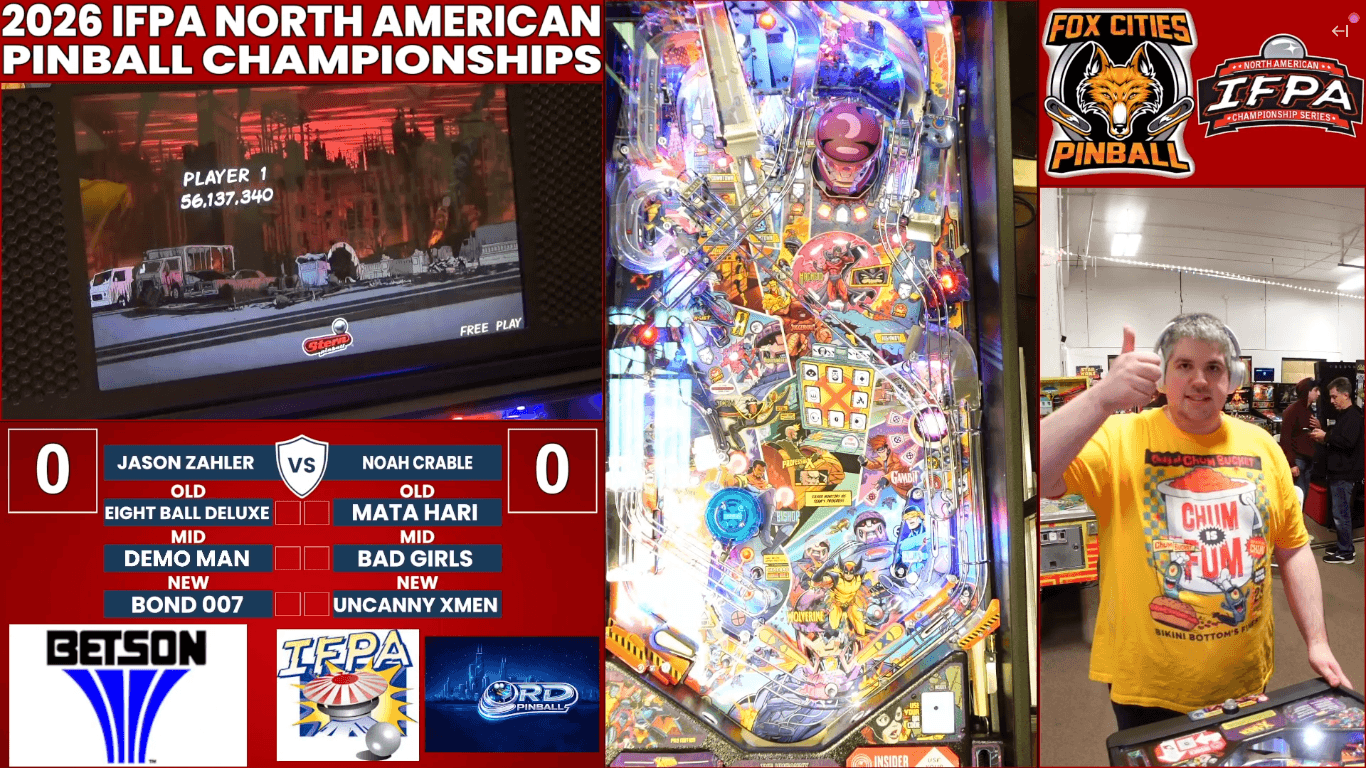
Noah: NBA Fastbreak (Bally, 1997) helped me win a match against Eric Stone but it was a hard-earned fight, one that started with a house ball and ended once I found the timing on the left orbit and ramp shots. But against Jason Zahler things went quite differently; I hadn’t found the timing of the midtown ramp on The Uncanny X-Men (Stern, 2024), which seemed to change over the course of the day, and some of his choices were ones I lacked experience with (Eight Ball Deluxe (Bally 1981) was truly vile, with the bumpers providing two house balls for me in a row). It was amazing being able to play against Jason, though, especially for the final match, and especially during that round on Bad Girls (Gottlieb, 1988) where Jason was able to beat the 15 million point score I managed on just 3 balls! That was a lot of fun and just plain impressive to watch, and shows that even that late in the day, Jason played well in spite of fatigue, something I still need to learn how to control myself.
Matt: When it comes to choosing games during playoffs or finals for a tournament, what's your strategy? Do you think it's better to choose a game that you're comfortable with, or one that you think your opponent will do poorly on?
Noah: It depends on the opponent but I generally prioritize the former, and if I think my opponent will do lousy on it then that’s an added bonus. During the North American Championship, I picked The Uncanny X-Men in every group, partly because I had a good round of it during practice and partly because I knew that a lot of people struggled with that machine and finding ways to score points effectively on it. For older games, I instead picked the games that I was most comfortable with which often resulted in choosing Mata Hari (Bally, 1978) and Bad Girls. I picked Genesis (Gottlieb, 1986) once, but after a first game on it that went well, the machine took pleasure in making me look like a horrible player for the rest of the weekend.
Matt: Apart from pinball, what do you enjoy doing in your spare time? Do you have any other hobbies that align with pinball in some way?
Noah: My only other hobby is collecting and archiving VHS tapes. Not very related to pinball, but archiving the contents and print dates of these tapes is pretty comparable to how I create my rules guides, and like with pinball designs, I always found some of the decisions on these VHS tapes to be fascinating. And Williams did release promos for their pinball machines on VHS at one point! I heard Data East might have done some too, but those haven’t seen the light of day yet; hopefully soon.
Matt: Okay, final question, one I love asking tournament players especially: what are your top 3 favorite pinball machines?
Noah: Godzilla, Jaws (Stern, 2024), and King Kong: Myth of Terror Island. Sorry, The Shadow (Bally, 1994), I love you too, don’t worry!
Thanks again for Noah for taking the time to answer my questions and for the length and care he put into his responses. Based on his performance in competition over the past few months and his desire to travel more, I hope to see him on the Stern Pro Circuit soon! Regardless, I'm sure that he'll continue to whip up excellent rulesheets and tutorials for the latest pinball machines, so be sure to check back here whenever a new Stern drops so you can check out his latest guide.