
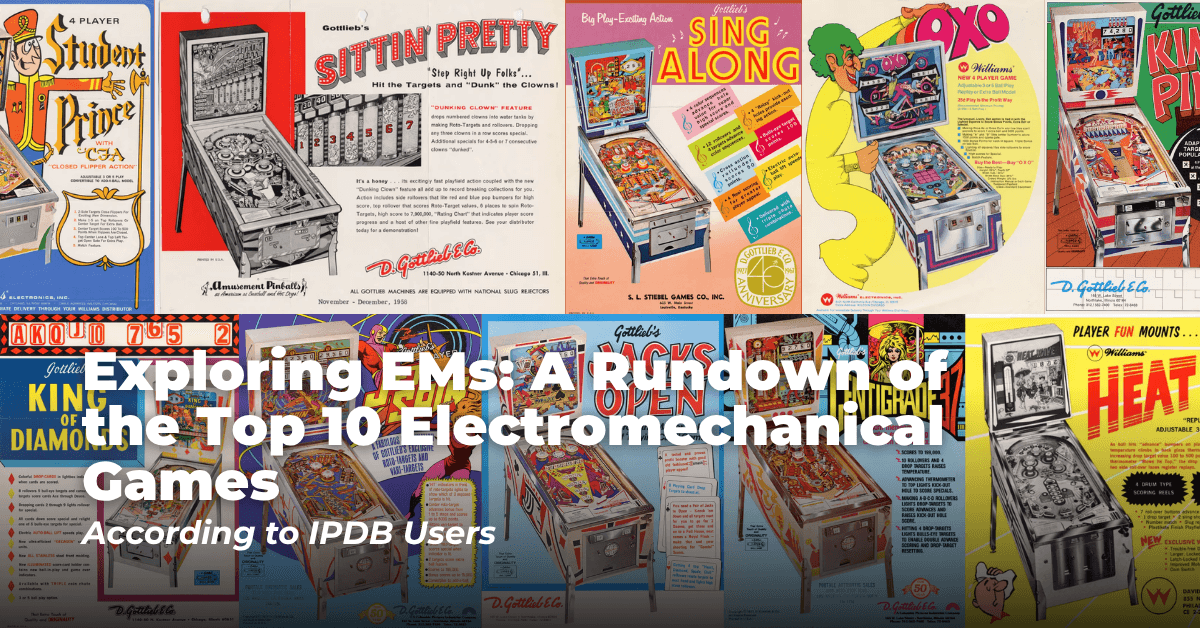
The Internet Pinball Database is, without question, one of the largest and oldest resources in the entire pinball hobby. Over the last 30+ years, nearly 3,000 contributors have kept the IPDB operational and current, with nearly 7,000 games logged. Entries on the IPDB preserve images, flyers, schematics, ROMs, operator bulletins, and sometimes even interviews with people who worked on each game. A lesser-known feature of the IPDB, though, is the ability for users to create an account and rate nearly any game on the platform. Games can be rated on a 10-point scale in four categories of Audio, Art, Playfield, and Fun, which combine into an overall rating. Here’s a rundown of the top 10 electromechanical games ever made, as voted on by users of the Internet Pinball Database — though, due to a 5-way tie for 9th place, it’s actually a top 13 list. You may be surprised by some of what is (or, indeed, is not) part of this list, and maybe you’ll find a new favorite.
This list is up to date as of 19 July 2026.
T-9th: Jacks Open (Gottlieb, 1977) - 7.82 / 10, 50 ratings
Audio: 7.2 | Art: 7.6 | Playfield: 8.0 | Fun: 8.2
Designed by: Ed Krynski | Art by: Gordon Morison
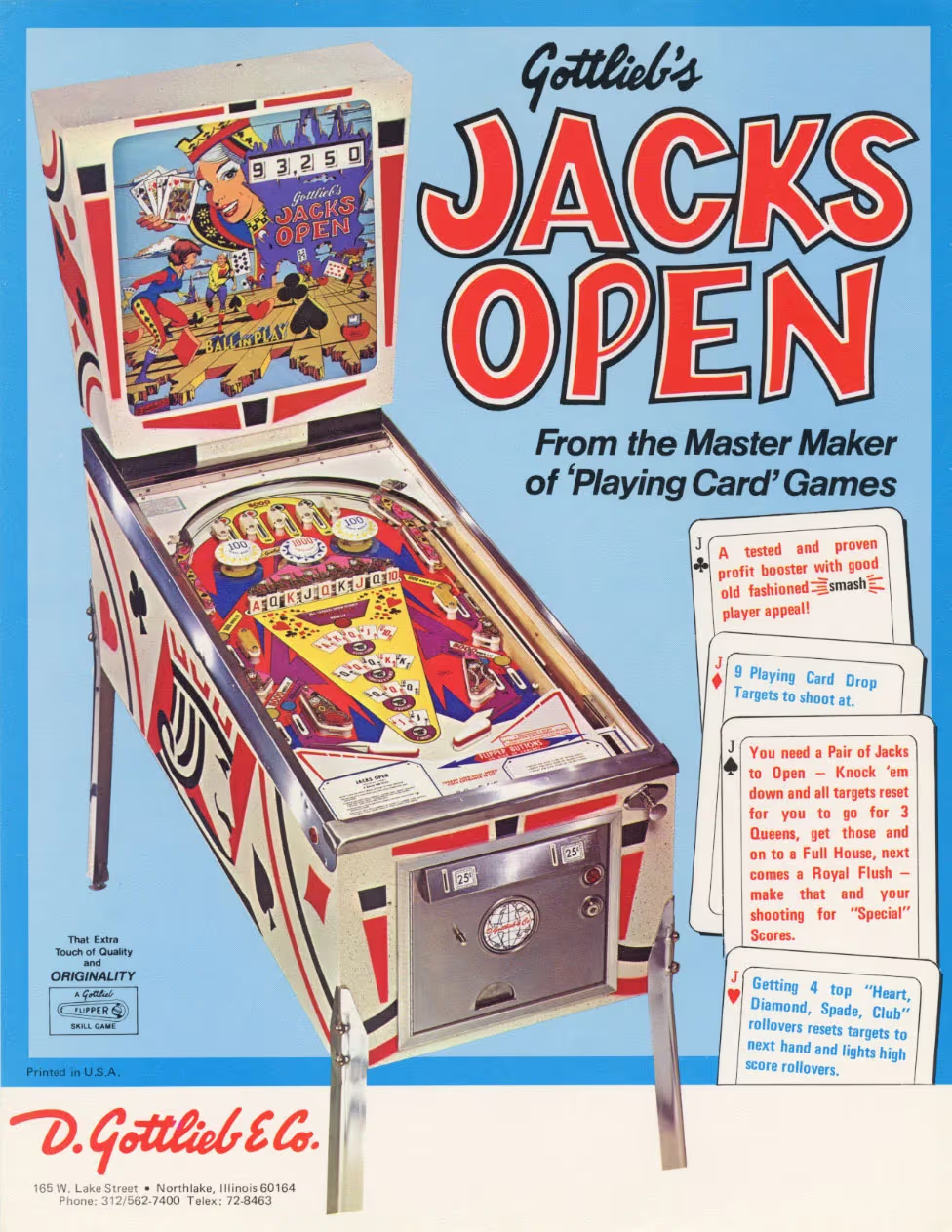
Released in January of 1977 just as solid state electronics were shaping up to rock the entire pinball world, Gottlieb decided to rely on what they do best: games that are easy to learn, difficult to master, and have a ton of satisfying drop targets to shoot. The primary feature of Jacks Open is a bank of 9 drop targets labeled with various playing card ranks, where poker hands can be made by knocking down specific individual targets. Jacks Open is loved in tournament play for how it demands that players exert total control over the machine. Making lit top lanes increases the value of every individual drop target, but with no funnel directing the ball toward those top lanes, skillful plunging is required to open the door toward high scores. Additionally, the in lanes are cut off on the sides, demanding a new level of consideration about how players use the flippers to keep the ball under control. The simple elegance of Jacks Open’s design led to it getting a solid state remake as Jacks to Open in 1984, and enduring in the hearts of many players to this day.
Lucky Hand, the add-a-ball variant of Jacks Open, also appears in T-56th place on the IPDB EM Top 300, with an overall rating of 7.73/10.
T-9th: King of Diamonds (Gottlieb, 1967) - 7.82 / 10, 49 ratings
Audio: 7.2 | Art: 7.7 | Playfield: 8.0 | Fun: 8.1
Designed by: Ed Krynski | Art by: Art Stenholm
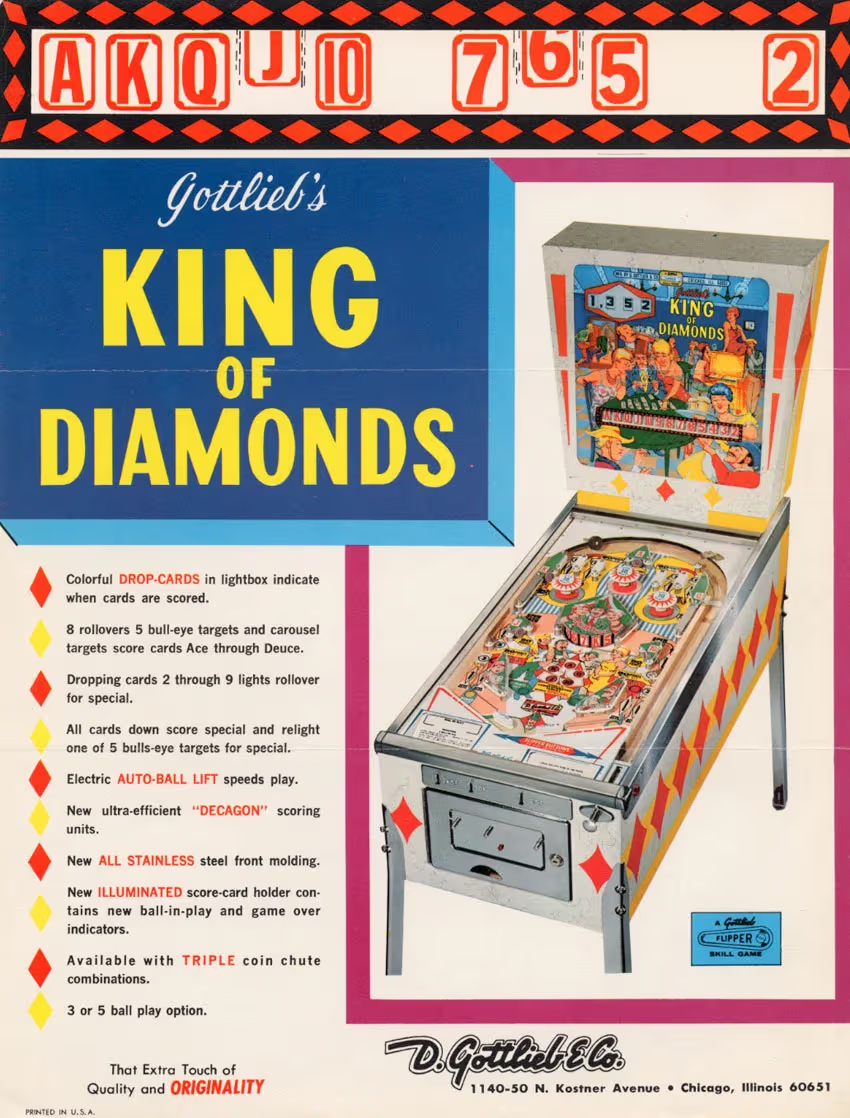
At the time of its release in January 1967, King of Diamonds struck the perfect balance of novelty and familiarity. King of Diamonds is one of dozens of playing card-themed games from the 1960s and 70s, and was the last game to include a light-up silkscreened number 1 rather than a full score reel in its thousands digit. Conversely, King of Diamonds was also among the first games to include the Ball in Play counter on the instruction card, a now-standard Italian bottom layout for the in lanes and flippers, and the iconic carousel-style roto-target in the center of the playfield. King of Diamonds shoots very well and has relatively reasonable in-game goals compared to many other games of its era, and is absolutely still worth a coin or two today.
Diamond Jack, the add-a-ball variant of King of Diamonds, also appears in T-64th place on the IPDB EM Top 300, with an overall rating of 7.72/10.
T-9th: Card Whiz (Gottlieb, 1976) - 7.82 / 10, 46 ratings
Audio: 7.5 | Art: 8.0 | Playfield: 8.0 | Fun: 7.8
Designed by: Ed Krynski | Art by: Gordon Morison
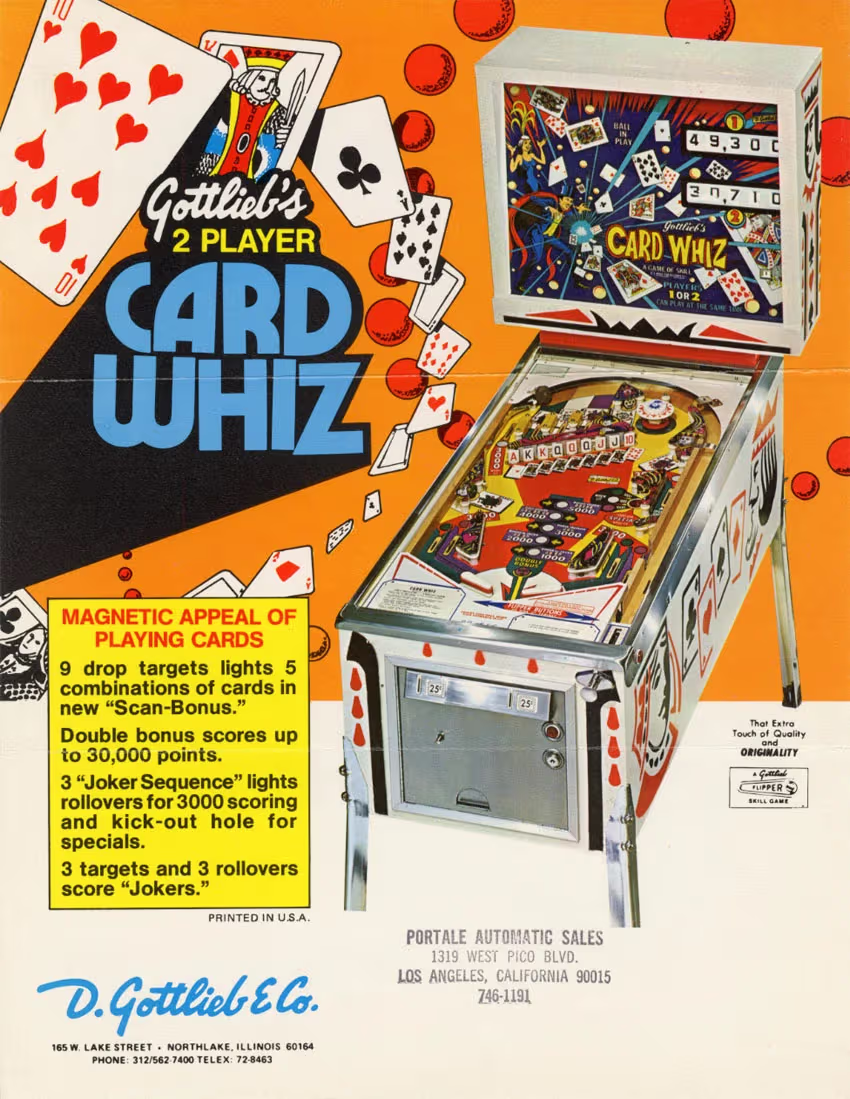
For the third entry in a row, we have a card-themed game designed by Ed Krynski and produced by Gottlieb. The high regard in which Card Whiz is held stems from many of the same successes that were also seen in Jacks Open, which was released 6 months later: drop targets that form poker hands, difficult but rewarding skill shots that increase the value of many of the game’s features, and easily attainable Specials. Card Whiz has an added bonus, literally, as there is an end of ball bonus available for your playing card progress as well, and an out lane gate to extend the play of master players. Card Whiz is the 2-player variant; its 4-player cousin Royal Flush (which is tied for 18th on the rankings at 7.80/10) sold over 12,000 copies, so there’s likely to be a way to play this masterpiece near you.
T-9th: Sing Along (Gottlieb, 1967) - 7.82 / 10, 49 ratings
Audio: 7.2 | Art: 8.0 | Playfield: 8.0 | Fun: 7.9
Designed by: Ed Krynski | Art by: Art Stenholm
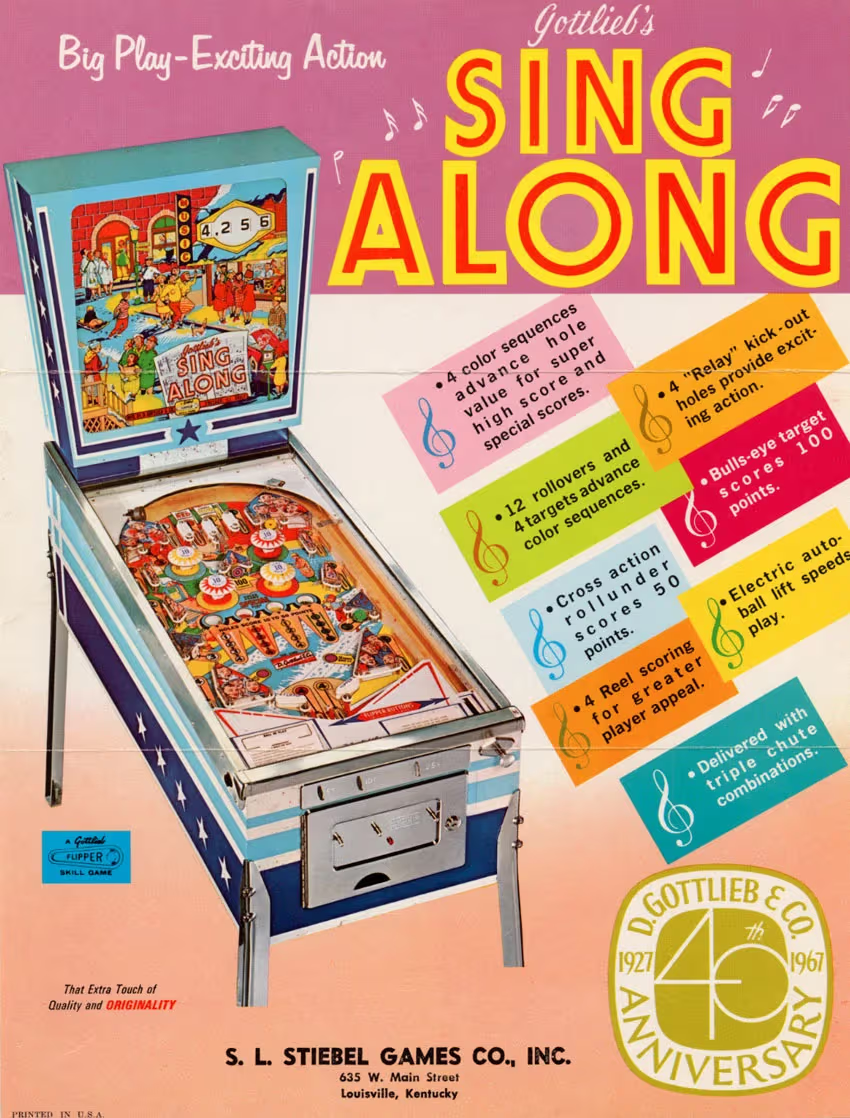
Gottlieb’s monopoly of the list so far continues with Sing Along, another late 1960s game that was ahead of its time in many ways. Sing Along tasks the player with collecting numbers 1-4 around the playfield in each of white, red, yellow, and green, then picking up big points and possible Specials based on numbers earned at the line of 4 center saucers. The center saucers kick the ball to each other from left to right, and few things in EM pinball feel more satisfying than shooting the white saucer on the left and watching the reels go crazy as the ball is kicked across the playfield. Crucially, the design of the lower half of the playfield keeps the game surprisingly controllable despite the wide flipper gap and lack of in lanes, making Sing Along worth revisiting time and again. Its add-a-ball cousin Melody, which only sold 550 copies but still manages to be somewhat commonly seen in competition, is also highly regarded with a 7.71/10 rating (tied for 70th place).
T-9th: Jet Spin (Gottlieb, 1977) - 7.82 / 10, 49 ratings
Audio: 7.3 | Art: 8.0 | Playfield: 8.0 | Fun: 8.0
Designed by: Ed Krynski | Art by: Gordon Morison
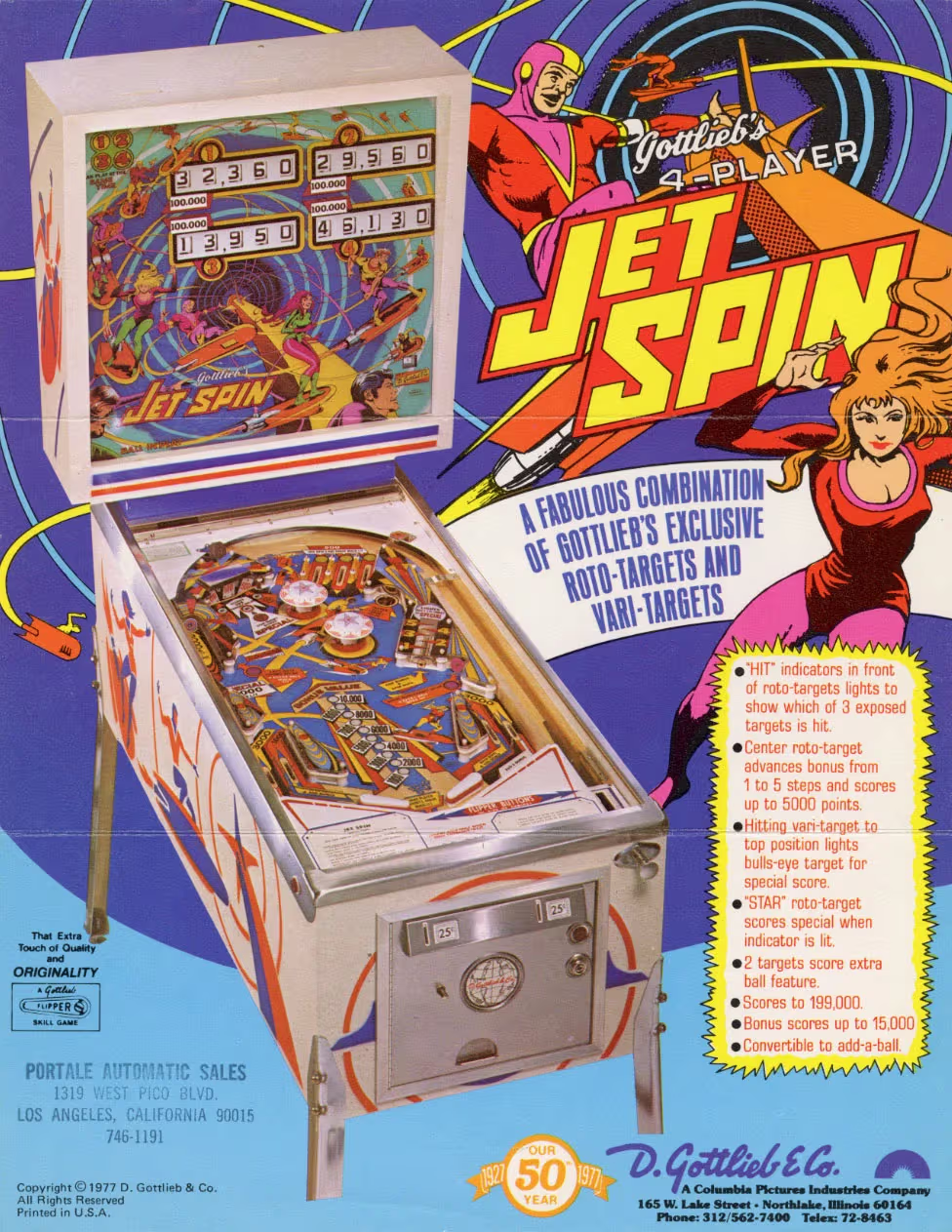
Ed Krynski’s streak on the list continues with Jet Spin, this time trading in big banks of drop targets with a conventional roto-target and a vary-target, which became Gottlieb staples in their own right throughout the 1970s. With its diverse shots of varying distance from the flippers, different players are likely to develop different preferences on where they get their points. Flipper power and table angle can also have a significant impact on what’s viable, making Jet Spin a dynamic experience, even from one copy of the game to the next. Like with many other entries so far, Jet Spin’s 2-player variant Super Spin is also highly regarded, barely missing the top 10 with a 7.77/10 score.
8th: Joker Poker (Gottlieb, 1978) - 7.83 / 10, 38 ratings
Audio: 7.2 | Art: 7.8 | Playfield: 8.1 | Fun: 8.1
Designed by: Ed Krynski | Art by: Gordon Morison
Released in June of 1978 as one of Gottlieb’s last 4-player EM games, Joker Poker is the only entry on this list to have received a contemporary solid state version, not just a remake. The solid state Joker Poker is actually rated even higher at 7.97/10, but more ratings and a higher standard on the IPDB Solid State Top 300 list mean that that rating is only good for T-54th place. Joker Poker is yet another drop target-focused, playing card-themed game, with added uniqueness this time coming from the fact that its drop targets are scattered around the playfield instead of forming one big line, leading to variety shotmaking and one of the most unconventional upper flippers in pinball. If you’ve played the solid state Joker Poker and are wanting to give the rarer EM version a try, note the following rule difference: none of the end of ball bonus levels are given for free on any ball, and the only way to earn your bonus multiplier is by completing A-B-C, making the top lanes skill shot far more important than on the SS counterpart.
T-3rd: Fireball (Bally, 1972) - 7.84 / 10, 103 ratings
Audio: 7.0 | Art: 7.3 | Playfield: 8.2 | Fun: 7.9
Designed by: Ted Zale | Art by: Dave Christensen
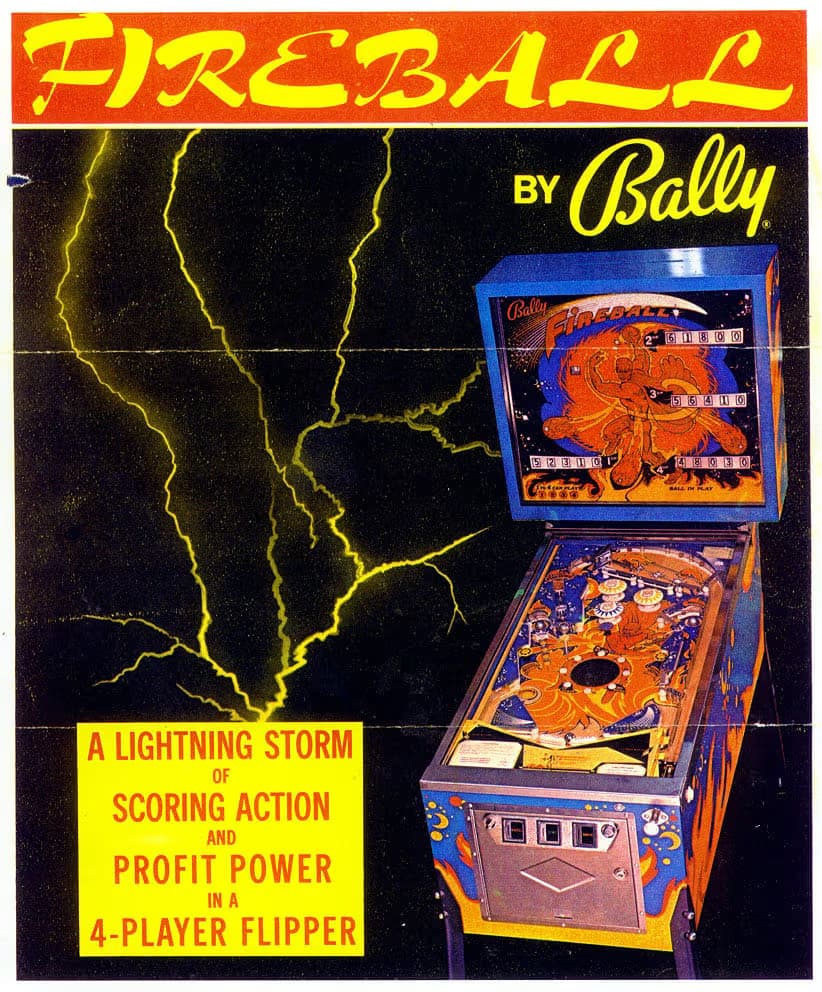
As the Ed Krynski/Gottlieb streak ends at 6, a new 5-way tie begins, starting with the one and only Bally offering on this list. Fireball receives some scrutiny from high level players due to how overpowering a successful skill shot can be for scoring and how much random impact the spinning disc in the playfield can have on a ball, but the experience Fireball offers to casual players is unmatched in the world of EM pinball. Ted Zale combined all of his ideas into one game and raised the whole thing to a fever pitch, with the result including zipper flippers, 3-ball multiball, an automatic kickback, features that automatically scan between multiple score values, and more. While Fireball can certainly be frustrating at times, it’s no wonder that the game got both a sequel (Fireball II, 1981) and a remake (Fireball Classic, 1985) later during the solid state era.
T-3rd: King Pin (Gottlieb, 1973) - 7.84 / 10, 38 ratings
Audio: 7.1 | Art: 7.8 | Playfield: 8.0 | Fun: 8.2
Designed by: Ed Krynski | Art by: Gordon Morison
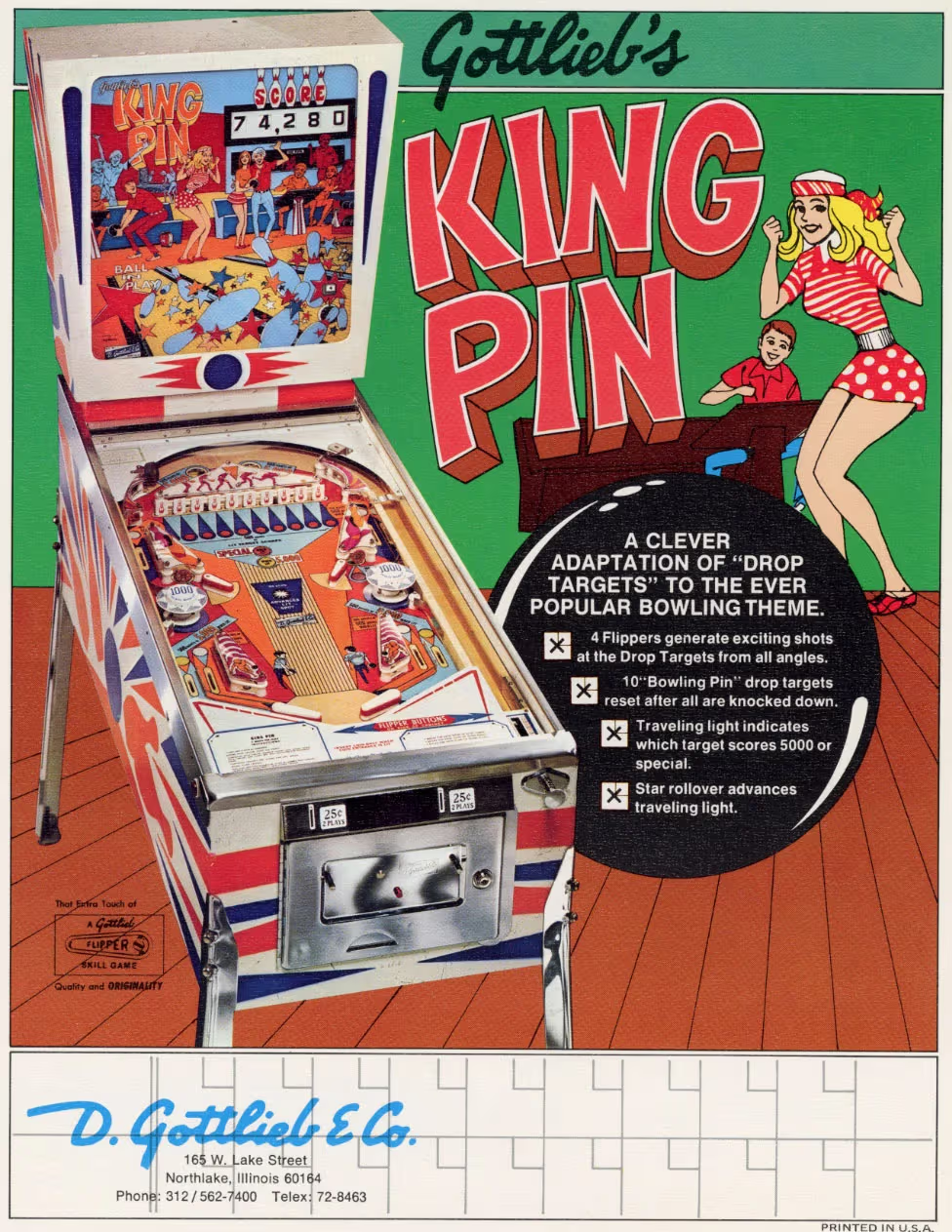
King Pin is an often-overlooked single-player game from late 1973 with a bowling theme and a simple, symmetrical layout which seems to have inspired the later Jacks Open in many ways. To assist in hitting the 10 bowling pin drop targets at the top of the game, upper flippers are added about halfway up the table, allowing new possibilities for fast-paced gameplay. The flipper gap and the in/out lane divider being much lower than the top of the slingshot mean this game does carry forward a bit of the mean streak found on many late 60s and early 70s games, but the alternating lights and fast chimes make King Pin especially frantic and exciting when a good ball is going.
King Pin’s add-a-ball variant Pin-Up is markedly lower on IPDB’s ratings lists, with a score of 7.57/10 only being good for tied 158th place on the EM Top 300.
T-3rd: Heat Wave (Williams, 1964) - 7.84 / 10, 33 ratings
Audio: 7.1 | Art: 8.3 | Playfield: 8.0 | Fun: 7.9
Designed by: Steve Kordek | Art by: Art Stenholm
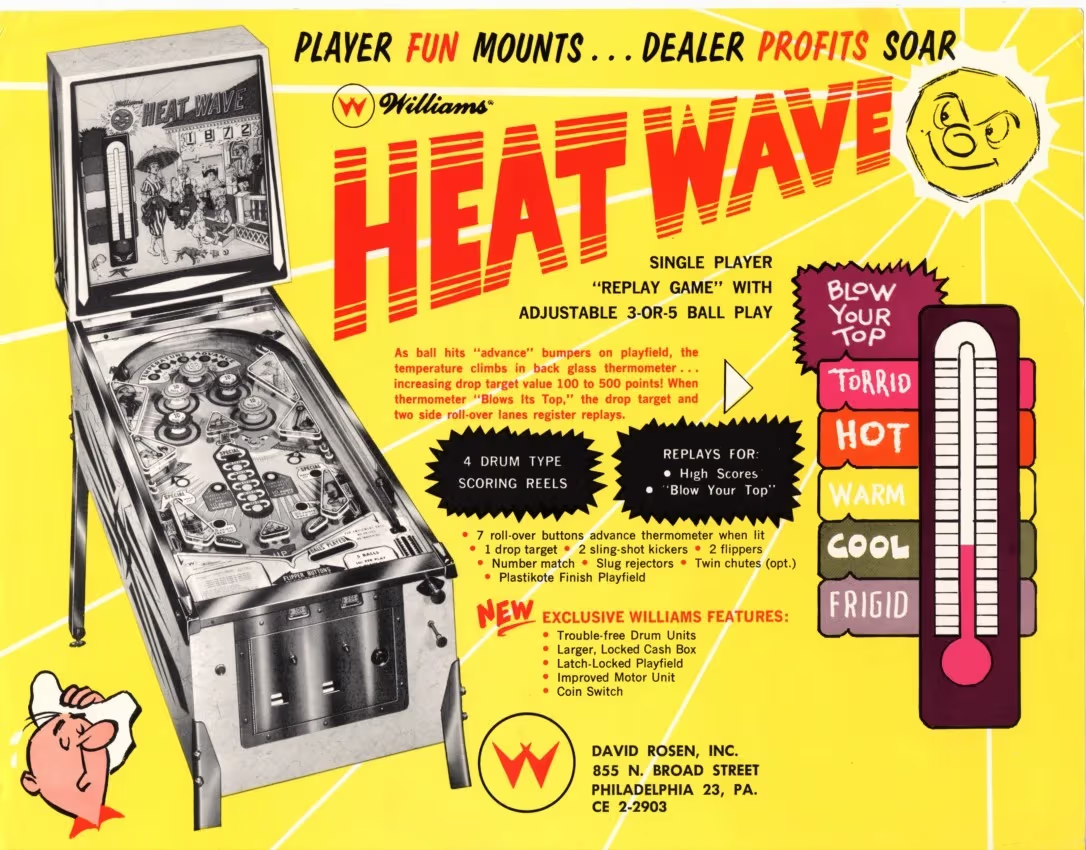
Heat Wave is a true hidden gem of mid-1960s pinball. The artwork is simple, but does a masterful job relaying the game’s theme. The flipper layout is unconventional, with the two flippers being far apart with a triangle-shaped wall between them, but never feels unfair or malicious. The temperature advance feature is a fantastic secondary goal, and trying to get the backbox thermometer up one more section can be addictive. The swinging targets and drop target work together to form an impressively high-skill environment for players looking to chase top scores. Don’t miss out on this one if you happen to be near a copy.
T-3rd: Sittin’ Pretty (Gottlieb, 1958) - 7.84 / 10, 14 ratings
Audio: 6.4 | Art: 9.1 | Playfield: 7.9 | Fun: 7.9
Designed by: Wayne Neyens | Art by: Roy Parker
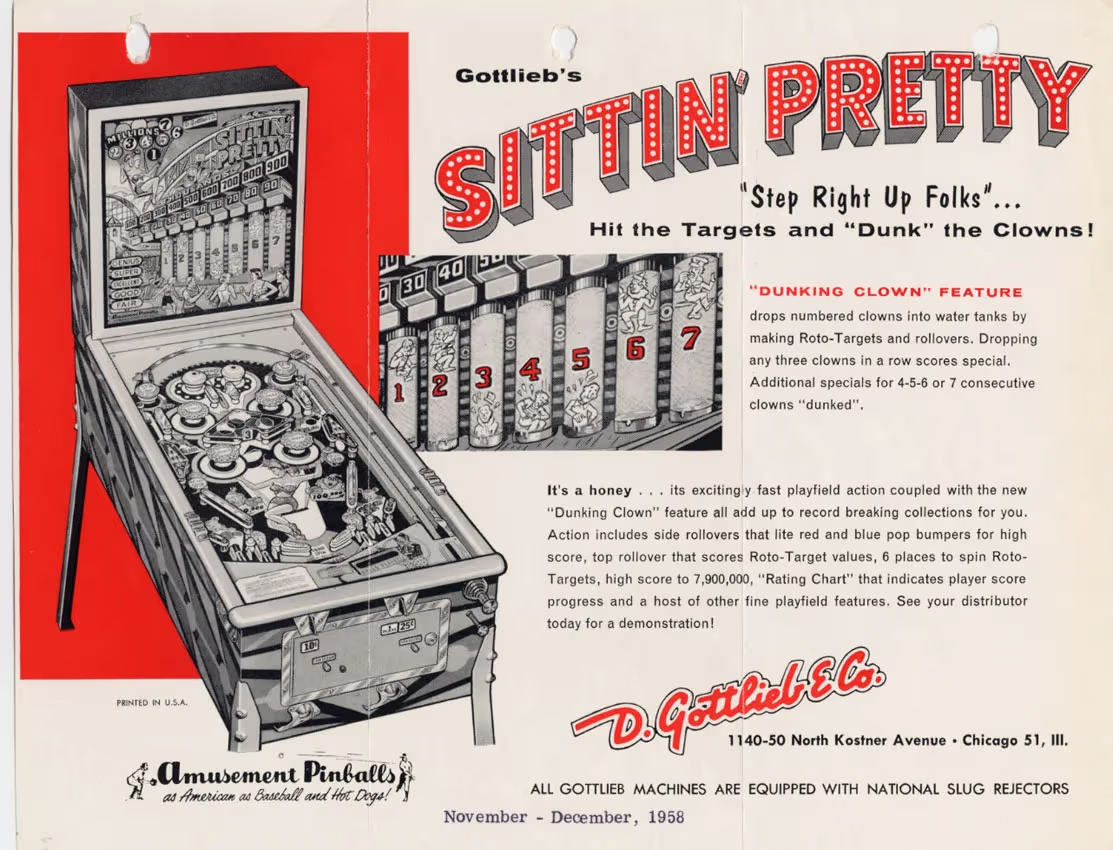
Sittin’ Pretty is the oldest game to make the list by a considerable margin, and accordingly, it’s the only woodrail game on the list, and the only one to use light-up scoring in the backbox instead of score reels. It’s also the highest-rated Wayne Neyens game, and one of the first Gottlieb titles to include the roto-target, which would be prevalent on many Gottlieb games for the next 25-plus years. Sittin’ Pretty appears so high on the list thanks to an astronomical 9.1 score in the Art category, which is the second highest Art score in the entire EM Top 300, trailing only the 9.6 seen on Space Ship (Williams, 1961). Be warned, though, that Sittin’ Pretty is, at its core, a carnival/circus themed game, and as such includes depictions of clowns that not everyone will enjoy. To its credit, Sittin’ Pretty does feel somewhat ahead of its time in gameplay, including multiple ways to advance through portions of the game progression and, somewhat uncommon for a 50s game, no gobble holes.
T-3rd: Centigrade 37 (Gottlieb, 1977) - 7.84 / 10, 73 ratings
Audio: 7.2 | Art: 8.3 | Playfield: 7.9 | Fun: 7.9
Designed by: Allen Edwall | Art by: Gordon Morison
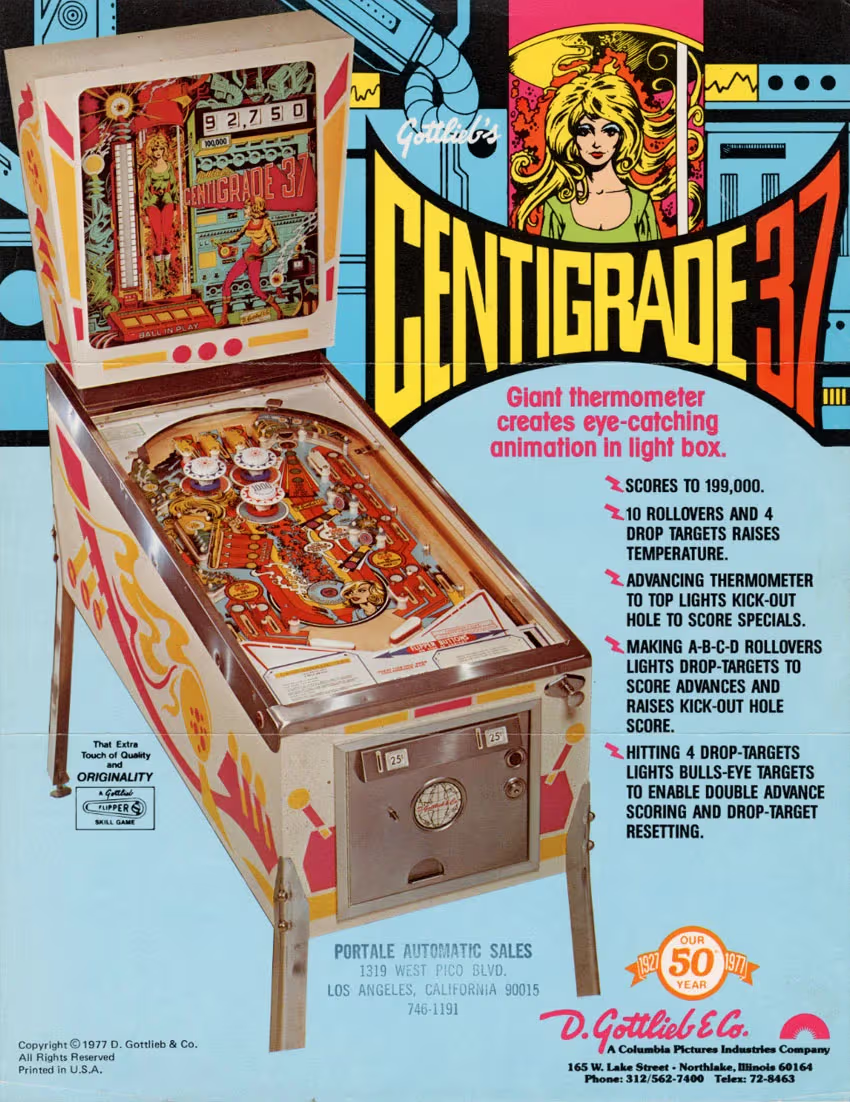
Centigrade 37 is often cited as one of the best EMs ever made for tournament play, and combines the best aspects of several other games from this list. The most well-known feature of Centigrade 37 is the “waterfall” lane structure on the right, a satisfying cascade that is always able to score 15,000 points in just one shot. Centigrade 37 also brings forward a similar secondary goal system as Heat Wave (interestingly, also in the form of a thermometer), the varied shot type and shot distance seen on other asymmetrical layouts like Jet Spin, and high difficulty/high reward skill shots from games like Joker Poker and Jacks Open. Centigrade 37 is a complete package in electromechanical pinball, putting plunging, nudging, shotmaking, and ball control to an ultimate test.
2nd: OXO (Williams, 1973) - 7.99 / 10, 31 ratings
Audio: 6.7 | Art: 8.0 | Playfield: 8.2 | Fun: 8.5
Designed by: Norm Clark | Art by: Christian Marche
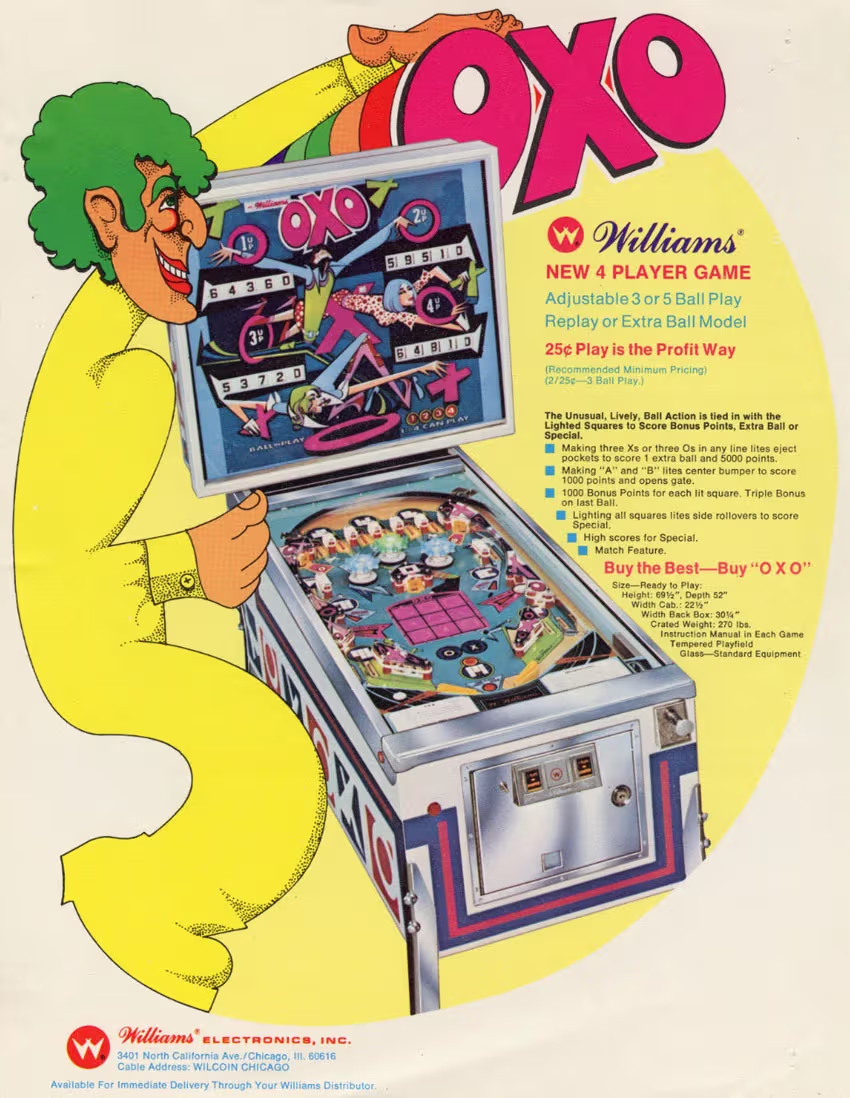
Many pins over the years have tried to implement tic-tac-toe in their own ways, but it’s easy to argue that OXO did it the best. IPDB users seem to agree, rating it 0.15 points higher than any other game so far. The locations around the playfield where tic-tac-toe marks can be earned are very intuitive, as is which mark is selected and how to change between them. Making any tic-tac-toe lights the side saucers for extra ball, a very enticing award that can be achieved again and again with skilled play. Extra fluff like the timed skill shot on X’s & O’s (Bally, 1984) or the super bonus on both that game and Mystic (Bally, 1980) are missing, but diversity in where marks are collected and the addition of the free ball gate make OXO much better as a competition game than older efforts like Egg Head (Gottlieb, 1961). OXO sold over 7,000 copies, making it reasonably common to come across to this day.
1st: Student Prince (Williams, 1968) - 8.02 / 10, 10 ratings
Audio: 7.7 | Art: 7.0 | Playfield: 8.1 | Fun: 8.3
Designed by: Norm Clark | Art by: Christian Marche
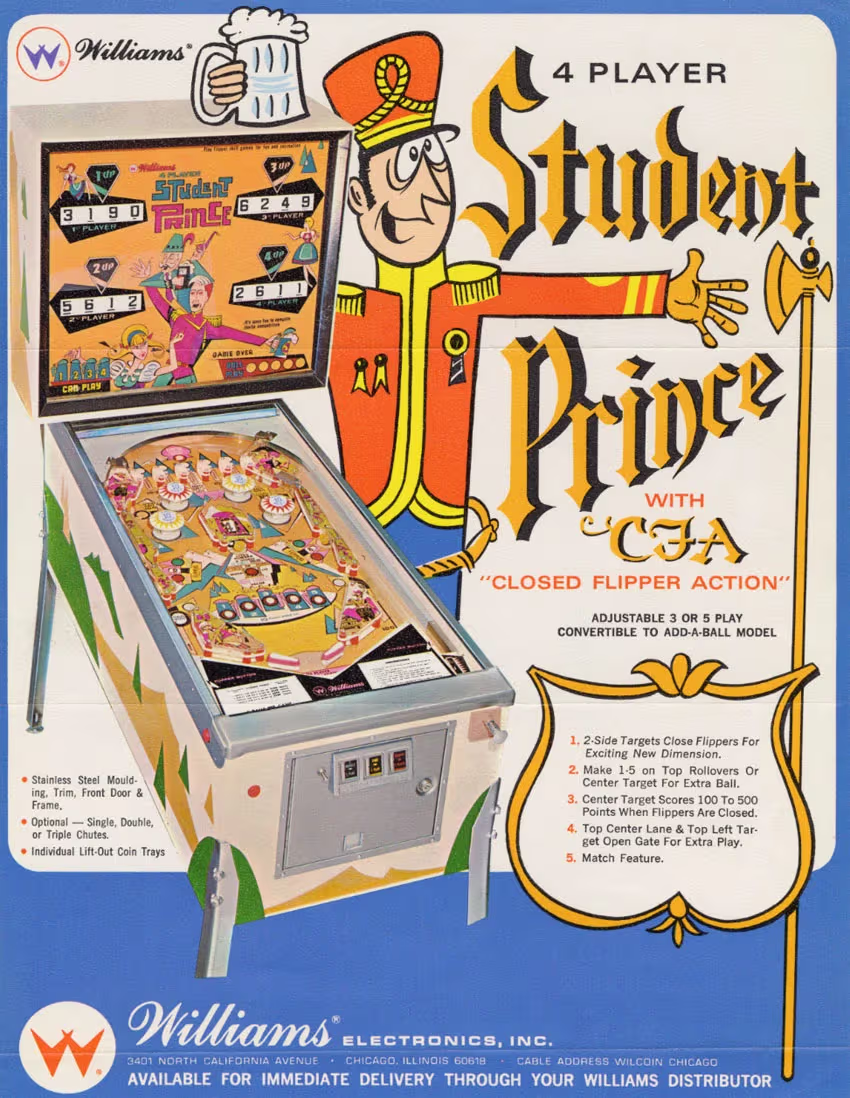
Student Prince may come off as a surprising pick to be number 1. Perhaps it is benefitting a bit from small sample size, as the game has only 10 reviews, which is the exact bare minimum needed for a game to make the list. Nevertheless, it is a strong and often underrated game from the late 1960s. Positive reviews about the game note how well Student Prince balances luck and skill with its zipper flipper feature and the constantly changing value of its center target. Sure, the out lanes can be drain monsters at times — it is a 60s game, after all — but when you get into a rhythm, Student Prince is a fast paced game with a high skill ceiling and an incredibly satisfying bell recognizing every 100-point score. Many EMs have a strong case for why they should be #1 on a list like this, but no matter which you may choose, Student Prince shouldn’t be too far from the top.


Comments