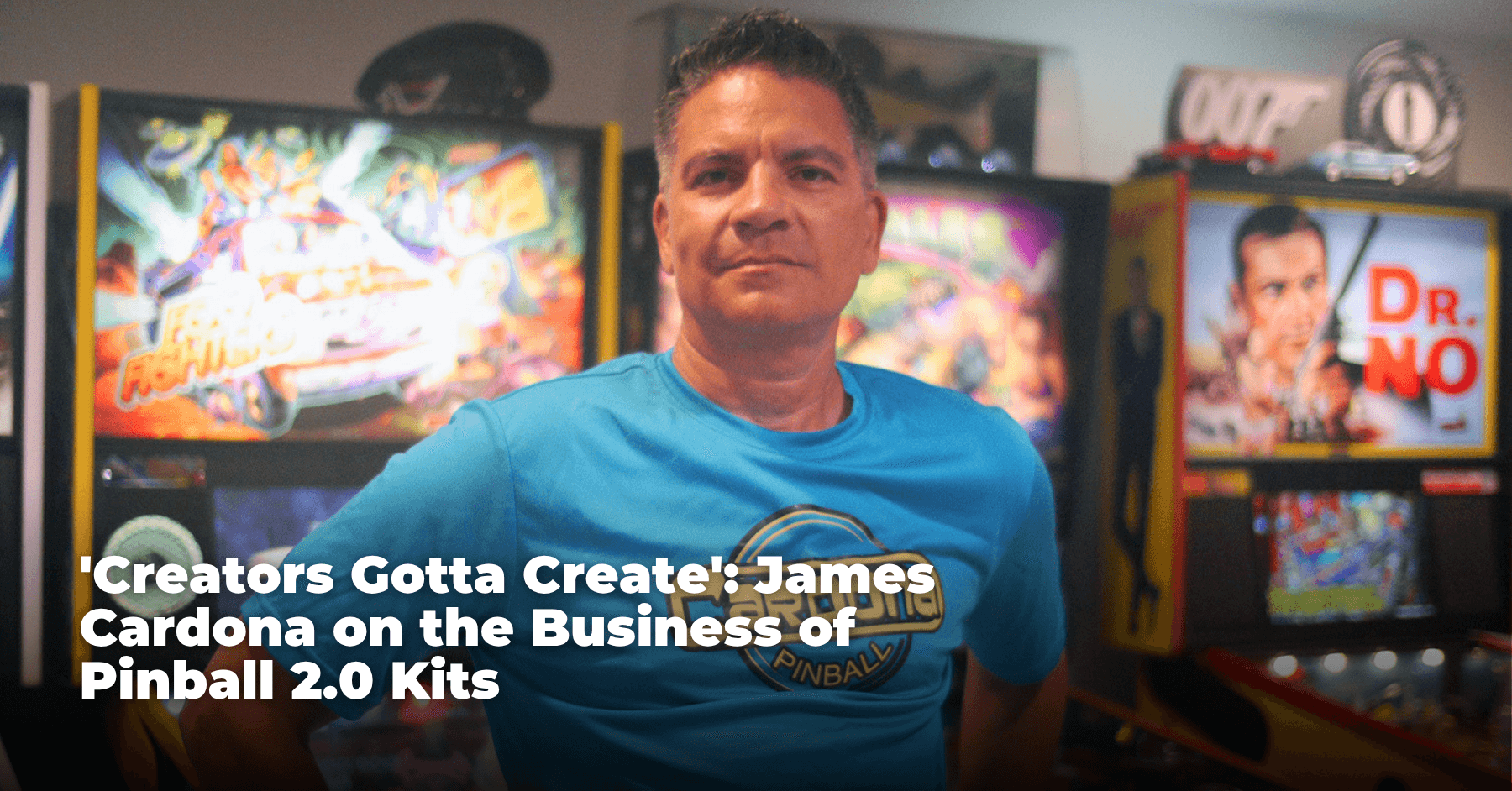
Back in April, James Cardona released Fish Tales: Ultimate Fishing Challenge, the third kit from his company, Cardona Pinball, with a fourth still to come. It's a 2.0 kit, a category of officially licensed products that install into classic Bally/Williams machines and turns them into a new game experience, while keeping the original intact. He's been hitting the show circuit since release, taking it to Pintastic New England and Allentown Pinfest, and at West Coast stops like the Northwest Pinball Show and the Golden State Pinball Festival.
Cardona has been at this for several years now, mostly on his own. He writes the code, designs the games, and has brought in more professional artists and voice actors with each title, while FAST Pinball handles the hardware. For all that, though, we've never really sat down with him. That changed recently, when we had the opportunity to interview him about his company and his work on Fish Tales: Ultimate Fishing Challenge.
The pinball community (rightly) likes to focus on the products first, and we cover some of that ground here. But we also wanted to push on some lesser-covered territory: what it actually takes to run a small business in this industry, how the licensing works when a handful of makers are all chasing a limited pool of classic titles, and the long road from hobbyist to manufacturer.
So we started at the beginning, with how a Navy veteran, engineer, and novelist ended up building pinball games at all.
Colin Alsheimer: You've had a few different lives before pinball: six years in the Navy, a career in electrical engineering, a run as a published sci-fi and fantasy novelist. How does all that lead to building pinball kits, and what's the throughline for you?
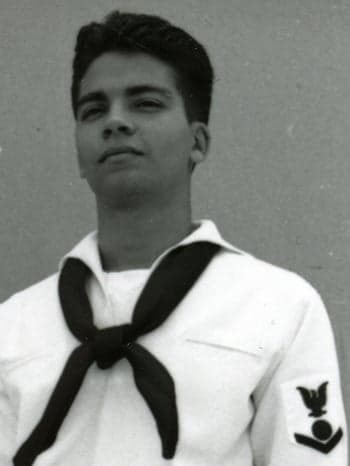
James Cardona in his Navy days via JamesCardona.com
James Cardona: The answer to this question is going to get philosophical and spacey so if that is not your thing then maybe skip this one. Well here we go:
The throughline is being a "creative type". All people, if we are true to ourselves, only feel complete, or one, or at peace, when we are actualizing who we are "meant to be", responding to our inner voice, and doing what our inner person yearns for. Yeah, something like that. Some people are meant to help others, be leaders, or fix broken things; I am creative. I always say, 'creators gotta create,' and so the things that led me to pinball creation were all creative things. I tried my hand at being a novelist, got my degree in computer science because I loved the creative aspect of writing code, and also spent seven years mentoring a high school robotics team with FIRST robotics. I think learning the robotics programming and the real-time operating system style of coding was what really emboldened me to try a stab at pinball.
Before pinball, I also dabbled into hacking arcade game roms. I created a full set of alternate levels for both Tempest and Arkanoid which was really fun. I used to have both of those games in my home and I handed my kids graph paper, when they were little, and had them drawn up levels and I coded them into the game. That was Arkanoid. It was pretty cool for them to play a level they had created on a real live arcade machine. This was about 1999 or so.
Pinball was the next logical step.
Colin: You spent years writing novels, and now you write a game's rules and modes from scratch. To me those aren't far apart: both are building a world and a sense of progression. Do you think about designing pinball code as a kind of storytelling? Has being a novelist changed how you build a game?
James: This is something I really feel is missing in pinball, and for me, Stern's Dungeons and Dragons: The Tyrant's Eye is the only game that has so far truly tried to tell a full, coherent story in pinball. And story is everything! Joseph Campbell's The Hero with a Thousand Faces should be required reading for anyone creating anything in my opinion. Without a story, what are we really doing here? Story ties everything together.
And telling a story in pinball is so hard! Take Foo Fighters, for example. An alien is trying to do something bad and only our heroes can stop him through their most righteous music. I love the game but that is a super thin story. Basically a one act play. But to get more complex than that is so hard in pinball!
The games that have 3rd-party IP can do it more easily because they can play movie clips and most people have already seen the movie so they know the story already. That's a lot easier and unfortunately, I think, it leads to a sort of laziness.
When I build a game, the first thing I start with is the story. Before I write one line of code or record one line of speech, first off is the design document where I lay out the entire game in written form and everything is in there. This could take a few months to write and typically is about 50+ pages long.
Now I think I am emphasizing story pretty boldly here and someone out there is thinking, "I feel you, but where's the deep detailed story in Gofers?" There's truth here as well. Gofers is basically a story of two gophers trying to disrupt a golf game. Another one-act play. I tried to get a little deeper with Black Rose and made it about foiling an attempted mutiny where the second mate, Red Beard, is trying to overthrow the captain and steal the boat and the gist is that they are trying to pull members of the crew to their side and all this leads up to the final battle between the captain and Red Beard.
Still I had to leave everything that was written on the playfield in the game and the names of all the modes are written on the ships mast on the center of the playfield so we needed a Polly mode which really didn't necessarily fit my story but we made one anyway.
For Fish Tales, the original was just "Let's catch some fish. Yeah!" So the story I came up with was a fishing competition with five world-class competitors and each challenge is part of the competition. Not much of a story there either as far as stories go, but story is something that is always on my mind.
Colin: Why upgrade kits for old Bally/Williams games, instead of designing an original machine of your own? I'm curious what working inside an existing classic gives you that a blank slate wouldn't.
James: Restrictions, really, is what working inside an existing title gives me unfortunately. I have to use everything that is written on the playfield, especially scoring values, and that ties my hands more than you would think. It definitely takes away freedom.
There is also the idea of taking a classic beloved game and having to make it better. For Black Rose, I didn't really feel that because the original was weak. If that stings you or you disagree, you can still play the original on my kit, I just didn't feel the need to keep any aspect of the original that I didn't want to.
Fish Tales and to a lesser extent No Good Gofers were different in scope. All the core elements had to be retained. People just love those games too much. So with those games it was more like a "continued", similar to Cactus Canyon Continued, rather than a complete new game which means I had to not only keep the core of the game but anything I added had to feel like it belonged and extended the original.
As far as why did I do this? I'm a coder and my mechanical design skills were pretty weak years ago. I figured I would do this first, because it is what I could do and what I knew I could complete and do well. If I started right out of the gate trying to build a full-blown machine, I don't know how successful I would have been. I guess what I am saying here is I have always had an honest view of my skillset and a reasonable idea of what I could accomplish. My six years in the military really taught me about setting reasonable, measurable, and achievable goals and that is something I have retained through life.
Colin: A lot of what you do seems to be finishing what was left unfinished. On No Good Gofers, you found modes that were designed but never coded. And you've said pinball is "the physics of the ball," which seems to be part of why you've stayed away from video modes (and I'd guess they're just hard to build, too). But the Fish Tales notes mention a video mode in the works, coming as a later update. So what's your rule for what a 2.0 should add, and what changed on video modes?
James: My first two rules in doing a title are:
1) I won't do a game that I can't improve on
2) I won't do a game that has a poor-shooting playfield
So, for me, I look for games that shoot great but were either unfinished, have really shallow code, or just outright bad code. Gofers was unfinished, Black Rose's code was not great, and that brings us to Fish Tales which arguably I shouldn't have done. I was on the fence about doing that game but the early reviews and feedback give me the feel it was the right choice to do it. And wow, that was a tightrope walk trying to keep the original spirit intact while expanding it to a modern-day experience. I mean the original Fish Tales is a great game, for 1992's standards anyway, and that's why they sold so many of such a weird concept of a title. So by my own rules, I shouldn't have done it, but the title was available and I thought I could improve it enough to be worth the risk. I think I have done that.
As far as video modes, pinball went too far in that direction in the 90s because of the threat of arcades and really that was a mistake. Early feedback from beta-testers on Fish Tales was solidly in favor of adding the video mode. For some reason people who are pretending to be fishermen in a game really love shooting down people on waterskis. Who knew?
So the just released update adds the video mode back in and it is a modern re-imagining of the original. As far as difficulty, I don't find doing video modes difficult. I just think pinball should focus on what is unique and not try to imitate another medium; it's really about the kinetics of the ball.
Colin: You originally planned to give No Good Gofers away for free, and then, in what you've called "a strange series of events," you connected with Planetary and it turned into a real company. How did that happen? How did you go from hobbyist to licensed manufacturer?
James: I've never gone into that, but after I posted a thread to Pinside about my 2.0 of Gofers, Rick from Planetary called me and it was all his idea to go commercial. Early on, he mentored me and we spent a lot of time on the phone talking through all the business stuff that I was clueless on and he convinced me to give it a go. He was huge for me.
There were a few things I was resistant to and the road has been bumpy for sure, but it was a good decision and I am glad he pulled me into this world. It was totally weird too, being just a one-man show who was doing this coding thing for fun being yoked into this world and learning about all these other manufacturers like Chicago Gaming, Pedretti, and a few others planning to do 2.0 games. I signed an NDA and got a lot of insider information a couple of years before it all happened. Rick hooked me up with Aaron from FAST who started to send me prototype hardware to test out in my machines and suddenly it was like being inside of something bigger. Yeah, cool.
Of course, I had to do a complete recode of my game so that it would work on FAST hardware and that took nearly a year — I was still working full time at this time, and that really killed all the buzz about the game so when we finally released No Good Gofers: Battle For the Green, everyone was like, "Yeah, yesterday's news."
I think Rick took a bit of a risk with me, but since I had already developed No Good Gofers, it wasn't like I was a totally unknown quantity.
Now it's quite a bit different and if I was to advise anyone who wants to go from hobbyist to pro, I would suggest starting with the homebrew community. The homebrewers are a pretty tight bunch and they are really game to help each other which is super cool to see. A few of them have gotten jobs with the major manufacturers so it seems like that is turning into the pipeline into pinball right now.
Colin: You've now done this three times, from No Good Gofers to Black Rose to Fish Tales. What's that journey been like? I'm curious what got harder as you went, what actually got easier, and what you know now that you wish you'd known before the first one.
James: When I was first contacted by Rick as I described above, I had only written No Good Gofers: Battle For The Green and developed the game for P-Roc hardware. The trade off to starting the company and making it all real was he wanted all the manufacturers on the same hardware which is why I had to switch to the FAST platform and he also wanted all the manufacturers to tie down their titles ahead of time.
I gave him a list of a bunch of titles I wanted and a lot of them were already taken so in a round about way I found out what other games were going to be remade, well 2.0s at least. So this was back around 2019 and all the way back then I knew someone had Tales of the Arabian Nights, I just didn't know who. I short listed 4 titles that were available and I have done 3 of them so far. I can't say what the 4th is at this time.
The coding has gotten easier for sure. I mean, the service mode that took me four months to write for Gofers is only slightly different for Fish Tales so it only took a few days to tweak that. There's probably 20 to 30 percent of the code that is reused like that — tilt modes, ball search modes, all the core stuff that is in every game.
Not sure that I can say anything has gotten harder. I think the more time you do anything it is going to get more intuitive and easier.
The thing I wish I'd known before the first one was how difficult it would be for a certain subset of the customers to install the kits. I mean, I guess since I work around technology I had this naivety around how much people don't actually know, like, don't swap components with a machine plugged in and turned on. I mean, do I need to explain how to drive a screw? If the monitor doesn't come on, the power cord is probably disconnected, right? Do I need to explain that?
I had no idea that so many people who had pinball machines in their homes had absolutely no idea how they worked or how to work on them. That was a huge learning for me.
Having said that, I am here to help anyone who needs it with the installation process of my kits. I give out my personal cell phone number and email to purchasers and I have certainly spent time on the phone with people from Australia, France, and all over the USA as well as many other countries. I want people to have a great experience and once they get through the install, they do.
Colin: I want to understand the licensing itself, because your position is unusual. How does the approval system for these Bally/Williams titles actually work, and how does your four-title deal line up with what you've put out so far?
James: So the way pinball licensing works, for Bally-Williams titles at least, is you pay a fee to have exclusive development rights for a title for a period of time, typically two years or so. Of course, just because you have money does not mean Rick will give you a license. I think he really needs to believe you're going to produce a product as well.
So I signed a contract for four titles and all that means is that no one else can do those titles during that time that I have locked up. My time expired for No Good Gofers and Black Rose so if there is another developer who wanted to do those games then they could pursue a license and write their own game from scratch, just like I did.
Being green, I miscalculated how long it was going to take me to do the games — it always takes longer than you think, so what I would suggest to others trying to do this is to lock up no more than one or two licenses at a time, well, unless you have really deep pockets and can pay for a longer period of time.
I have one more title in my pocket and haven't looked into others recently but I have a rough feel for what's available and not available.
Colin: Related to that: Pedretti's already shipping full-size remakes (Funhouse, now Tales of the Arabian Nights), with presumably more coming, and American Pinball just licensed a batch of Williams/Bally titles. Where does that leave someone like you? Are you starting to feel squeezed for sellable IP?
James: Yes, those two and the rumor mill says there are others with licenses as well. I don't know anything official, though.
The squeeze has always been there because right from the beginning I couldn't get several of the titles I wanted because they were already taken. Doing 3rd-party IP is not an option for me because the licensing cost is too steep and there are only so many clear titles to choose from. I mean, I would love to do T2, but how can someone like me get a license like that? It's just too expensive and too much risk to take on for my sized company. There are other angles here as well, like targeting much older games, but they come with their own set of problems. I think the Haggis approach of doing games from the early 80's had a lot of merit and it's sad to me that they couldn't make it.
Still, there's stuff out there. I have no intention of doing White Water and I think that's still available if someone is passionate about the game. There's probably about 10 titles out there that interest me that I or someone like me could do. As I understand, a group of folks in Europe are working on Black Knight 2000 and Anthony VanWinkle was toying with Swords Of Fury, but he may have given up on that.
One thing to point out here is that the business model for remakes and for 2.0s is really different. Typically a company wanting to remake a game wants an expensive, hard to find game, with low production numbers, like Medieval Madness, Attack from Mars, etc. I don't see the logic in reproducing a machine that already sold 25,000 units like The Addams Family.
On the other hand, 2.0s work best for high production existing machines so we're looking at machines that are relatively cheap and they made a ton of them and Fish Tales is a perfect example with over 13,000 made. We're talking titles like High Speed or Pin-Bot. No one is going to remake those, but a 2.0 might do well if it's done well.
So it's really two different business models and I don't see a lot of overlap between the remake folks and the 2.0 folks. The license problem I had previously described with unavailability of licenses stemmed from several manufacturers wanting to do 2.0s six to twelve years ago. Somewhere in the neighborhood of twenty different titles were reserved between Haggis, Pedretti, my company, and two other companies, as I understood, and that has all dried up since Haggis went out of business and Pedretti merged with Euro-Pinball and stopped doing pure 2.0s. My understanding is the other players have fell away as well so I guess I may be the last man standing for pure 2.0 kits that get installed into existing machines.
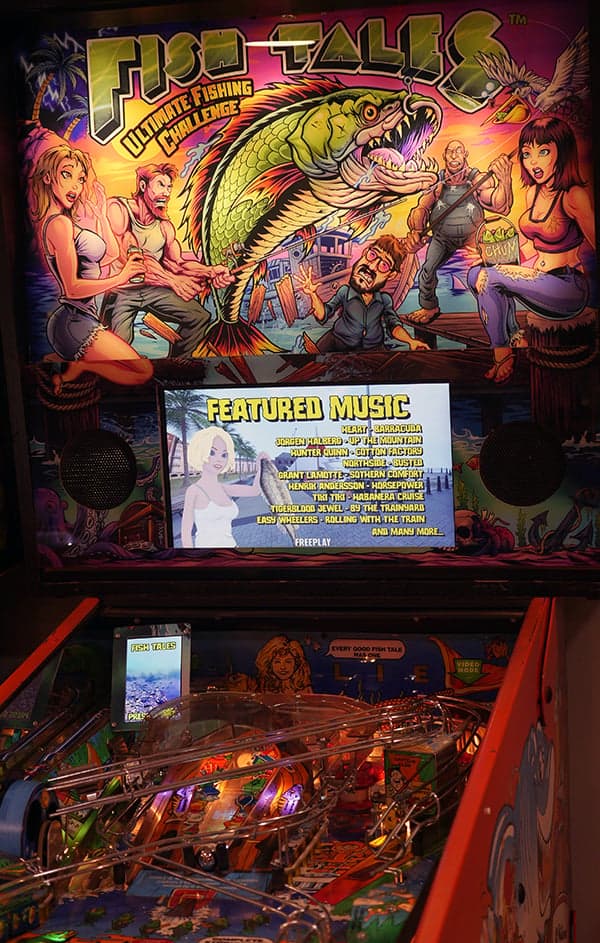
Colin: The music licensing is the part I really want to get into, because landing a legit major-label license is rare for an operation your size. For Fish Tales you cleared Heart's "Barracuda" through Sony Music. How does that actually work, going out and getting a song like that for a kit, and what did you learn doing it?
James: Wow, what a crazy experience. In my initial design, I was looking for three commercial songs, one for each of the wizard modes. I contacted individuals both at Barrels of Fun and Spooky to ask for advice before I walked this path and people from both companies were both gracious enough to give me some guidance but both said what my experience has borne out which is that music licensing is a difficult and tangled maze of muck to wade into.
You have to do all the research yourself and present a proposal stating exactly what you want and how much you are willing to pay. They won't tell you anything. Both the artist and the recording company, or the superseded entities that retain those rights, have to sign off and they both want to be paid, and they want to squeeze as much out of you as they can. Sometimes you do all this front end work and no matter how much money you offer they refuse.
I tried to get several Creedence Clearwater Revival songs, Green River and Born on the Bayou and John Fogerty just said no. No reason, no excuse as to why. Did he hate pinball? Was it not enough money? No clue. No discussion, just no.
I almost got the B-52's Rock Lobster. The record company and 3 of the band members had signed off on my offer and that alone took about 3 months. Finally, I released the game at Pintastic and I still hadn't heard from the representatives of the remaining band members so I called and begged for an answer. I still wanted the song and I'd add it as a software update. Just give it to me please!
I don't know if these rich folks are sitting on a beach somewhere drinking Mai-Tais or what, but finally the answer came back that one of the band members was a vegan and didn't like the idea of the song being associated with a game about catching fish. Like what? "Catch and release," I said. But no arguing. So there you go. Another no after tons of work.
Others just don't respond at all. I couldn't get anyone who covered Jimmy Buffett to answer me. Ever. Just radio silence.
I was super blessed to get Barracuda and working with Sony was the best experience. The people at Sony are super reasonable and will actually guide you so you have a sort of a feel of what the artist will and will not accept so that was unique and refreshing after all the difficulties I had with other management companies. Still, I wish I could have gotten a few more songs.
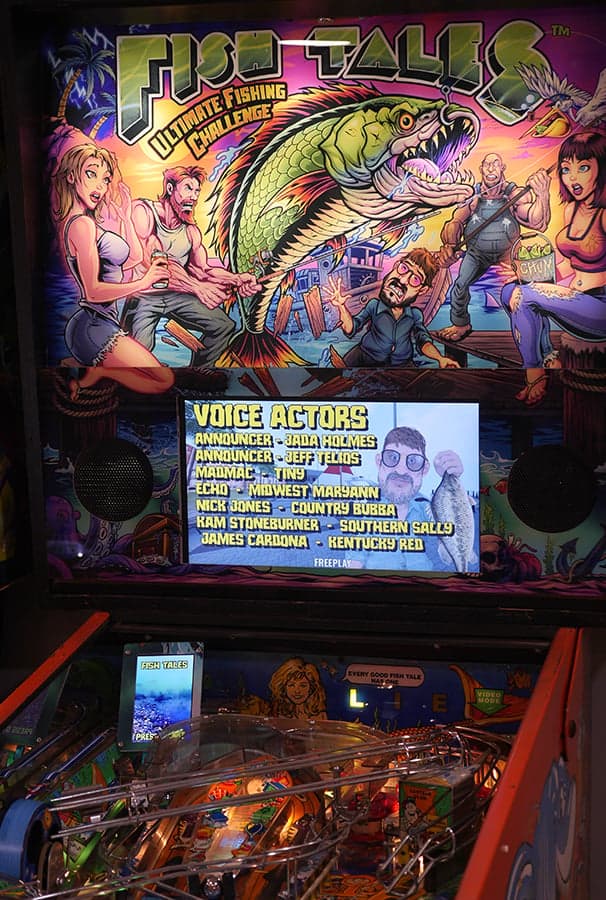
Colin: From what I can tell, you're basically a one-person shop, bringing in artists and voice actors as you need them, with FAST Pinball building the hardware. What's the business model, and what's the hardest part of running a small manufacturer in a niche this small?
James: The hardest part is always the things you are not personally good at. I write code and that has always been easy and enjoyable for me. Brian Allen did my artwork and I got a bunch of professional voice actors so I was covered there. I have been muddling through animation and if you are familiar with my titles you can see that I have gotten better on each one, but it has been a learning experience for sure. Other things, like marketing, I am just terrible at. I just don't have the intuition for it. Yeah, so being a one-man shop is tough but you also learn a lot because your hands are in everything.
Also there are a lot of fixed costs that really eat into your profits if you are not moving a lot of units. For example, for the last two years that I have been developing Fish Tales, I'm still paying for business insurance, my website, and a whole host of other miscellaneous costs. It is no wonder so many small companies go out of business before they can scale.
Colin: On the economics: a nice Fish Tales is listing for $6,000-plus on the secondary market now, and your kit is another $2,200 on top. Who's the core customer here, and what do you think they're really after?
James: Williams made a ton of Fish Tales and a lot of collectors have them so I would say my customer base is more likely to be someone who already has the machine versus someone who is trying to pick one up now that the prices have shot up. I currently have 4 Fish Tales machines (so I can take them to shows) and I bought all 4 of them from $2500 to $3000 each. People who have had machines longer might have paid $1000 so many years ago. So someone like that might be interested in dropping $2200 on a beloved game to get an entirely new game that is up to today's standards.
As you say, buying a 30-year-old machine for $6000 and then adding another $2200 probably doesn't make much sense. Although I have recently seen nice Fish Tales machines pop up on Facebook Marketplace for about $4500 so I might push back on your numbers a wee bit.
Colin: These kits seem to divide people, and not just yours. A Pinside poll asking people if they were fans of 2.0 kits ran about 70% "hell no." But digging into the thread, some critics aren't necessarily anti-2.0 (a few seem to like Bride of Pinbot 2.0, for example). The objection seems more about facelifting games that were already great, and art or voice work they don't think is pro-grade. You seem to be comfortable taking on those criticisms directly. So what do you have to say about this line of critique?
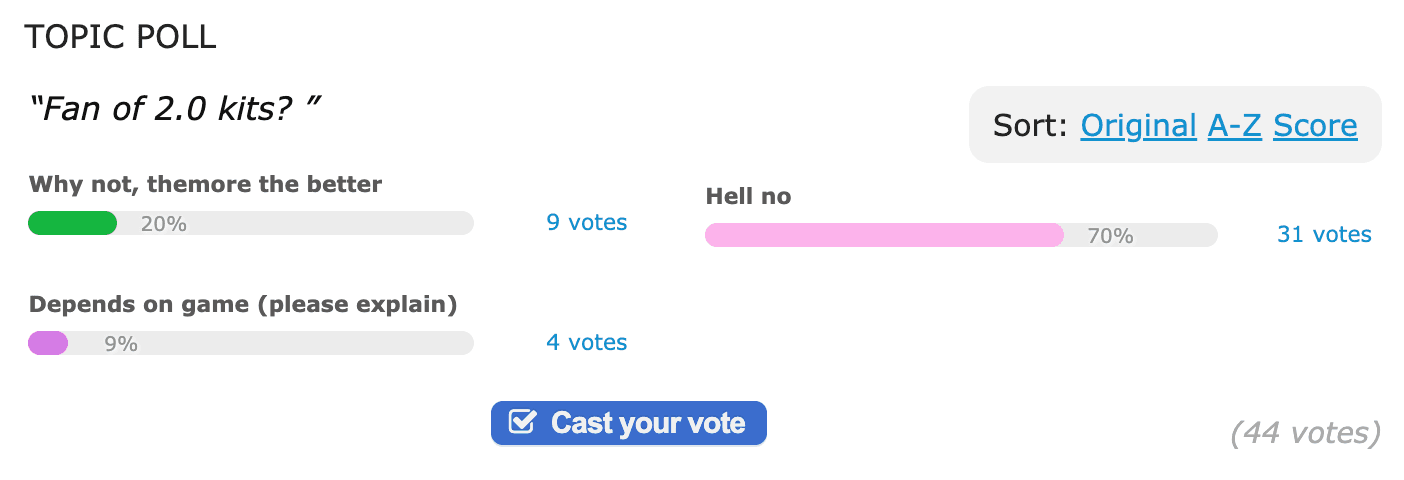
James: My argument, at least with my games, is that you don't lose the original. My games all offer the ability to play the original game as well, so you don't lose anything.
Now with the first two titles, the original code ran through emulation so it is the actual original rom that you play. With Fish Tales, we haven't completed the original game yet, but we're recoding it from scratch. This is what CGC does and the big benefit is that you can then add stuff to the original like RGB lighting, shaker motor support, etc. This is the goal with Fish Tales.
As far as the artwork and voice acting, I really take those points to heart so I have been migrating to hiring more professionals on each title. I hired Scott Gullicks to do my Black Rose artwork and now Brian Allen for Fish Tales. All the voice actors for Fish Tales are professionals and several work in radio for their day jobs. I mean, $2200 is a lot of money and I think the customer deserves a quality experience and should enjoy spending countless hours with my game in their home. I try to honor that.
Colin: Okay, on the kit itself. You packed a lot into Fish Tales: Ultimate Fishing Challenge. A new game alongside the original, five angler characters, all the LCD work. Now that it's out in the world, how do you feel about it?
James: When someone creates anything, a movie, a TV show, a song, or anything creative, you live and die by the critics. No one puts out a large sum of money and sinks years of their life trying to create a bad product. Still some of them are just not good.
So it's hard. Every songwriter, musician, or director out there is trying to make the best thing that they can. Maybe I'm being a bit generous, but I know I have poured my life into things, the books I've written, for example, and maybe one of them just didn't click with some subset of readers. It didn't matter that I poured so much of myself into it. They didn't enjoy it. Pinball is no different.
Stern or Jersey Jack or any of the others invest several millions of dollars and many multiples of man-years of development time into any given title for some pinballer to casually say, "Man, that sux!" and for that individual, it did. I am not denying their real experience, I am just saying pinball is hard.
So Fish Tales is the game I am most proud of and it is because people have been coming up to me at shows, shaking my hand, thanking me, and honestly telling me that they really enjoyed it. That didn't happen so much with the other two titles. This one feels different.
Colin: Where does this go from here? How many more of these do you have in you, and do you see yourself staying in upgrade kits, or eventually going the way Pedretti has, into full-size remakes, or even original games of your own?
James: I have one more title that I intended to make and I have the full design document done for it, as well as about half of the voice acting recorded, but what I do next really depends on how well Fish Tales sells. I am going to do something though. Creators gotta create. But if I continue with 2.0 or migrate to something else is a little up in the air right now. I can say with certainty that I will not be doing full-sized remakes unless some other manufacturer wants to partner with me. I know my limitations.
Colin: What are your top three pinball machines of all time, setting Bally/Williams titles aside?
James: This list changes constantly but right now it is Elton John, Foo Fighters, and James Bond. Obviously, anything Keith touches is great as well. I own Godzilla and Jurassic Park and will never sell them.
I might buy a Sonic. It looks like something I would like.
I've owned a few Spooky games over the years and their quality seems to be improving and they keep innovating so it is no surprise to me that they've really gotten popular lately. This makes me happy.
As far as older stuff, Harlem Globetrotters never gets old. I love that game. Oops, that was a Bally. Meteor and Quicksilver are cool too. Those are both Sterns.
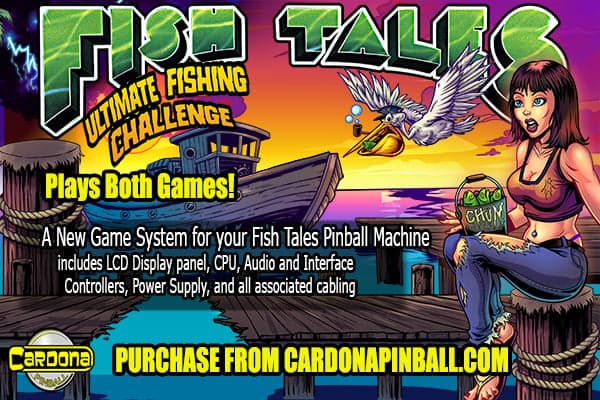
Colin: A couple of practical questions, for anyone who wants one: what's it cost, where do they buy it, and can they try it before they commit?
James: Fish Tales: Ultimate Fishing Challenge can be purchased either on my website at CardonaPinball.com, Cointaker.com, or Planetarypinball.com. Retail is $2200.
As far as trying before committing, we have taken the game to Pintastic New England and Allentown Pinfest. FAST and Planetary have been gracious enough to cover the west coast shows for me, so it's been at the Northwest Pinball Show as well as the Golden State Pinball Festival.
[Cardona plans to have Fish Tales at Southern Fried Gaming Expo at the end of July, with other shows to be announced.]
Also, if anyone is traveling through Delaware we have one on location at the Delaware Pinball Collective which is right off highway 95. If there are other large pinball locations who have a Fish Tales and want to have our game on location, please contact me and I'll hook you up with some swag and free shipping when you purchase.
This interview has been edited for length and clarity.