Is IPDB Dying? Visualizing the Slow Death of a Pinball Institution
In early December, IPDB.org went down, and people noticed. Reports popped up on Facebook, Pinside, and enthusiast Discord groups. Service was eventually restored, but complaints about slow load times and unreliable access persisted.
For a community that depends on volunteer-run infrastructure, this kind of outage would normally raise alarm. But periodic technical issues for IPDB are nothing new, even if this most recent incident does seem particularly acute. Peruse Pinside threads, and you'll find discussions about IPDB's maintenance challenges stretching back years.
Taken alongside some other signals and community whisperings, though, I think IPDB might be dying. Here's why.
A Historical Primer on IPDB
IPDB has long been one of the most complete and detailed databases of pinball machines on the internet—the go-to resource for looking up information on old machines, historical tidbits, downloadable ROM files, and game schematics. Many consider it the backbone of the modern pinball community.
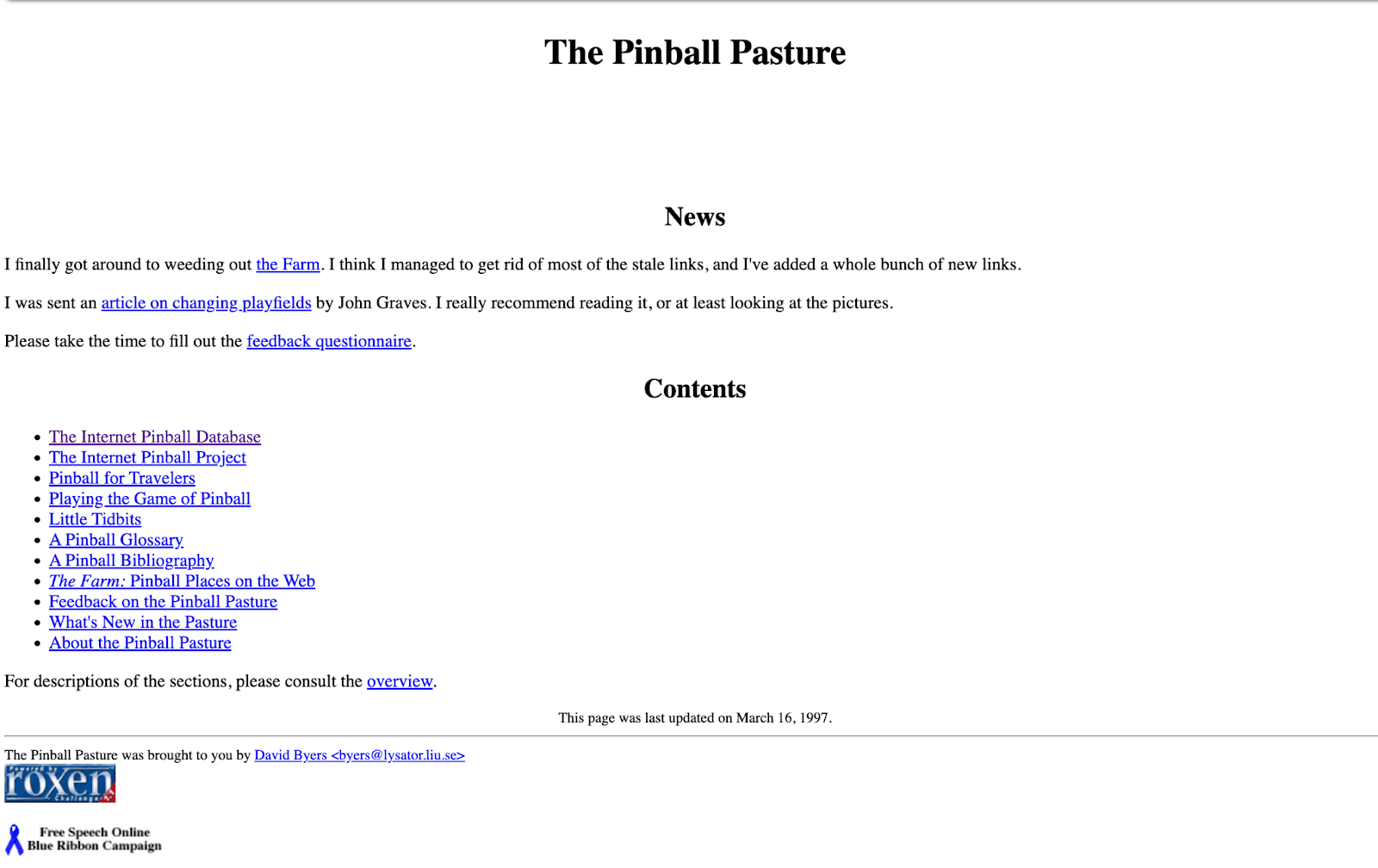
A living relic of the early internet, IPDB traces its roots back to 1997—seven years after the founding of IMDb and four years before Wikipedia came online. That year, a Swedish pinball fan named David Byers created one of the first websites dedicated to pinball, called Pinball Pasture.
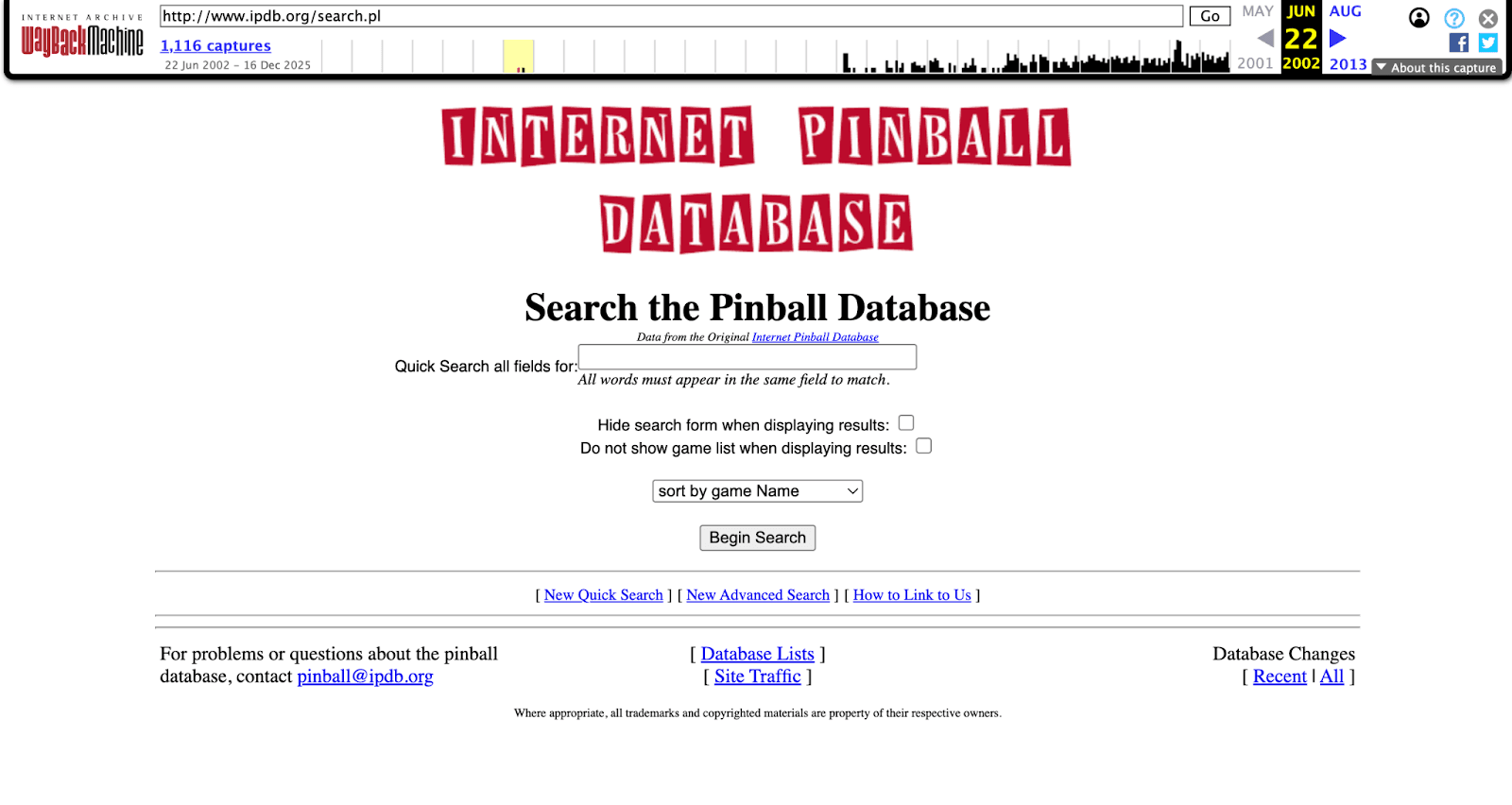
In collaboration with Frank Laugh, the two grew the first iteration of the Internet Pinball Database to over 4,000 machine listings and 2,000 photos by 2001. Around that time, as updates slowed and other projects diverted their attention, a group of new hobbyists led by Chris Wolf got together and purchased the domain ipdb.org in December 2001.
On March 22, 2002, Wolf announced the launch in the rec.games.pinball usenet group:
"I'd like to announce a new replacement Pinball Database available on the Internet at http://www.ipdb.org... The work done by Frank, David and the others for the existing IPD site has been of immeasurable value to us all and is probably used by everyone reading this, but as their businesses have taken off, they've been unable to continue their excellent work. To prevent this work from being lost, and to continue expanding the database, a group was formed 3 months ago to rewrite the database from scratch."
The data collected and maintained by David and Frank formed the backbone of IPDB as we know it today.
Shortly after launch, Chris was joined by Jay Stafford, who assumed the role of Senior Editor, a role he continues to this day.
While Chris settled into more of a background webmaster role, Jay became the face of the operation. As he described it in a 2011 interview with Skill-Shot magazine: "...I do everything else, which is provide content, interact with people, go to the shows, do what I call outreach which is just try to find pinball machines and pictures and data that we don't have and bring it into the site, collaborate with other historians and try to build history, and research history, so we can have things to say about the games rather than just some antiseptic listing of name, rank and serial number."
With the help of a small group of dedicated volunteers, contributions from the community, and other forms of material support, the site steadily grew in size and ubiquity. Today it claims listings for 6,700 games, 80,846 images, and 6,031 other game-related files like ROMs and technical documentation.
Visually, the site looks much like it did when it first launched—minimal, text-heavy, more substance than style.
Decreasing Update Volume

Over the last few years, despite pinball's general resurgence and the influx of new manufacturing companies, the pace of updates to the IPDB database has fallen off. The drop is particularly steep recently.
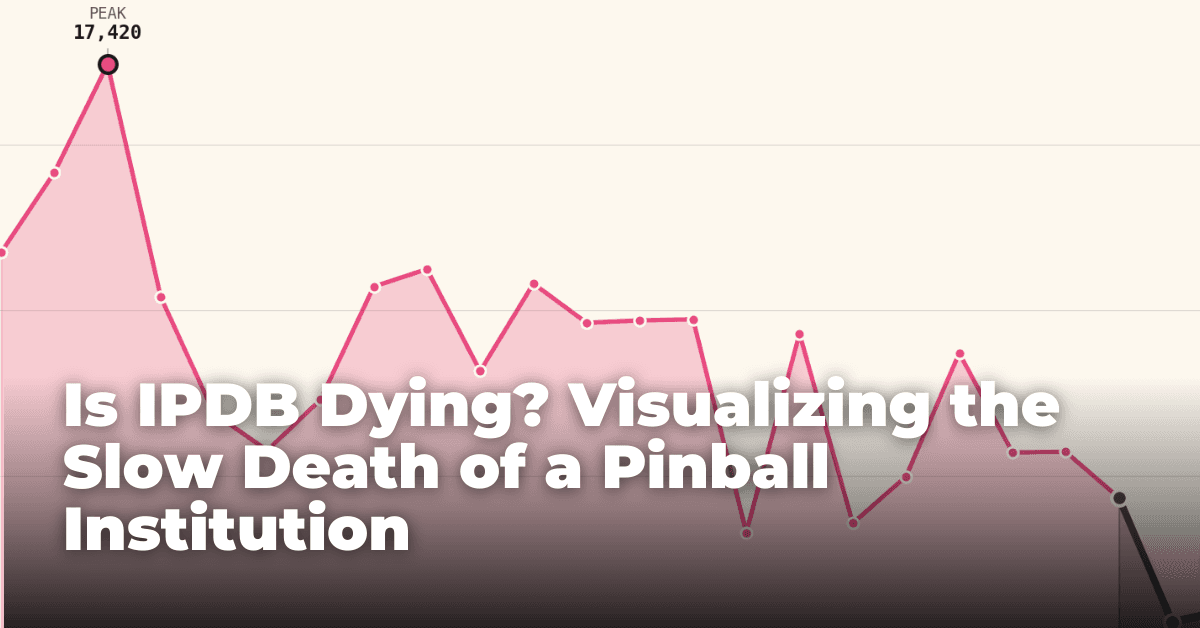
In 2024, IPDB made only 612 changes to its database—a 93% drop in volume since 2020 and 96% decline since its peak in 2004.
Updates in 2025 have ticked up to 968 changes (as of 12/31), but that's still way down from 2023's pace of 4,349 changes.
On its own, a reduction in database updates isn't necessarily concerning. At a certain point, you run out of new material to process. But that brings us to the second troubling trend.
Lack of New Games Added

IPDB has, for the most part, stopped adding information about modern pinball releases.
Since 2020, the pinball community has seen roughly 56 new major launches of commercially available games. (For this exercise, I'm not counting home editions, remakes, remasters, anniversary editions, or, in the case of a company like Multimorphic, third-party modules.)
IPDB has added only 16 of those releases to its database, with the last entry in 2023: Stern's Venom. It's the only game from 2023's crop of 13 releases to make it in. None of 2024 or 2025's releases have been added.
That this coincides with the broader slowdown in database updates is telling.
Declining Search Traffic
As one user on Pinside wrote recently, "It's so strange you can't even hardly put a game name and 'IPDB' in a Google search now and get it to show. It used to be within the first 3-4 search items by just throwing any game name in."
There may be technical reasons for that specific issue, but the broader trend is clear: reach and visibility for IPDB content is lower than it's ever been.
According to SEMRush data (a popular search data provider), at the end of 2013, IPDB.org regularly saw traffic of 100,000+ visitors per month. In November 2025, monthly visitors had dipped below 20,000.
Looking at it another way: in February 2017, IPDB content had visibility within search engines for around 69,000 different keywords. That manifests as "search for a game name, get an IPDB page served as a result." Today, IPDB only has visibility for around 7,000 keywords, about a 90% drop.
Some of this reflects broader industry trends as users move toward competing websites like Pinside, different forms of media like YouTube, and new technologies like AI search.
IPDB Reaches the End of the Line
So what do we have? A legacy website that's not consistently maintained, largely static in design and content, featuring increasingly outdated information, and experiencing more frequent technical issues. It's no wonder its prominence in the community is waning.
The site could certainly limp along in this state for years to come as long as its hosting holds up. But every signal I see suggests an entity that may not be with us into the next decade, if not sooner.
I should be transparent here: Kineticist operates our own pinball games database, and we've seen increased engagement as IPDB has declined. That obviously colors my perspective, which I feel should be clear. But I also think the data speaks for itself, and I'd be writing this piece regardless. The story is really about marking a moment in time and what happens when important community projects end, by choice or otherwise.
I haven't reached out to Jay Stafford or other IPDB contributors for comment. I'm genuinely curious if there's a plan to revitalize the project or a transition in the works, as it would be a shame to lose all that data, and I'd be happy to cover it if so.
In the meantime, for those thinking about where community data infrastructure goes next, OPDB.org, an open API service, is worth a look, even if it's not a 1:1 replacement. Pinside has its database. We have ours. I don't know where the home is for things like game manuals and ROM files. The community usually finds a way forward, but if these things are important to you, the time to start thinking about it is now.

Colin is the chief pixel pusher at Kineticist. He's a lifetime gamer who became enamored with pinball after taking in a family copy of the 1979 classic Joker Poker (the EM version). Since then he's bought, sold and repaired many machines, competed in all kinds of tournaments, and contributes to This Week in Pinball, the New England Pinball League, and Pin-Masters of New England. Previously, Colin spent over a decade working in marketing for agencies and tech startups. He also started and ran a music blog, happy hour website, and wrote a regular craft beer review column for Central Track in Dallas. Once aspired to be an artsy film director.
Like what you're reading?
Get pinball news, analysis, and deep dives delivered to your inbox.