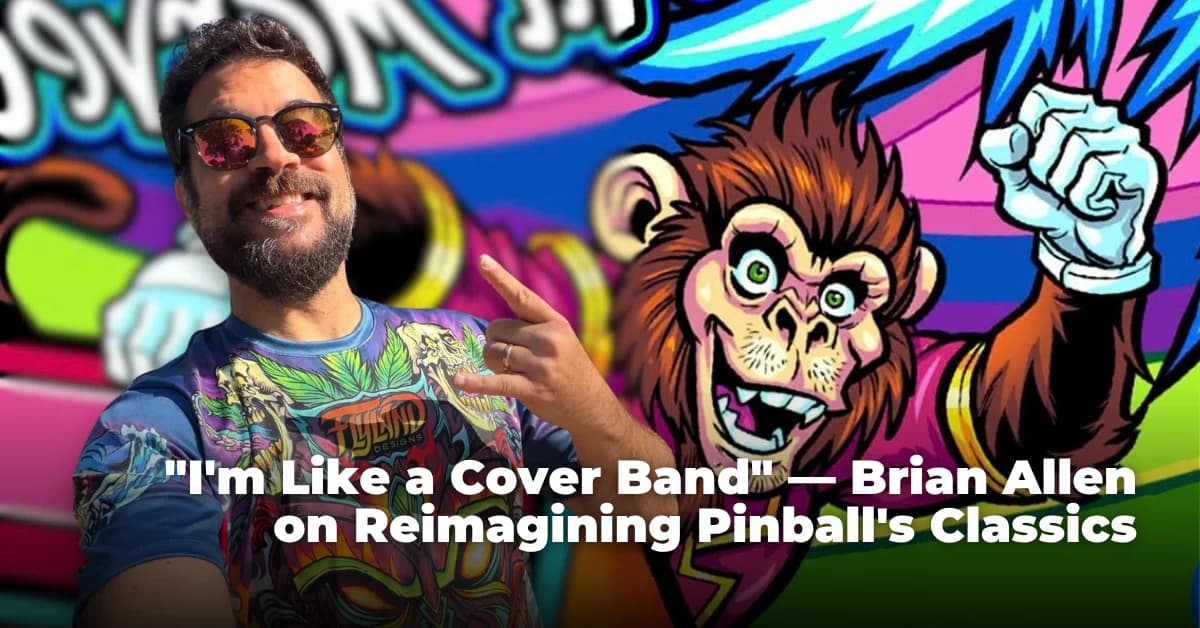
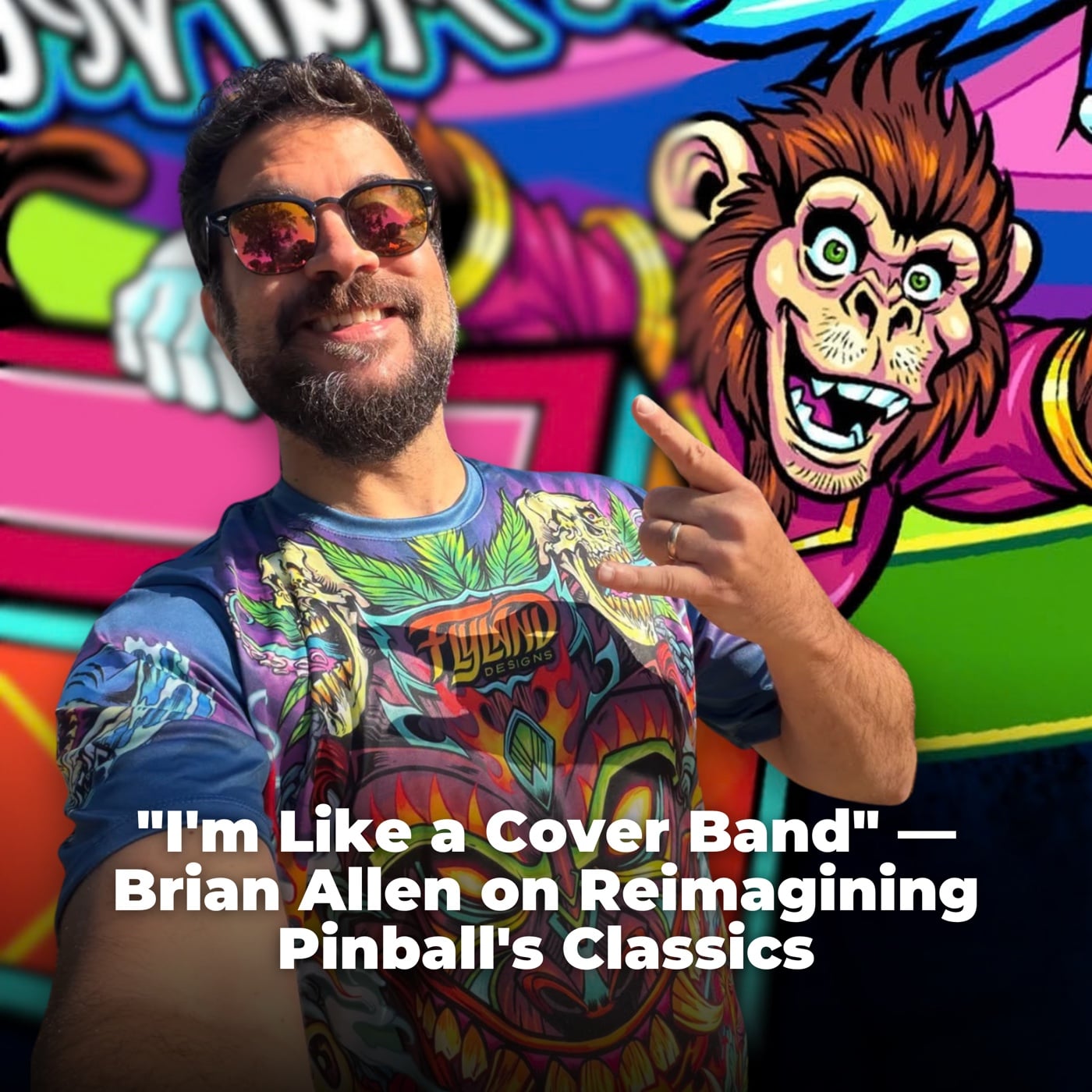
"I'd rather show you a piece and maybe you don't love it, but you still know it was mine." — Brian Allen
Brian Allen has established his own distinct style, that's for certain. Out of his design studio, Flyland Designs, he does the custom backglasses for the classics you can spot across a room, packed to the edges, beloved at conventions, bemoaned on Reddit. And after a damn lucrative year reimagining two Popadiuk games at the same time, I made sure to ask him what his actual work process is and what a remake owes the original. Then the whole thing gloriously derailed into his opinions on AI, where he did not hold back. Long story short, it was a fun chat.
Gritty was probably the biggest job he's had
() Paul Melio: It always surprises me how few people know that you designed the literal mascot for the Philadelphia Flyers, Gritty. How on earth did you get that job, and what was the initial design process like?
Brian Allen: It was probably the biggest project I've ever been involved with. I'm from State College, Pennsylvania, which is near Philadelphia, and the Flyers were working with another company at the time to design Gritty. But they weren't happy with what they were getting, because the company kept designing real safe and traditional, kind of cutesy mascots. And if you've ever been to Philadelphia, it is not cutesy, and it is not traditional either.
About two months before Gritty was released, they found, I think, a mascot I designed of a tiger playing basketball. It had my kind of signature attitude to it. It looked a little fierce and weird, and they thought that would be perfect for what they were looking for. So they just called me, or emailed me, out of the blue.
We didn't have a lot of time, so I had to sketch very quickly. I think I sketched maybe 25 completely different mascots. We were exploring everything: creatures, people, animals, whatever. I sent that to them, and then we fine-tuned it, iteration after iteration, until we eventually got to what Gritty looks like now. Then I drew what's called a turnaround, so it's Gritty from the front, side and rear. We sent that to the costume company, and they built it.
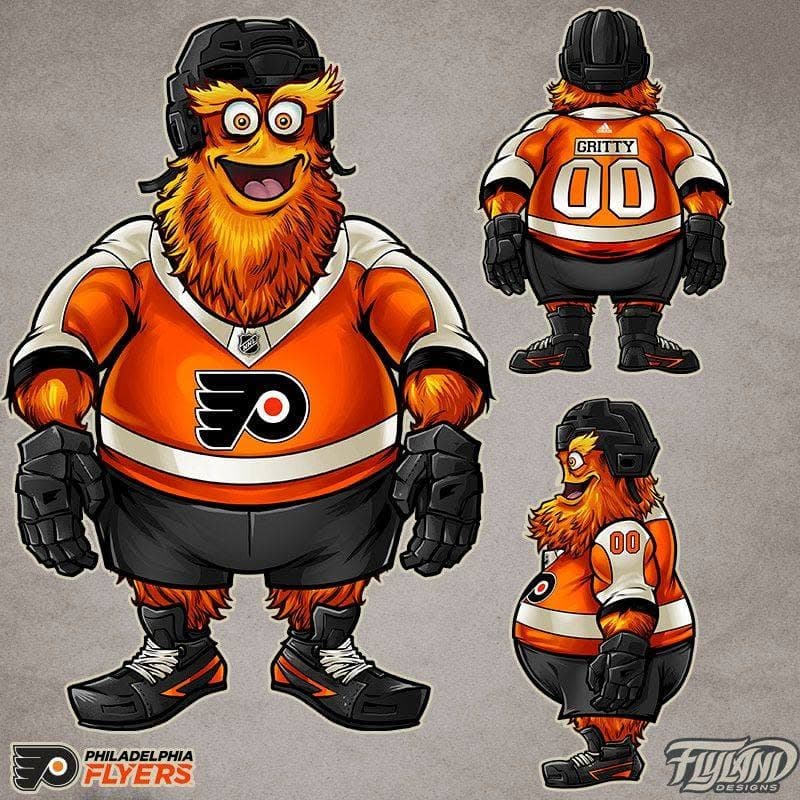
What was cool is that I was only seeing little pieces of Gritty as he was being built. They would text me a picture of his head on a table, which is freaky. I didn't see him all put together until the rest of the world saw him, when they released him.
And when they released him, it was very stressful, because most people don't remember this, but everybody hated Gritty at first. So they also hated me, because many Flyers fans did not even want a mascot. But in about five days, that all turned around. Philadelphia was sort of tired of everybody making fun of Gritty, so they rallied behind him, and now people forgot they hated Gritty. Everybody loves him now. So it's a great feather in my cap, and it's a great bar story, for sure. I'm very proud of that.
() Paul: I've got family in Philly. They're very defensive of Gritty.
Brian: You should ask them if they liked Gritty at first.
The release of Gritty was very funny, because the two photos that were taken of him were lit almost like you would light a horror movie character. I think that had a lot to do with how creepy and weird he looked. Luckily, the marketing team behind the Flyers, instead of retreating from it, really doubled down on it and kind of made Gritty's personality strange and fought back a little bit. That was the best decision, because now he's like an anti-mascot, which is what we were trying to do. A mascot nowadays is seen as such a corporate cash grab that if you come out with a traditional-looking mascot, it just looks very fake and false. So we were trying to make something where you look at it and you're not sure what it is. I think we achieved that.
Pinball is now about 20% of his business
() Paul: From there, you've covered a lot of types of work at Flyland, going back to your first job, drawing motorcycle graphics at XGX Racing. How has your process changed on the way to the kind of work you're doing today?
Brian: XGX Racing was my very first job out of college. I drew graphics to wrap on motorcycles, which is kind of cool, because I've sort of come full circle: wrapping pinball machines in cabinet vinyl is not much different than what I used to do then. I learned a lot at that job, because my boss was this fantastic artist who used to work on video games. I wasn't there long, maybe a year and a half, but I picked up a lot of techniques from him.
Then I worked for a book publisher for a long time, about seven years. On the side I was doing freelance work, and eventually I had enough freelance clients that I thought, I need to take a chance, quit this job and start my own business. That was in 2012. I quit with maybe 20 regular freelance clients under my belt and just went at it. I had enough savings that I thought I could do this for a year and a half or something, and if it doesn't work, then I'll just go try to find another job.
But luckily it worked out great, actually. That was about 14 years ago, which means I've been doing it longer than any other single job I've ever had.
I started off drawing traditionally, pencil and ink on paper, and then I would scan it in and color in Photoshop. But around that time, in 2012, they kind of perfected what I use, which is the Wacom Cintiq. It's a big monitor that you draw on, and it feels so much like the traditional drawing I was used to that I was finally able to convert over to 100% digital. That was very important, because with freelance work, whenever you're doing so many revisions, or setting something up for silk screening or for print, working digitally saves a ton of time. I've been doing that ever since. So that's one way it has changed.
Then over time, my clients just got bigger and bigger as my work improved and as I put more of it out there. The other thing that changed was that selling my own artwork eventually became a much bigger part of my business, to the point where now I believe it's over half of our income. That means I can be more selective with which clients I work with. I have a little more freedom. I can kind of do what I want. I'll say that with an asterisk, because it's still so much work to do what you want. But theoretically I can do what I want, and here we are.
I've just experienced this fun, gradual growth, and it's exciting, because every year I'm doing something a little different, working with different clients. I never know what I'm going to be working on. Eventually I started working on the pinball stuff, which is something I would never have predicted, and it's now a big part of our business, probably 20% of it, actually.
() Paul: Getting to that pinball stuff: when did you start playing, and do you remember the first pin that got you into it?
Brian: Yes, I do. This is going to sound weird. I was really young, maybe six or seven, and we used to go to Rehoboth Beach on vacation every year. There was a pizza place that had, I'm almost certain, Centaur, because I distinctly remember being too young to be allowed to look at sexy girls, but interested in looking at sexy girls. And here in the background of the pizza place was this crazy... yeah, it must have been Centaur, because that's the one with a heavy metal chick and dude who just so happen to have the bodies of motorcycles. It's fantastic art. I wrote down the name of the artist, because I have a terrible memory and I wanted to make sure I shouted him out: Paul Faris did the artwork for that.
Back then, my brother and I drew constantly. We were raised by artists. So I picked that out and just thought, I'm interested in this. This is incredible.
Then as I grew up, in high school, we would go to an arcade downtown called Playland all the time, after school and on the weekends. I think the machine I remember playing the most was probably The Addams Family. We sucked back then. I still suck, by the way. But we really sucked back then, because I was young enough that I didn't even really know there were rules to the game. You put the money in and you flip for a while and you lose. I didn't know you had to try to shoot for certain things. I just liked seeing the art, hearing the sounds, and spending my mom's money. So: Centaur and Addams Family, to answer your question.
() Paul: That's a great first pick. Paul Faris's work on Phantom of the Opera was one of the first I ever saw, and that's a stunningly beautiful game. Before we get to your work reimagining classic titles, you've done original work too, like Big Trouble in Little China for Kyle Smet at Barrels of Fun. Kyle's a friend of mine from homebrew, and incredibly talented. When you're handed a blank playfield, a whitewood, where do you begin?
Brian: Well, I just want to say I have done a lot of original stuff too. Unfortunately, a lot of it was canceled, and I'm under an NDA, so I can never share it. I always joke that I could probably fill an arcade with canceled projects.
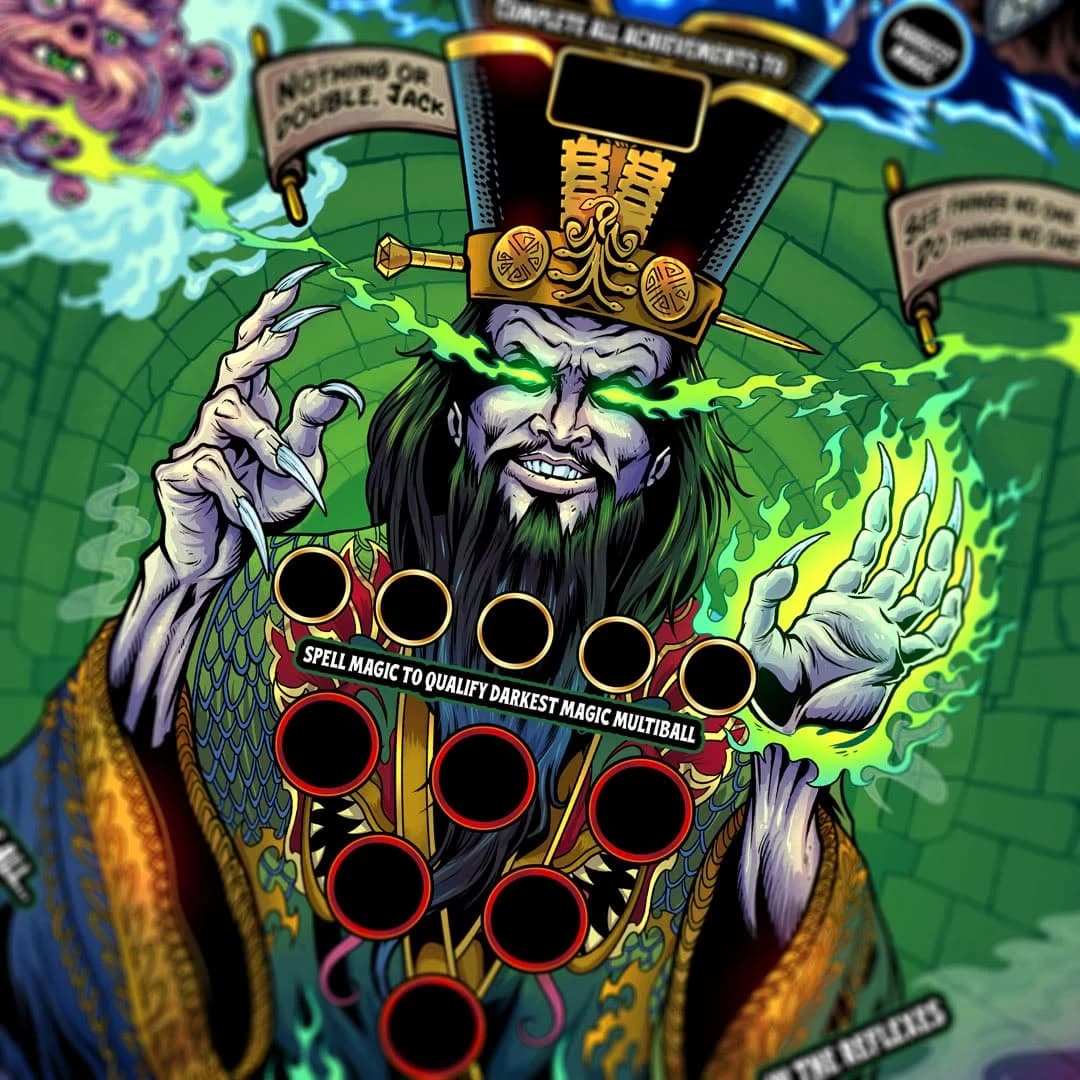
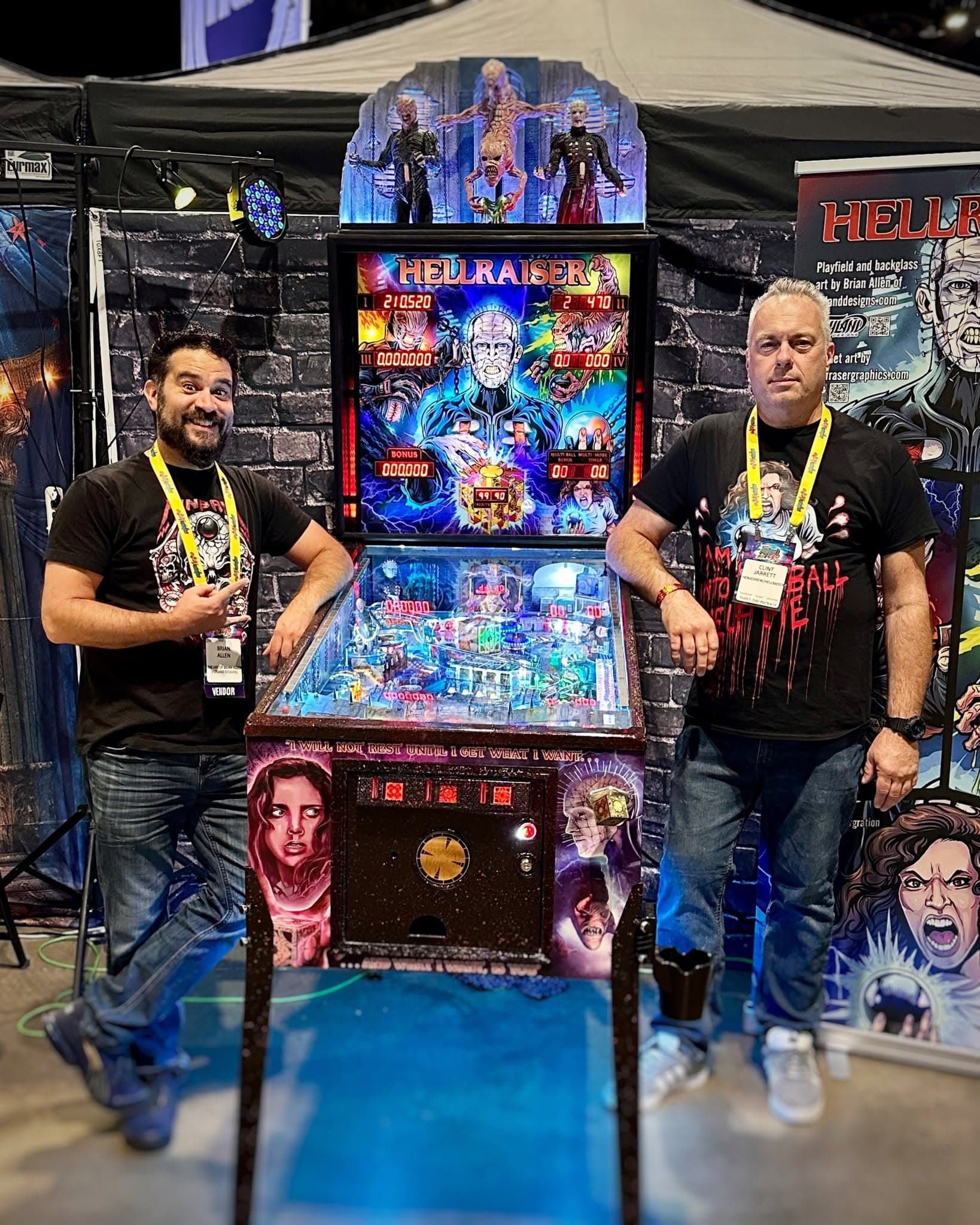
I wrote it down: I think I've done eight homebrews at this point. Breaking Bad was my first ever homebrew playfield. It's a little rough around the edges, but I still love it. I did one for Hellraiser, a Metroid one, a Predator. I did this really cool mad scientist theme that has not been released yet, for an engineering school.
This is strange, but I also did a playfield design that was in a TV commercial against gambling, of all things. The commercial showed the ball going around in a 3D rendering, and it depicted different stages of how gambling ruins your life. I drew that as little purple monsters and creatures attacking this woman. It's very bizarre, but it's very cool, because it was on TV for a while. That might have been the first pinball thing I ever did, possibly.
And it all started with the Alien Queen I drew for the Alien pinball machine by Heighway Pinball. That's what brought me into this whole thing in the first place. Unfortunately, that was never released, because they went bankrupt right as I finished. I had nothing to do with that, though.
But to answer your question (sorry, I ramble a bit): when I'm handed a whitewood, sometimes the clients will give me specific direction, but most of the time they don't. I like to figure out with them which characters we definitely want to focus on, which characters are okay to get on there if we have room, and which things we don't need to include. If we're talking about an IP that already exists, there's usually a lot of work that has to be done just to take the template and get it ready for me to start drawing on. Often what I'm handed is a CAD drawing, and the CAD drawings don't have closed paths. They're just a mess of layers, and I need to go in and isolate the things I actually need and get rid of all the stuff I don't need to know about. So that's a lot of work.
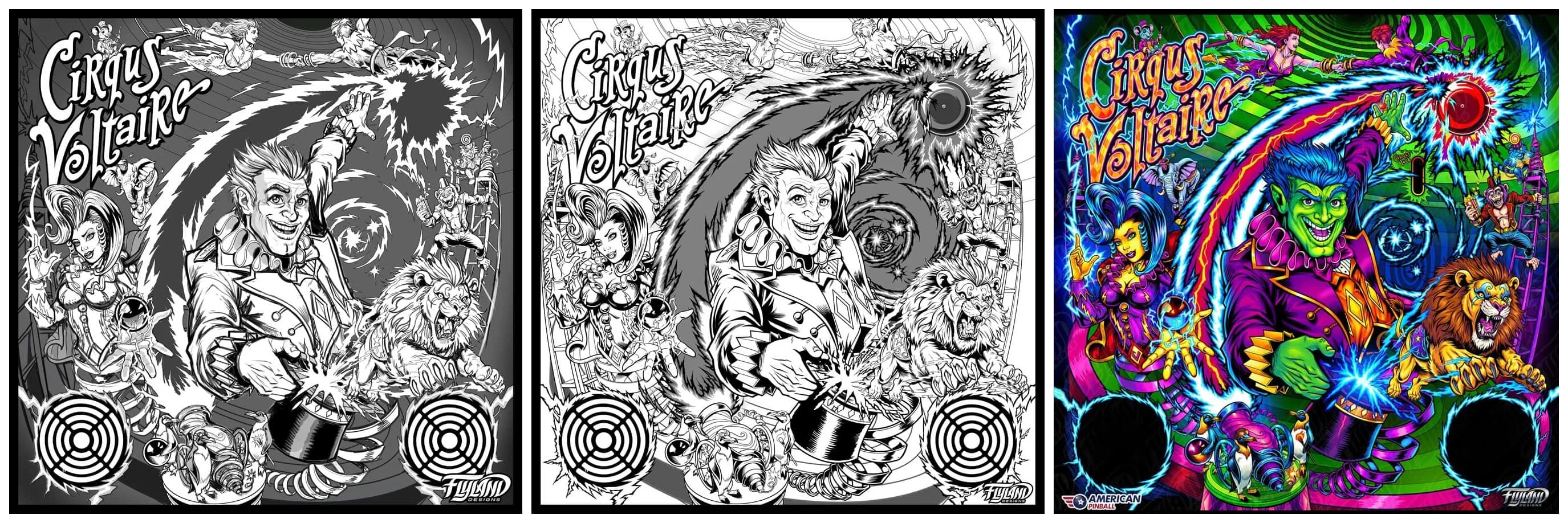
Then I start drawing rough sketches, then a pencil drawing, an ink drawing, and color. At each of those stages I talk with the client, and we adjust things and move things around. That's generally how I work.
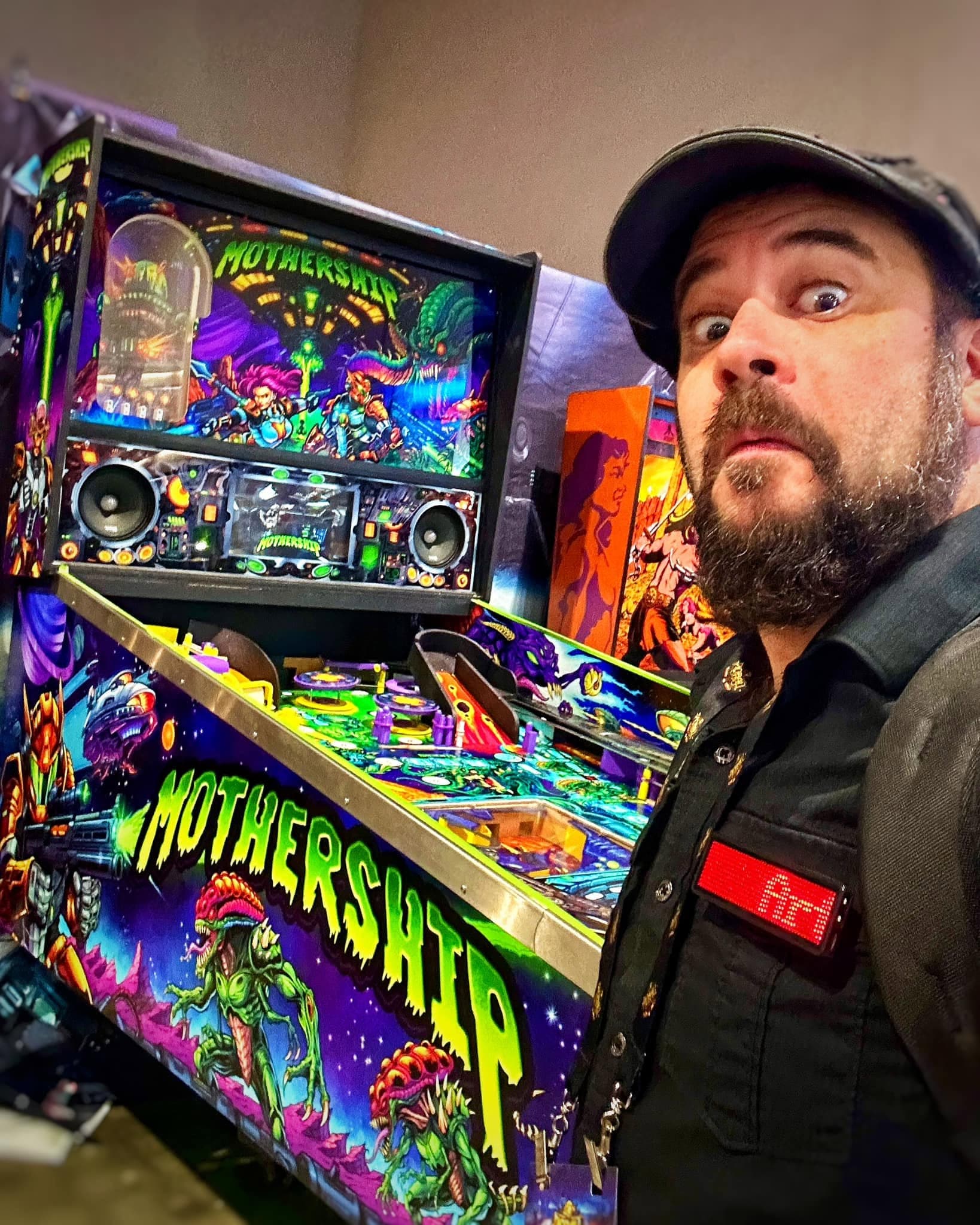
There are a few [exceptions], like Mothership for Rob Berk. That's this giant pinball machine that we made. It's bigger than Hercules, even. On that one I had the most freedom, probably, of any machine I've worked on, because every single character needed to be created from the ground up. The story had to be created. It's an alien space, kind of generic theme of soldiers fighting these monster creature aliens, and I really enjoyed that one.
About working with a whitewood: sometimes, especially when dealing with homebrews, we don't even really have a template, because some of these games are very old and there's no template out there. I've done things before where they will just send me a photo of their whitewood and some measurements, and I'll have to warp that in Photoshop and make a template from it. It's a little risky, but so far it's really worked out fine. It's definitely much more complicated than designing a T-shirt, or even a backglass, which are far simpler.
Every stroke is drawn by hand, on a Wacom Cintiq
() Paul: What does your day-to-day process look like right now: the software you're using, the tools, and how a piece actually comes together?
Brian: For decades now, I've been using a lesser-known program called Clip Studio Paint. It's like Photoshop, but it was designed for manga and comic book artists. I noticed that a lot of artists working for Marvel and DC used it. I think Zombie Yeti uses it, but I could be wrong about that. I just fell in love with it because it matched the way that I draw on paper so well. And as I mentioned earlier, I use what's called a Wacom Cintiq, which is basically a giant monitor that you draw on with a pen.
A lot of people will ask me, do you draw your artwork by hand? I say yes. I know that's not what they're asking, but I literally do move my hand for every single stroke. There are some programs out there, like Adobe Illustrator or Procreate, that kind of smooth your lines. Clip Studio Paint is not doing that with my lines. So I am using the same process I use as if I was drawing on paper. You just have the advantages of being able to undo, of course, and to draw symmetrically, which is a very handy tool.
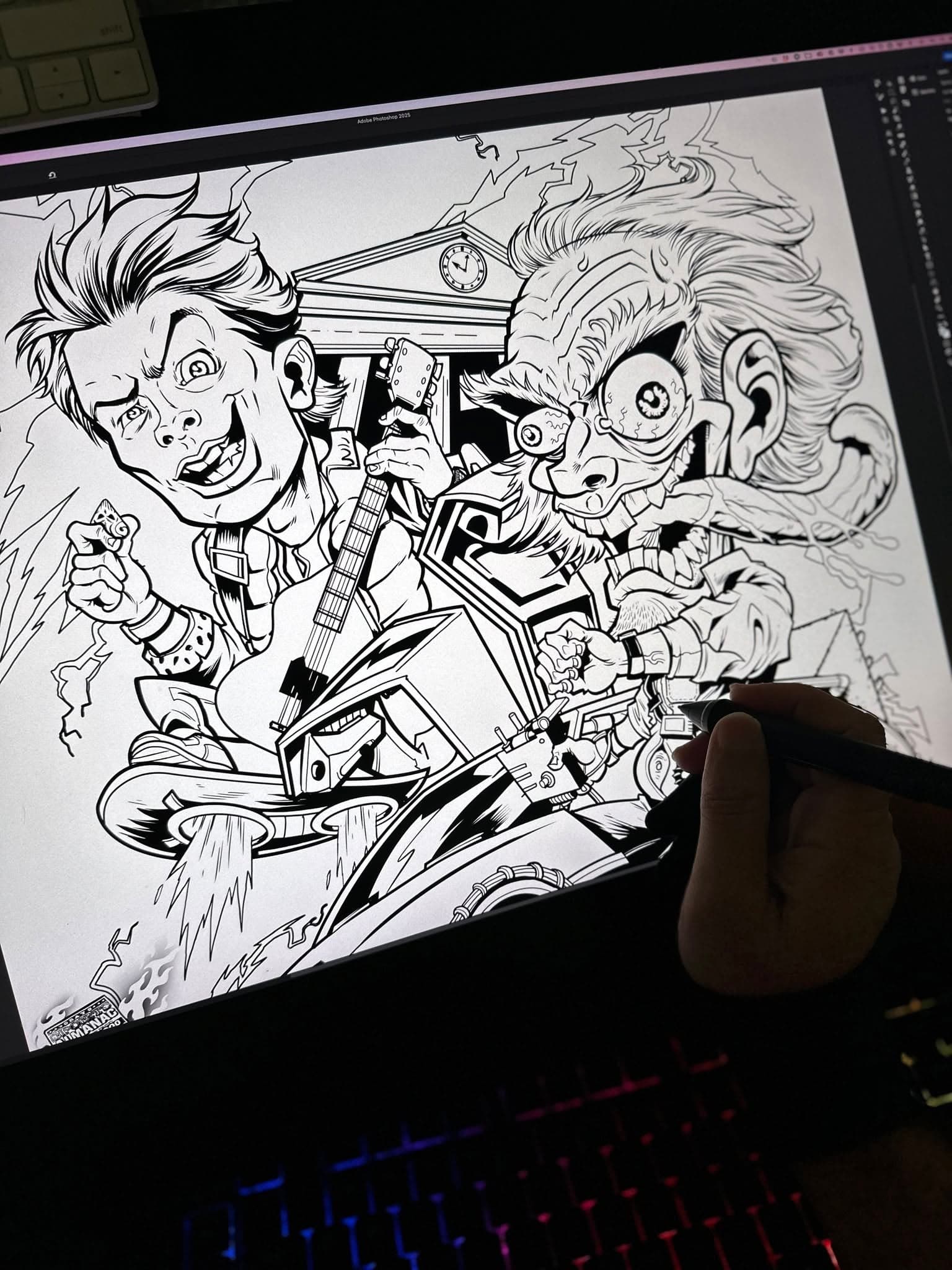
The biggest benefit of working digitally is that when you're doing something like a playfield, there are so many layers to this thing. It's easily over a thousand layers, because you have so many little pieces. You have the plastics that need to go in a certain place, but you need to know what they look like and what they're overlapping, so that you don't draw something on the playfield that is later covered up. So working digitally is such an advantage. It's amazing to me that the guys 30 years ago who did this incredible silkscreen playfield artwork were able to do that with just paper templates and stuff like that. I imagine they must have used some kind of acetate templates or something, but it's just incredible to me that they were able to accomplish that.
Day to day, I work from home. My wife, Lesha, works with me, and her main job is to ship all of our products. We have a friend named Bree who comes in once a week to help ship products. She will do the marketing and other types of things. But mainly I'm here at my desk, all hours of the day, unless I'm traveling to a convention, which I've been doing more and more of lately. That's my exciting life.
() Paul: Do you have a favorite convention, one you're just excited to get to go to?
Brian: I'm going to cheat and say two. Pinball Expo in Chicago, that's coming up next month. That's our biggest show, and I love it for so many reasons. And then I love Pinfest in Allentown, just because that's in my backyard, so it's very convenient. We're also very successful there.
If you're talking about non-pinball conventions, my favorite is a huge music festival called Sonic Temple in Columbus, Ohio. They usually have Metallica, Megadeth, Tool, huge bands, and I've been lucky enough to be invited as a vendor there. We have a huge tent for about six artists, and for five days straight I'll just be selling my artwork. But whenever I want, I can put up an "I'll be right back" sign and go check out Metallica, or GWAR. I got to see GWAR backstage, which was incredible. So if you're talking non-pinball, that's my favorite. It's hard to compete with seeing GWAR change into their outfits backstage.
Paul: My little sister is a huge GWAR fan.
Brian: Is that right? It's funny, because they're all [old] men now, like me, but older. I don't know how old they are. They're probably close to 60. So you just see these wrinkled old men changing into these giant alien monster costumes, with goth girls handing them their equipment. It was a sight to see, for sure.
Licensed games come with a second art director
() Paul: What does a typical creative brief look like when you're working with the bigger pinball studios? How much is already decided beforehand?
Brian: It can be extremely different. Some companies I've worked with have had very specific art direction. The templates are ready to go and all laid out. And then there have been others where they're not provided, and I have to create much of that, and there's not a lot of direction. I've learned to work in both situations, because many clients come to me without any ideas, and some have very specific ideas. So you just have to adjust your expectations.
I generally prefer to work with more open-ended direction, but that also has some downsides, because it means I might pitch something that I love, but it's just so out there in their mind that it's going to get rejected. But I do think that often leads to pleasant surprises, and maybe a better final result.
I have not worked with a pinball company yet that had overly restrictive direction, because I think when people come to me, they're coming to me because they also want my input. If they didn't, they could probably hire just about anybody to do this, if it was already laid out like a cookie cutter.
When you're working with an IP, though... I am working on something very big. It does involve a big IP in pinball. I can't really say anything about it, but when you do something like that, it is much more challenging, because now you have two art directors. You have the pinball company, and then you have the guy at the IP sitting in an office who doesn't know you, and his whole job is to make sure that the IP looks exactly the same in every iteration, so that they can sell the action figure, the T-shirt, the flamethrower. So that's challenging, because I want to try to add my own spin and style on it, but you have to go up against a guy who's a gatekeeper. His whole job is to make sure that everything is consistent.
I don't have any inside knowledge on this, but I think you've seen a lot of pinball machines that have come out recently where, instead of artwork, it's more like copied-and-pasted assets. And it's clear why that happened. It's because the IP [holder] in charge doesn't really want an art piece. They want a billboard for their product, which, you know, I totally understand their point of view. But there's no room for me in that equation.
He treats a remake like a cover song
() Paul: Your style is very dynamic, and you've had a very good year with two major games: Pedretti Gaming's reimagining of Tales of the Arabian Nights, one of my favorite games of all time and originally Pat McMahon's art, and then American Pinball's Cirqus Voltaire, your second John Popadiuk game this year. As an artist, how do you balance putting your own spin on things versus honoring what's already there?
Brian: It's actually similar to the process with Gritty. When I made Gritty for the Philadelphia Flyers, you go into it knowing that maybe 30% of the fans don't want a mascot. They made that clear. So whenever I'm remaking something where a fantastic artist already made an incredible piece of artwork, you're already set up to fail a little bit, because there's already 30% of the people who don't want it. They say, why mess with it?
My point of view is that just because I'm making an alternate version, I'm not commenting and saying that I think the original was bad. It's making an alternate choice. I'm like a cover band. I'm covering a song, but I'm trying to put my own spin on it. There are a lot of bad covers out there that just play the song exactly the same. The good covers are the ones where the band puts their voice into it, and that's what I'm trying to do.
I also want to say, I would love to work on stuff that is not a remake, and I am doing that right now. I alluded to it earlier. But [remakes are] what I keep getting hired for, and I do understand that I set myself up for that, because I made a deal with Planetary Pinball [Supply] to make all of these alternate backglasses. So I understand that's my lane. I did work on a lot of other things that were not remakes, but again, they were all canceled, unfortunately. I do hope that eventually someone gives me a shot at something that is not a remake, because I would much prefer that.
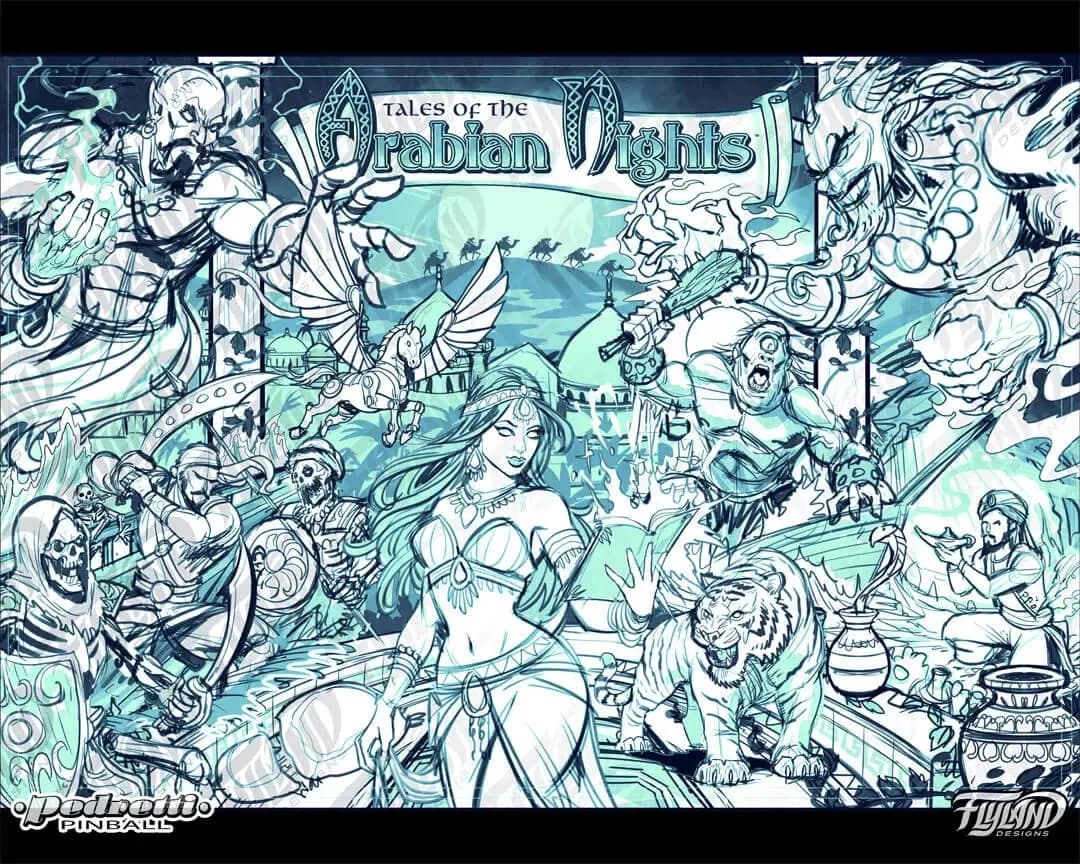
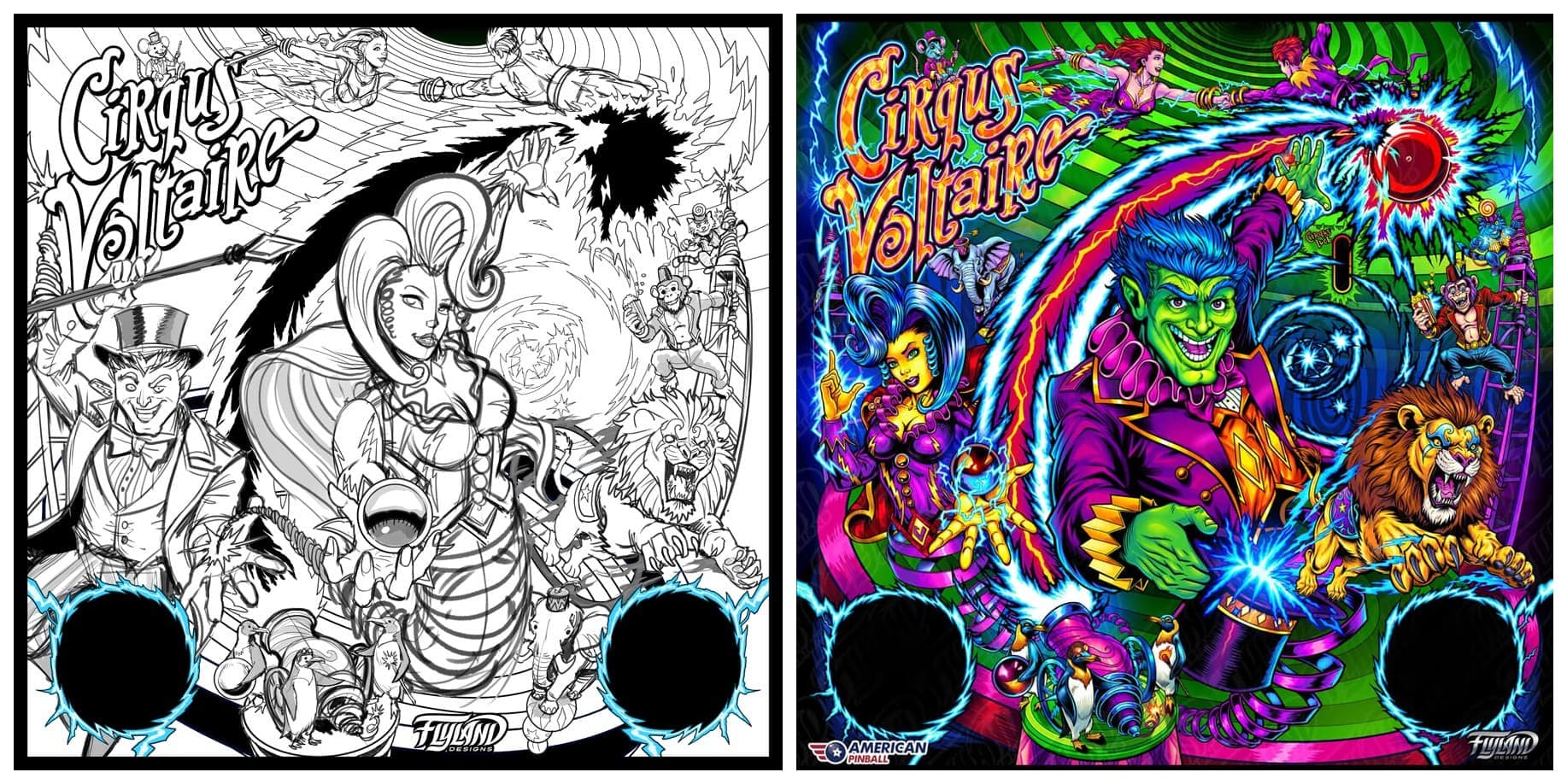
To expand on your question: if you look at Cirqus Voltaire and you look at Tales of the Arabian Nights, the TOTAN backglass was completely different than the original, and the Cirqus Voltaire one was much more similar to the original. That was mostly because it has that odd shape, where the pinball goes up through the backglass. So right away you're very limited as to what you can do, because you've got to put a cannon down there, and you've got to put the characters divided here and there.
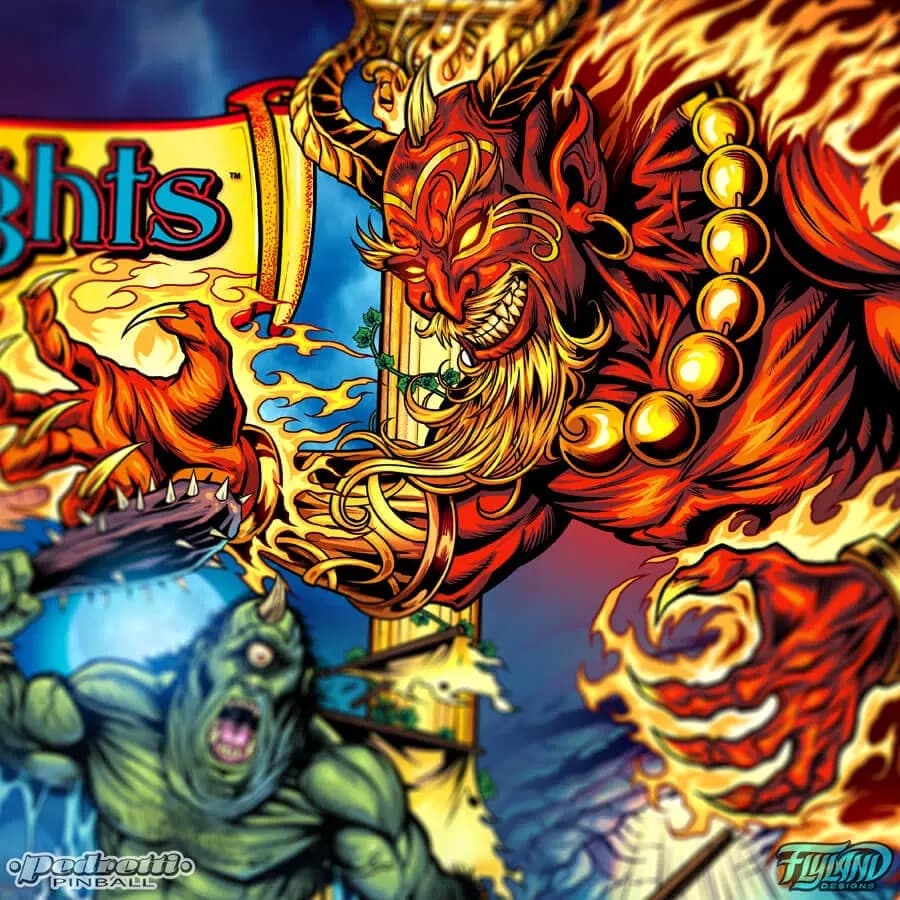
With TOTAN, I wanted to do something that was 100% completely different, because they're releasing the original game too. So if you don't like my artwork package, the original is available to you. I didn't really see the point in redrawing the exact same thing, but cleaning it up, modernizing it. That's the approach I took there.
Cirqus Voltaire was a different situation, because on that project (and we'll get into it) I had a lot more specific direction, so I didn't have as much freedom there. They definitely wanted the Ringmaster in the middle of the backglass. I keep saying ringleader; it's a very different guy. That wasn't my call. So that goes back to what we were talking about earlier: there are two different types of situations. Sometimes I have freedom, sometimes I don't, and you just have to adjust your working style to make the client happy.
() Paul: On Cirqus Voltaire, Melvin Williams did the sculpts while you did the art. How did that work between the two of you? Was there a fair amount of back and forth, or were you in your own distinct lanes as artists?
Brian: I don't think I mentioned this, and I don't even know if I'm supposed to say this, but what was crazy is I was working on TOTAN and Cirqus Voltaire at the exact same time. It was an insane few months. That just happened by chance, because I had been talking to both of those companies for a long time, and then it just so happened they were both ready to go at the exact same moment. So that was very stressful.
Melvin came on to the company when I was maybe halfway done with the game. That was difficult, because the direction changed a little bit when he came on, which I understand. He's the art director. So yes, I did talk with Melvin a lot. We were on chat going back and forth. He's very particular about color choices and very particular about certain details looking exactly the same and consistent. I was literally drawing, screenshotting, sending, drawing, screenshotting, back and forth, which is completely different than working with Pedretti on TOTAN. On TOTAN we had less time, so there really wasn't a lot of time for revisions or direction from them, and they understood that. I'm proud of both results. They were two very different processes, but the results are both something that I'm proud to put my name on.
But to answer your question: no, Melvin did much more than just the sculpts. He was directing the way he wanted me to draw certain things. The direction from the beginning with Cirqus Voltaire, especially with the playfield, was that they wanted it to look almost entirely the same as the original. I was not to add too many new characters or move things around. So I was really just modernizing the characters and adding more color to things, because back then they were limited in their tools. They had to use silkscreen, they had to use limited colors, and the resolution on the line art got muddy and things like that. So there was a lot of work there, even though I wasn't changing much about the layout. TOTAN was totally different, because we wanted to add a lot of new scenes and a lot of new characters, and that's what we did.
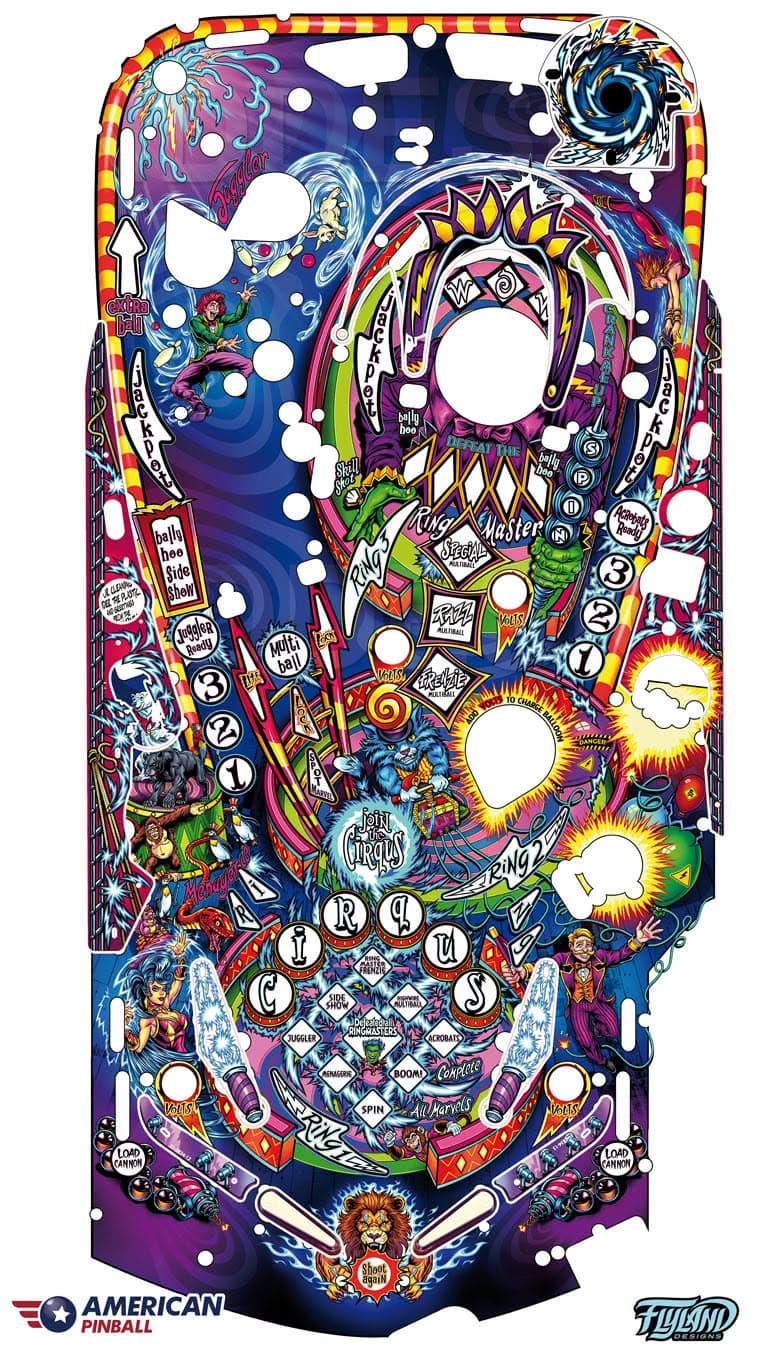
So yes, Melvin was very involved with the art direction. And again, I was already done with the cabinet by the time he came in, so we had to go back and make some revisions to that as well. But that happens sometimes. I've worked on really big projects with large brands, and then all of a sudden the art director you're working with will quit and go work for another company, or he'll be poached or something. Now all of a sudden you're working with a completely different art director who doesn't know you, maybe doesn't like you, and it's just something you've got to roll with.
() Paul: That's so interesting, how different those two processes sound, just in the amount of freedom you had. With TOTAN, you were handed a substantial amount of existing characters people have seen, the genie and all these set pieces, and they're all inherently fighting for space on the translite. How do you decide which characters to emphasize and which to alter?
Brian: Well, my critics would say that I don't put any thought into it and I just throw them all on there anyway, which is probably half true. I love throwing so many things and so much action into a scene that every time you look at it, you spot something different, because these are things that are going to be in your home for years. You're looking right at it while you're playing the game. So I want there to be little hidden things. I want there to be a lot of things happening.
That can be very challenging when I'm drawing. If I showed you my file, I usually keep each character or little scene in its own layer group. That is helpful if I need to resize a portion of it or move something around, or if the art director says, no, no, no, we're not going to use that anymore, I can delete it, and it doesn't affect the artwork underneath it. It can be very challenging, because when I ink it, when I color it, I'm constantly fighting: is this too noisy, or is there not enough going on, and it's going to be clean and boring?
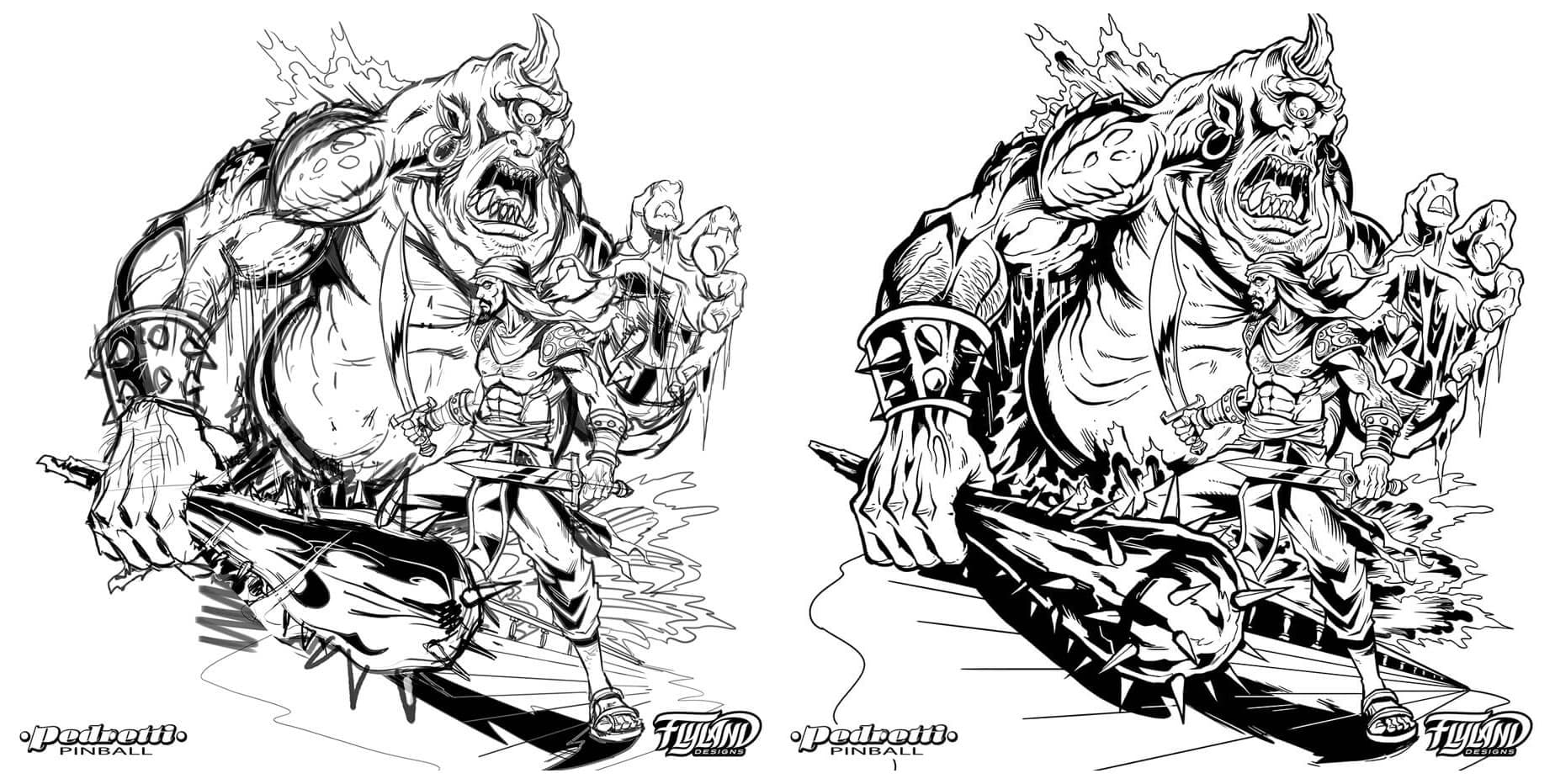
Because that's just the stuff that I love. I grew up reading MAD Magazine, and those artists were probably some of the best draftsmen that ever lived. They would draw a parody of a movie, and it would just be filled with characters and action. That's just how I learned, and it's what interests me. I'd probably get bored doing it any other way, really.
So to answer your question, it is tricky to balance all of the characters. But we usually have a discussion at the beginning on tiers. A tier is: these are the things that must be on the backglass and must be a focus. B tier is: let's see where we can fit them. C tier is: we don't need this. That's usually the approach I take to most things.
He thinks AI art is cheating
() Paul: Both TOTAN and Cirqus Voltaire came out completely hand-drawn, with no AI tools, which I know is important to you. With how fast AI is moving, is holding that line getting any harder, or does it not even factor into how you think about your own work?
Brian: How much time have you got? It affects me constantly. Not to be snobby here, but emotionally it affects me, just the existence of it. Because I and other artists used to think we were special, you know, maybe a little egotistically. And we're not anymore.
I have to face it every day. Every time I log into Facebook, every time I'm on Reddit, on the internet, anytime I'm driving down the street and see a billboard, AI is everywhere. When I go to a convention now... I used to see people walking around with really cool T-shirts. And that's my icebreaker, by the way. Not to reveal the curtain, but when you come up to me and I say, hey, I love your T-shirt, that's because I can't think of anything else to say, because I'm awkward. But everybody is wearing an AI T-shirt now, and they probably don't know it. That's the thing. People will come up to me and tell me how much they hate AI, and then I'll point out that they're wearing an AI T-shirt, and they had no idea.
So it's changed my business in three ways.
One, I used to do a lot of work that I would classify as simpler work, where somebody would need a logo for their business, or they'd need me to draw a cool skull for a T-shirt brand they were making. I used to love these jobs, because I didn't have to think about them too much, and I could get them done fast enough that I made a good amount of money doing them. But most of those jobs are gone now, because those businesses can just type into a computer, "draw a cool skull for my automotive business," and there you go. It's done.
The second way it's affecting me is that I now have to compete with other artists who are using AI. Some of them have admitted to it, which is crazy. But most do not admit to it, which I think is extremely dishonest. I think they're lying to you, because anytime an artist posts something, there's sort of an expectation that they drew it, that they created it.
So if you're using AI in your work, let's skip the nonsense about it being a tool, okay? Because a tool, you need to have human hands to use. When you type into a machine what you want and it gives you something, you didn't create anything. You ordered a pizza. You picked up the phone and said, I want a pepperoni pizza. You didn't make that pizza. Somebody else made it for you. So I've lost jobs, and now I have to compete with guys that are using it.
And the third way it's affected me is that now, sometimes when I release work, people who are not familiar with how long I've been around or with my portfolio will accuse me of using AI, because I have a very clean and colorful style, which is something that is a signature of AI. So now I have to spend more time making drawing videos, which literally show me drawing the piece from start to finish. But that takes time, and not everybody even sees those videos, because you post a video and the algorithms kind of hide it. And I've been in situations where I've posted a video showing that I literally drew the thing, and then I'll get accused of using AI to make the video. At that point, it's literally impossible to win.
I don't know what is going to happen in the future. I feel really bad for the next generation of artists, because I look at the path that I took, and I see that that path is gone. For the first ten years of my career, maybe more, I was working with small businesses, people who didn't have enough money to hire a seasoned professional but still needed something good-looking. So I learned by doing these smaller jobs, and that business benefited by basically getting a decent-quality product at a lower cost. That's how it always has been. That's how you grow your business. But now that whole bottom rung has disappeared, because all of those types of clients can just type what they want, and they get it.
Which is stupid, by the way, if you're listening, because you can't copyright an AI-generated logo. So if you're using AI-generated images as your logo... And if you want to do something fun, just go start selling T-shirts of their logo. I don't think they can stop you. I'd better put an asterisk on that. You'd better check with a lawyer.
The other thing that I can never understand about AI defenders, and I want to say, I think most AI defenders out there are kind of partly trolling. They're doing it because it's fun. But what I don't understand about people who support AI images is that we hate Milli Vanilli for lip-syncing, right? They told us that they were singing live, and it turned out they were just lip-syncing, and we don't accept that as a society. We think that's fake, and it immediately devalues them, because they are not the ones creating the art that they say they are creating. Or sports: we do not tolerate cheating in sports. We don't want athletes using steroids. We don't want athletes intentionally fouling people and stuff like that, or deflating footballs. So why are these people supporting what I think is cheating in the art world? It is cheating, because you are using something that you did not create and letting people believe that you created it.
Sometimes they will defend it by saying that they know what prompts to use and they know how to do it just right. But that's all a lie. You can create some very convincing things just with plain language. This is not something that takes a skill to learn. It's not like programming.
That's all I want to say about that: if you're listening to this and you do support human art and you want to continue supporting it, it means, unfortunately, that you're going to have to be more vigilant with what you spend your money on. I would suggest purchasing things directly from artists, or purchasing things from companies that clearly name the artists they worked with. Then you can do a tiny bit of research to see if that artist really is creating this artwork or not.
I won't name this company, but I just saw a pinball T-shirt company, I think in California or something. They've been posting all these Facebook ads, and every single design in their catalog is AI-generated, and I've seen other people share it and talk about how cool they are. And it's very frustrating, because I will draw pinball apparel, and it will take me a couple of days to draw it. And I'm proud of what I've done. I think it's different, and I think it's a valuable contribution. But then these companies pop up, and they are able to fool so many people. And when I say fool, that is exactly what they're doing, because if they didn't think that they were doing something shady by using AI art, it would say that on their website. It would say this was created with AI, with ChatGPT or whatever. They're afraid of doing that, because the consumer at this point, I think, generally still rejects it. So it's very sneaky, and if you're a supporter of human-generated content, you probably need to be more vigilant. It's a shame. But here we are.
() Paul: Well, I now know exactly what you think about AI.
Brian: I do not pull my punches on AI. Honestly, I'm very lucky in that I'm close enough to retirement, and we've been very successful with this. So if I was pushed out of this, I will be just fine. But I feel really bad for the next generation of artists, and I don't know what it's going to look like in two years. But you could say that about nearly any job. So we'll see.
The "Ludicrous Speed" lever was a joke
() Paul: On a much lighter note: there's a monkey on the Cirqus Voltaire playfield at a lever set to "Ludicrous Speed," and my editor, Colin, wondered in TWIP if it was a tease for a Spaceballs pin. It's very on brand for you to hide Easter eggs in your work, like the Creature from the Black Lagoon in your White Water translite. When did that start?
Brian: I think I've been doing that as long as I can remember, because I'm a very pop culture guy. I grew up in the '80s and '90s, and back then everything was about selling the action figure before the show, or creating a show after the action figure was made to sell it, like ThunderCats or something like that. So I have all of these nonsense facts in my brain, and I like hiding things in there.
I don't plan on doing it. With Cirqus Voltaire, I was just drawing that monkey. I think it was a monkey operating a switch, and the switch had text on it, and as I was drawing, I just thought, hey, that would be funny, and I put it in there. Funny is the key word. I like to make myself laugh. I'm usually the only guy I can make laugh. But I like to hide funny things in there in the hopes that somebody sees it later on and has the same reaction.
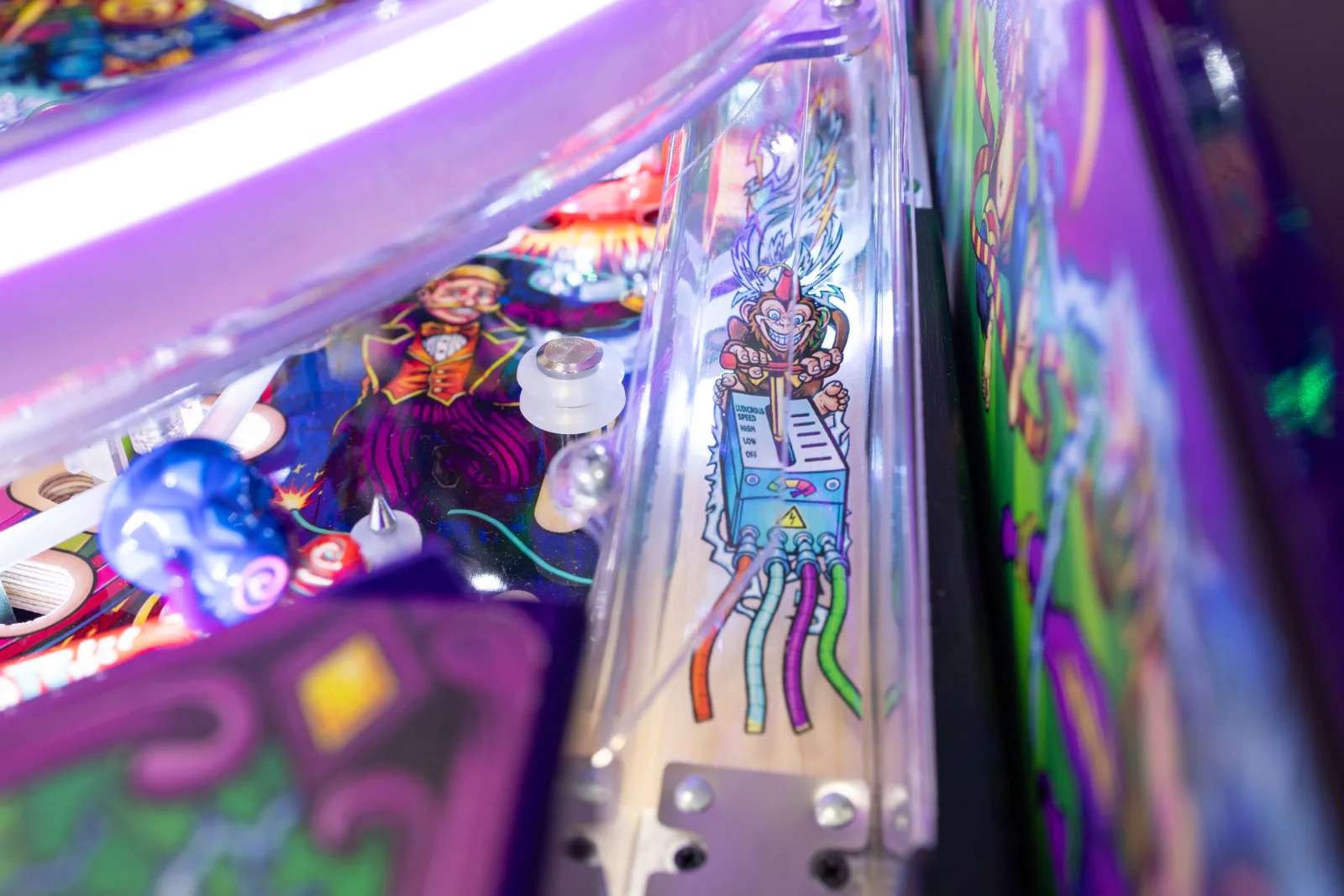
It's just a way to keep myself entertained, because sometimes when you're drawing, this stuff takes hours and hours and hours, so it can become a little monotonous. Parts of Cirqus Voltaire did become that way, because much of it, the plastics especially, is just things like lightning bolts, and I have a lot more fun drawing characters than I do objects and environmental stuff. So the simple answer is, I just do it to keep myself entertained, and hope that other people have the same reaction.
His favorite pinball art is Zombie Yeti's Iron Maiden
() Paul: Going back to Centaur and everything: which pin that you didn't work on would you consider your favorite art of all time? The top of the mountain.
Brian: It's no secret that Zombie Yeti is my favorite artist. Jeremy Packer. On Reddit, I've been called the Temu version of Zombie Yeti, so I will take that as a compliment. They hate me over there on Reddit.
But I think Iron Maiden is his strongest work. Or maybe I love it so much just because I'm a huge Iron Maiden fan. I just love the way that he tackled all the Eddies, and it just flows together so nicely. What I've admired about his work for so long is that he's able to get his voice and his style in there. It's almost like he's found a way to sneak it past the IP guys, or maybe he's just been able to work on projects that fit his style so well.
I think that whole machine is just beautiful. I love his artwork. I gravitate toward line-art-driven artwork, where people are inking like a comic book and then coloring underneath, which is the technique that he uses and the technique that I use. So that's probably my favorite at this point. Godzilla's also great, but I just love Iron Maiden so much.
() Paul: You brought up a point I'd honestly never considered. Take Venom: a lot of personality, very vibrant. Everything he does has to go past the licensors, the IP holders, and somehow it still reads as a Zombie Yeti game. Getting something that looks unique past the people who have to approve it is Herculean in itself.
Brian: If you look at my work, sometimes... I drew fan art of Back to the Future, and I drew Doc and Marty as caricatures, so they looked almost like a Rat Fink style: exaggerated, tongues hanging out, eyeballs popping and stuff like that. Some of the reaction was, well, that doesn't look exactly like them. To me, that's boring. I don't really see the point of just drawing a portrait that looks exactly like the character. It kind of reminds me of the stuff they used to sell at the mall. Do you remember? You'd go in the mall, and there would be some guy at a kiosk selling all these framed drawings of Michael Jackson or whatever.
That's why I appreciate his artwork so much. He's doing the IP justice, so you know what it is, but he's still maintaining his style. That's what I always want to do. I don't always succeed, but that's what I try to do. I'd rather show you a piece and maybe you don't love it, but you still know it was mine. I would rather that than create something that you love, but you have no idea who did it, or it doesn't look consistent with the rest of my work. That's been my philosophy, and it's worked out so far.
() Paul: And as a result, your stuff is recognizable. I can look at a piece and say, that's a Brian Allen, the same way I can say, that's a Zombie Yeti. One last one I absolutely have to ask. Remake or original IP, what would be your dream pin to work on, one where you'd have total control?
Brian: Man, I would have loved to do Sonic. I'm a huge video game guy. That one is a clear case where they had to use the current IP, because those are mostly 3D models. But man, it would have been fun to draw those characters. I would have loved to have done that.
Non-IP, I've been saying this for a long time: I'm a big fan of tiki artwork, beach and surf themes. I've been doing that for a lot of clients for years. I would love to do a tiki-themed pinball machine, because I think that would do really well with people who have their own tiki bars in their house. Some people spend way too much money on making a tiki bar in their house, and there are lots of tiki bars out there. I just think that would be so cool. And you could even do some fun things with that, like integrating actual 3D-modeled bamboo around it and stuff.
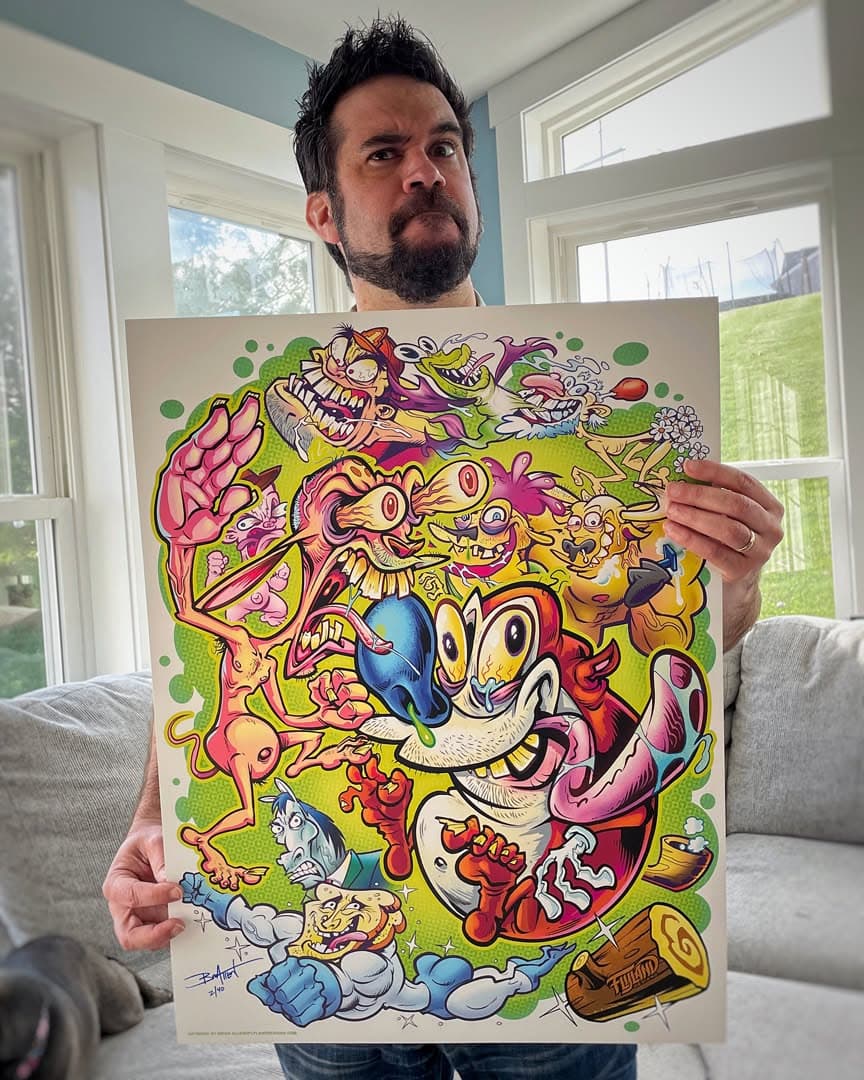
And I'm trying to think of another IP that I love. I gravitate toward cartoons. I love horror movies, but I'm not necessarily the guy for that, because I don't generally draw realistic people and stuff. I'm more of a comic book and cartoon guy. I would love to do Ren & Stimpy, because that's when I grew up. Probably the biggest influence on my work was Ren & Stimpy cartoons. Let's just leave it at that: tiki, or Ren & Stimpy.
() Paul: Now that you say it, I can absolutely see the Ren & Stimpy influence.
Brian: Just a shoutout to Ren & Stimpy. The animation in that show is just top tier. I think we've gone a little backwards in animation since then. It's just incredible, if you really look into it.
() Paul: Thanks so much for swinging by. Is there anything else you want to add before we go?
Brian: If you're in the Syracuse, New York, area, I'm going to RetroGameCon up there [October 2–4], I believe, in about a week. And of course I'll be at Pinball Expo in October [14–17], and I'm going to have a new alternate backglass there to reveal that I'm really proud of. So I hope you come out and swing by our booth, because I always try to have all kinds of new stuff. I appreciate your support. Thank you.
This interview was conducted over video and has been edited for clarity. The full conversation is in the audio above.
Photos and artwork courtesy of Flyland Designs.