90/100
Fun Score · from 2 ratings
2
Ratings
56
On Location
Game Info
Design Team
How to Play
Where to Play
Documentation
ROM Files
Takes
No takes yet. Write the first take
Community Photos
Flyers & Promo Media
Featured Videos
Flash video
No takes yet. Write the first take
Flash video
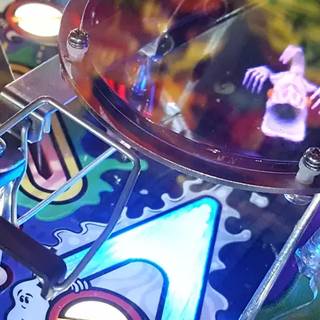
"Flash," designed by Steve Ritchie and released by Williams in January 1979, is a landmark pinball machine known for several pioneering features. It was the first pinball game to introduce background sound and flash lamps, which significantly enhanced the visual and auditory experience of the game. With a production run of 19,505 units, it became Williams' most successful pinball machine and one of the most successful pinball game of all time.
The same machine, made under a different name by a different manufacturer: licensed copies, conversion kits, and re-releases.
| Name | Manufacturer | Year |
|---|---|---|
| Storm | Sonic | 1979 |
| Shock | Taito | 1979 |
Complete the left targets to light the spinner, then spinner all day.
Right until the spinner is lit, then Left to shoot it.
High for targets, Medium for up top, Low for the saucer; exits from the bumpers to the left are riskier than to the right
Spinner
The top lanes are your bonus multiplier, but this game is pre-lane-change, so you have to skillfully plunge or nudge to get all of them. 1-2-3 awards 2X, 1-2-3-4 awards 3X. Bonus X resets each ball, but completed lanes carry over from ball to ball if you haven’t got 2X. So, for instance, if you have the 1, 2 and 4 lanes, you keep those for the next ball, but 1-2-3 or 1-2-3-4 resets all four lanes. Max base bonus is 29K, so max total bonus is 87K. With a long ball, you can get more than that from lit spinner shots, so don’t dwell on bonus. Nice to have, not imperative. The spinner is lit by completing the left target bank. The machine may be set to require competing the bank twice to light the spinner. Targets score 1000 if unlit, 5000 if lit [only one is lit at a time, it cycles continuously from bottom to top], so time your shots to hit the lit target, getting up to 25K per set rather than 5000. Center drops are only 3K when lit. Completing the center target bank awards Thunder the first time [5K], then Lightning [10K], Tempest [20K], and the fourth time Super Flash, worth 50K. Yeah, 50K is good, but given how many shots it takes and the high rebound drain risk, spinner shots have a better per-shot payoff, especially when you remember than a spinner shot will also go through a top lane for 1-4K plus some bumper hit payoff. As for the right saucer, its value goes up one notch each time you complete either target bank. It can be a useful shot if the return from it is easily controlled. It can often be used as a ball transfer shot, too: if you haven’t finished the left drops yet and have the ball on the left flipper, you can shoot the saucer, catch the kickout on the right flipper, then shoot a drop on the left. Of course, if the spinner is lit, ignore the saucer and take the spinner. The top 4 lanes are not equal in value, unlike most games. The 1 lane is worth 1000, the 2 lane 2000, the 3 lane 3000 and the 4 lane 4000. If you already have your bonus multiplied, you want to nudge for the 4 or 3 lane whenever you shoot the ball up top. Ignore the two bullseye standup targets on the lower left and right; they’re big drain risks. If you do hit them, the left one lights the bumpers and the right one lights the return lanes [for 3K + 3 bonus advances vs. 1K and 1 advance when unlit].
via Bob's Guide
On the floor at 56 locations
Showing top 20 of 54 locations
Shared with Phoenix, Pokerino and Pompeii
January 1979 booklet with blank settings log
For green-labeled ROMs, with recommended score levels
New discrete-component display board, shared with 2 other games
Adds Revision 6 CPU board drawings
March 1979 print, without schematics
February 1979 supplement with new ball guides and buttons
Replacement board resistor and jumper changes
Foldout drawings from the 1977 set
Settings table with CODE switch alternate defaults
JPG
Covers many Taito machines, with playfield diagrams
Recreated cards with credit thresholds
ZIP
ZIP