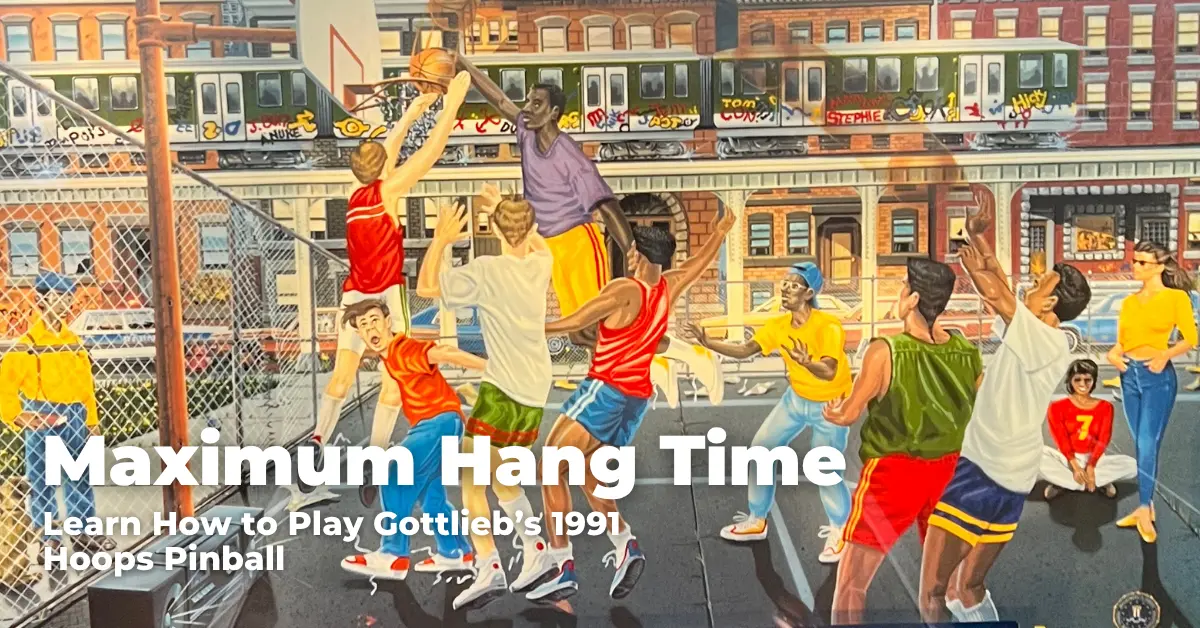
Gottlieb’s street-level designs, while short lived in the overall scope of the company lasting only for the early 90s, have found more recognition today thanks to designers like Keith Elwin and Jack Danger returning to some of their ideas and introducing them to new generations. Silver Slugger proved to be a massive hit for the company and the demand was there for another sports-themed pinball machine with similar rules and aesthetics, so in 1991, the company released Hoops to follow in that machine’s footsteps. While the machine tends to be overlooked like other Gottlieb releases of the era, I find it to be incredibly underrated and offers quite a few methods for high scores, making this one of the few tournament-friendly Gottlieb tables.
Being a street-level design, Hoops contains no ramps whatsoever, instead being a layout all about orbits, standup targets, and saucers. The game is notable for containing both normal and basketball scoring years before a similar rule was implemented in Bally’s NBA Fastbreak, though here, basketball scoring simply serves as an end-of-game bonus award that accumulates as saucer shots are made. The entire playfield is useful for scoring, even the bumpers and captive ball that are used in a high-scoring hang time feature that can run at any time during play. Though Hoops lacks the depth of many pinball machines that were releasing at the time of its release in 1991, it is still an addictive machine and one I always look forward to playing whenever it shows up.
About Hoops Pinball
Lock balls, score basket points, and maximize your hang time bonus in this Gottlieb street-level table themed around the game of basketball.
- Manufacturer: Gottlieb (Premier)
- Release Year: 1991
- Design: Ray Tanzer
- Art: David Moore, Constantino Mitchell, Jeanine Mitchell
- Music / Sound: Dave Zabriskie
Hoops Playfield Overview

The left side of the playfield contains a massive lane that sends balls through the left inlane, and can be shot either through the spinner or fast break loop located at the top left of the playfield. Near this lane are several smaller shots that are nonetheless important to hit: the S target in SLAM DUNK, the left saucer, the spinner, and the captive ball.
The left saucer is the most consistent ball lock shot on the playfield, requiring a late flip from the right flipper to shoot. The spinner increases the hang-time bonus quickly and sends the ball exiting out of the fast break loop or towards the left flipper depending on the strength of the shot. The captive ball lights the fast break loop to activate alley-oop and collects the current hang time bonus if it was lit by the right inlane. Lastly, the fast break loop sends balls flying towards the left flipper, though the Gottlieb “catch-all” flippers allow for the left flipper to be held and slow down balls exiting via this lane.
The center saucer is called the tip-in shot and is gated by two targets that help guide the ball towards the saucer: it requires a precise shot from the left flipper to hit due to the barrier located directly below it. The top lanes near the tip-in shot are used to light the multiball locks and cycle with the flippers, and a standup target at the apex of the orbit that feeds the top lanes will start hang time once it is hit and collect extra ball once enough basket points have been scored.
There are several standup targets dispersed throughout the bumpers that pause the hang time feature for 5 seconds when hit, and one last saucer that scores 3-point baskets and is the toughest to consistently shoot, requiring a precise left flipper shot that doesn’t hit any of the bumpers; however, the bumpers can also help guide the ball into this saucer through lucky bounces. This saucer is also used to score the alley-oop 10-point basket when lit via the fast break loop. To the right of this saucer is the right orbit, which is also where new balls are plunged. The LAM targets in SLAM DUNK gate the top of the plunger’s entrance into the playfield.
The inlane / outlane setup on Hoops is slightly unique. Due to having to accommodate for the speed of the fast break loop, the left inlane has a diagonal slant to help slow down balls that exit it and the slingshot is taller than normal, meaning left outlane drains are less common on this table than average. The right inlane and outlane are in their normal position and responsible for most drains on this table. These return lanes also spell out DUNK, which can be cycled with the flippers, and completing SLAM DUNK through the return lanes and targets increases the basket multiplier by +1x for the rest of the ball.
Scoring on Hoops is slightly lower than average for this era of Gottlieb tables due to having no dedicated million shots outside of the super slam award having it as an option. Basket points account for a sizable amount of scoring (10k per basket point), but if the player tilts on their last ball, this end of game bonus won’t be scored!
Getting Started with Hoops

- Lock balls by rolling through a lit top lane which cycles with the flippers, then shoot any flashing lock shot. The first multiball of each ball is 2-ball, but subsequent multiballs on the same ball will be 3-ball and require two balls to be locked.
- During multiball, re-lock the balls in the saucers to award a super slam. In 2-ball multiball this is a choice between 1M and 20 basket points, while in 3-ball multiball the choice is between 3M and 50 basket points. Always take the points unless your current basket bonus is sizable.
- Earn baskets by making shots. The top lanes award one basket, the left saucers & fast break loop award 2 baskets, and the right saucer awards 3 baskets. Alley-oops score 10 baskets and can be collected by hitting the captive ball, then shooting the fast break loop to light the right saucer for the award. Alley-oop unlights if any switch that isn’t a bumper is hit.
- Every basket awards 10k points in bonus scored at the end of the final ball of a game.
- Complete SLAM DUNK by hitting all four standup targets and completing the inlanes / outlanes to increase the basket multiplier by +1x for the rest of the ball, to a max of 3x. The basket multiplier does not apply to basket points earned via super slam.
- Start hang time by hitting the blue target near the top lanes. During hang time, all spins add 10k to end-of-ball bonus, and all bumpers add 10k + 1k per each bumper hit to end-of-ball bonus until hang time ends. The value resets when the ball drains.
- Hang time bonus can be collected during a ball by rolling through the right inlane, then shooting the captive ball. Collecting hang time bonus this way does not reset it!
- Light extra ball and special at the hang time target and captive ball respectively by scoring multiples of 40 and 50 baskets respectively. On tournament settings, extra ball and special score 500k.
Multiball & Super Slam

Multiball is where the bulk of points on Hoops come from, but it requires skilled, controlled play to execute, despite it being easy to start. Light the locks by rolling through the lit top lane, which cycles with each flipper button press, then shoot either saucer to lock a ball.
For the 2nd and subsequent multiballs played on the same ball, multiball will be 3-ball and be slightly tougher to start, requiring one lit top lane to be completed to light each lock. If the player drains with one ball locked before locking the second one, the locked ball will release and the ball will automatically end.
Though all normal scoring resumes during multiball, the main goal of multiball is to collect as many super slams as possible by re-locking the balls in the saucers. Once one ball is locked, the player will be given about 10 seconds to lock the remaining balls in the saucers. There’s no way to restart the multiball if it ends quickly and no ball save when the multiball starts, so this multiball requires knowledge of how to shoot the saucers and how to react to the saucers releasing the balls.
Super slam is a choice between two different awards: 1M points or 20 basket points. It is possible (but very difficult) to score a 3-ball super slam, and the awards will be buffed respectively to 3M points or 50 basket points if this occurs. The process will then restart until multiball ends. Generally, it is always best to take the 1M points here, as 20 basket points only amounts to 200k bonus points at the end of the third ball. Weigh your options accordingly.
Basket Points, Basket Bonus & SLAM DUNK

Baskets are the secondary source of scoring in Hoops. Every basket point scored during a game correlates to 10k points scored after the final ball of a game drains, but if the player tilts, this end-of-game bonus won’t be scored! The player can score up to a max of 999 basket points.
There are several ways to earn baskets, mostly by hitting shots:
- Top lanes – 1 basket
- Left saucer – 2 baskets
- Fast break loop – 2 baskets
- Tip-in saucer – 2 baskets
- Right saucer – 3 baskets
10 baskets can be earned by scoring the alley-oop in a 3-step process. First, shoot the captive ball to light the fast break loop to qualify it. Then, shoot the fast break loop. Lastly, shoot the right saucer without hitting any other switch that isn’t a bumper.
All baskets earned through these methods can be multiplied by spelling SLAM DUNK with shots to the standup targets and by rolling through the return lanes whose lights cycle with the flippers. Every time SLAM DUNK is completed, the basket multiplier for the rest of the ball increases by +1x to a max of 3x. The multiplier doesn’t affect the basket points earned from multiball super slams, just the methods described above and the alley-oop 10-point basket.
Hang Time Bonus
Hang time can be sizable over the course of a long ball on Hoops and is the only source of proper end-of-ball bonus on the machine, which resets at the end of each ball. To start hang time, hit the blue target located at the apex of the right orbit, whether by hitting it from the plunger or with a strong shot to the right orbit from the flippers. Relight the hang time target during a ball by rolling through the left inlane.
During hang time, the spinner and bumpers add to the hang time bonus scored at the end of the ball. Each spin adds 10k to the bonus, and each bumper hit adds 10k + 1k per bumper hit during the current round of hang time (which resets to 10k once the timer runs out). The timer for hang time lasts about 20 seconds and can be frozen for 5 seconds by hitting any standup target in the bumper area. The timer can’t be re-frozen if it is already stopped.
Hang time bonus is normally scored and reset at the end of each ball, but there is a way to collect the bonus during a ball without resetting it! When the ball rolls through the right inlane, the captive ball will be lit for about 10 seconds to collect the current hang time bonus. This is easier said than done because the Gottlieb “catch-all” flippers are tough to alley pass with but can pay off during a long ball.
Extra Ball & Special
Basket points are also used to light the extra ball at the hang time target, and the special at the captive ball. By default, extra ball is lit at every multiple of 40 baskets, and special is lit at every multiple of 50 baskets. On tournament settings, extra ball and special award 500k points. The two awards only remain lit for about 20 seconds.
These two awards are the main reason you’d want to select the basket points option from super slam in casual play. However, in competition with the extra ball & special scoring only 500k and only lit for a short time, the guaranteed points from the millions outweigh the compensation from these awards.
Noah’s Strats
- Multiball is where all the points on Hoops are at but requires good execution to make the most out of. Generally, I ignore the right saucer as I’m not good at shooting for it and it requires a precise shot, more precise than either the left or tip-in center saucer, but if a ball happens to fall into it, I’ll be happy. Shoot the left saucer from the right flipper, and the tip-in saucer from the left flipper; then always choose the 1M or 3M award. Only choose the basket points if you’re playing on location with extra balls/specials enabled.
- Hang time can be worth significant points, but should be weighed accordingly. At the start of a ball, even if hang time starts, your priority should still be locking balls. Hang time during multiball tends to lead to larger points thanks to balls staying in the bumpers for longer, and there is significantly less risk to saving balls in the right inlane / outlane area to light the captive ball for collect hang time.
- Hoops is predominantly a left flipper gam,e and balls exiting the bumpers or saucers should be primarily caught with that flipper. The right flipper should only be used to shoot the fast break loop or spinner, which transfers the ball to the left flipper, or in exceptional cases, the captive ball if collect hang time is lit.
- Ignore SLAM DUNK unless one letter remains, then try aiming for it. Even then, the risk of aiming for SLAM DUNK targets is generally not worth the reward and should only be done sparingly during multiball.