
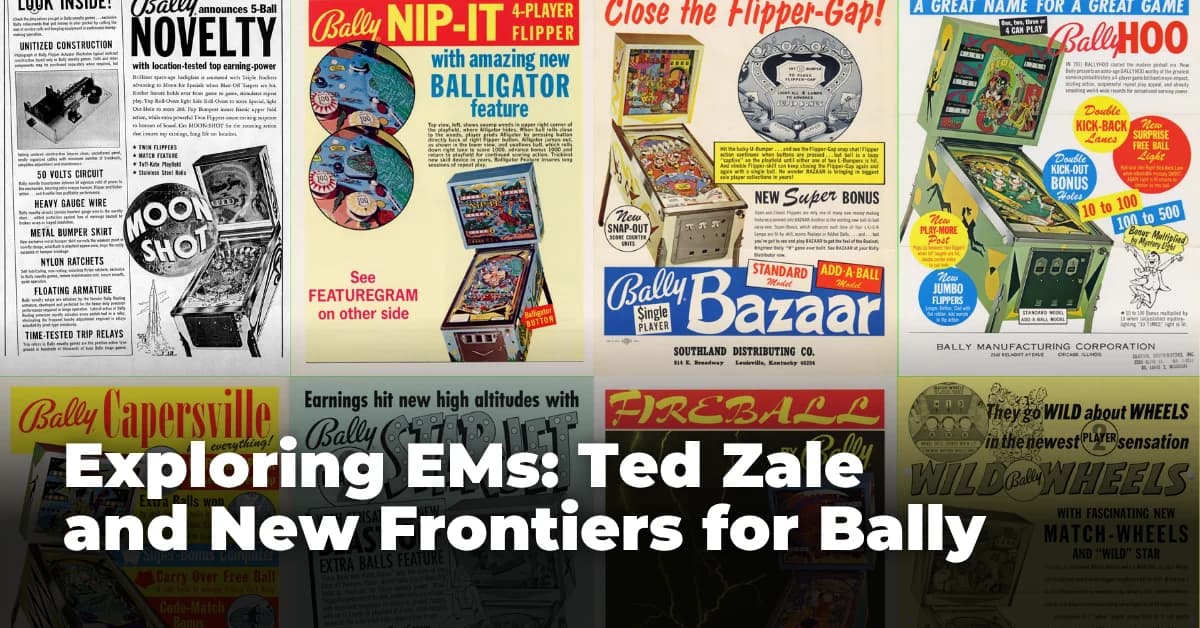
Born Thaddeus Zalewski in 1901, prolific Bally designer Ted Zale had a long life before pinball. After living in various cities and trying out various careers, Zale joined amusement manufacturer Genco sometime in the 1940s. He may have contributed to pinball there, but he is believed to have worked primarily on shooting gallery-style gun games through the 50s. Genco shut down in 1958 and was later incorporated into Chicago Coin. He was hired by Bally in 1962 and would change pinball forever over the next decade-plus.
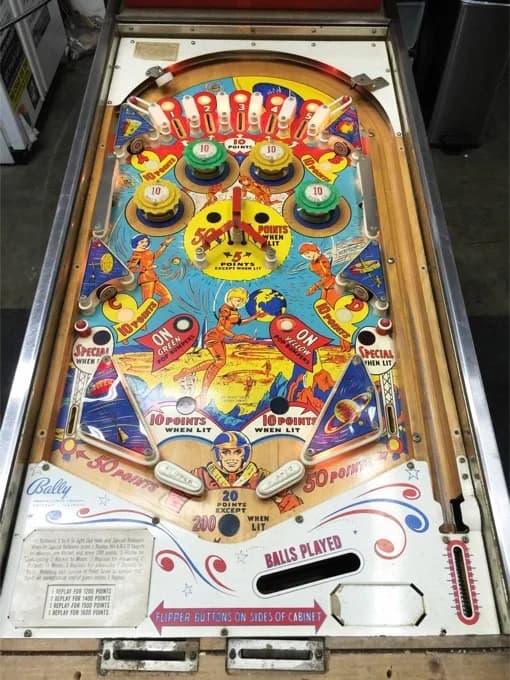
His First Design: Moon Shot (1963)
In the early 1960s, Bally was falling on hard times. Bally had been losing money ever since original founder Ray Moloney passed away in 1958. The majority of Bally’s income in the 1950s and early 1960s was from gambling-focused bingo games, but that root looked like it was about to be pulled too. The Gambling Devices Act of 1962, which was signed into law in October 1962 and slated to be effective in December of that year, prohibited interstate commercial transport for gambling devices, which bingo machines definitely were. To plan for this, Bally abruptly stopped the production of all bingo machines in October 1962 and hired Ted Zale to focus more on flipper pinballs. The final version of the Gambling Devices Act was amended to allow for some interstate transport and export of gambling games, and Bally did resume making some bingo games in 1963, but they committed to the pivot and would be primarily a pinball manufacturer through the end of the millennium.
Zale’s first work for Bally was Moon Shot, released in early 1963. To get one back on Gottlieb, whose legal team worked on the Gambling Devices Act to ensure that Gottlieb games would be exempt from the new guidelines in said Act, Moon Shot was an almost-identical recreation of Tropic Isle, a flipper game by Gottlieb from April 1962. Moon Shot was Bally’s first flipper pinball game since 1957, and sold 1,250 copies.
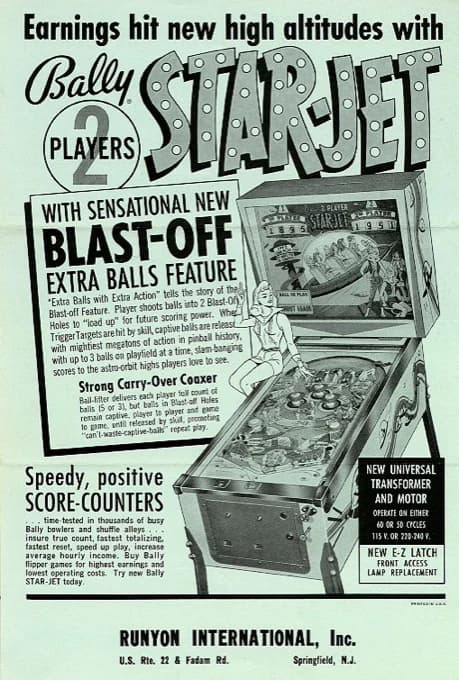
The Rise of Multiball: Star-Jet (1963)
Bally’s first iteration of a multiball feature in flipper pinball was on Balls-a-Poppin in 1956. In that game, various switches add to a “Wild Balls” counter, and landing in a center saucer releases the number of earned Wild Balls. Star-Jet’s approach is much more familiar, with two saucers at the top of the game serving as places to “lock” balls, and various standup targets around the game releasing those locked balls. Balls can be relocked at any time, and locked balls would often be preserved from ball to ball, player to player, and even game to game until being released. Marketed as a "sensational new Blast-Off extra balls feature", Ted Zale’s games at Bally were the only attempts by a major American manufacturer to try multiball play in the electromechanical era.
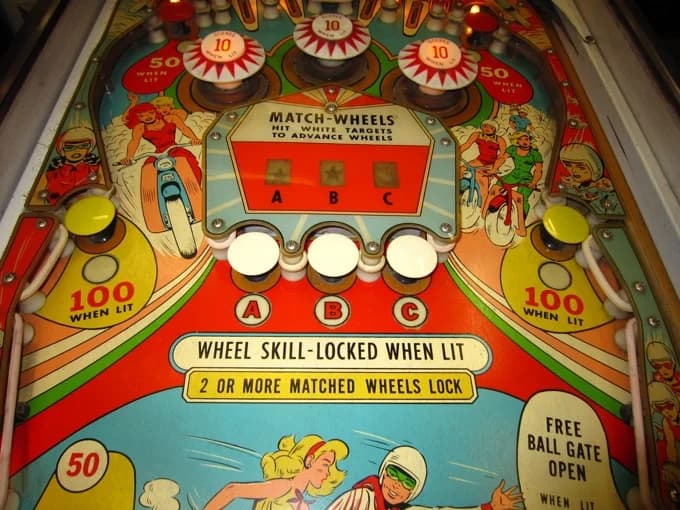
Score Reels…On the Playfield? Wild Wheels (1966)
Wild Wheels features three score reels on the playfield, each corresponding to a mushroom bumper. Hitting a mushroom bumper advances that reel, unless it is part of a pair; making a three of a kind on the reels could award points, open the freeball gate in the out lane, light Specials, and more. A handful of games through the 1970s used this concept for similar slot-machine style features. Variations on the theme have popped up sparingly since then, including the slot machine on the center ramps of WHO dunnit in 1995, the in-playfield DMD tracking Hold ‘Em hands on World Poker Tour from 2007, and the miniature LCD screen under the glass on the Steve Ritchie-designed Star Wars in 2017.
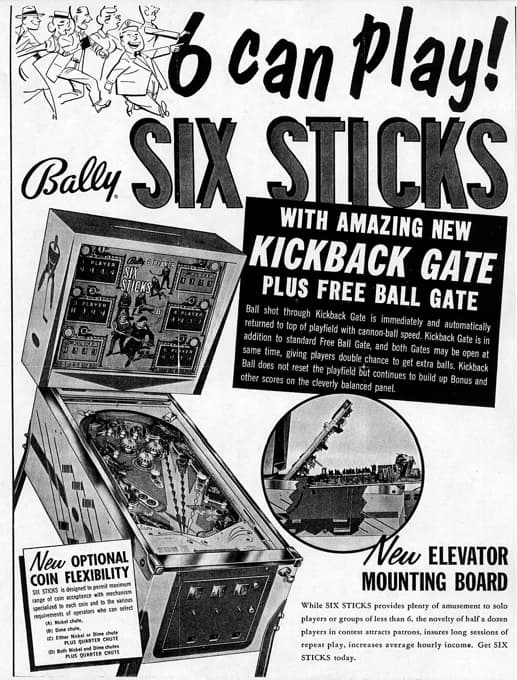
The First Production 6-Player Game: Six Sticks (1966)
Shortly after Gottlieb released Super Jumbo, the first 4-player flipper pinball, in 1954, Wayne Neyens experimented with Hi Boy, a 6-player version of a similar playfield. Only one copy was ever made, due likely to the size of the machine and the amount of circuitry involved. Twelve years later, Bally took the idea and ran with it, giving Six Sticks a production run of 1,410 games in 1966. After the release of Six Sticks, only Six Shooter in 1966 and Six Million Dollar Man in 1979 would support more than four players in the next two decades. 6-can-play became a standard feature on many Sega Pinball games in the 90s, but was removed around the time Sega was bought by Stern in 1999. The concept has largely been abandoned, likely due to the fact that 4-player games are already rare enough outside of competitive settings for games on location, so there’s minimal demand to support more than that.
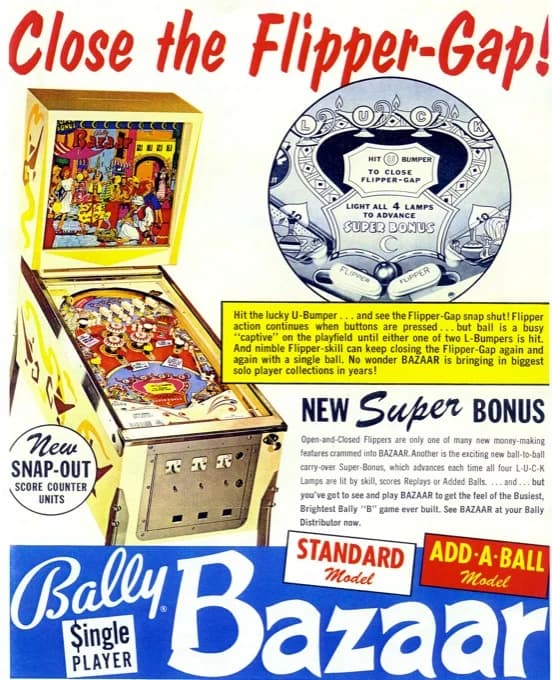
The First Zipper Flippers: Bazaar (1966)
Likely the most recognizable of Ted Zale’s innovations, zipper flippers first appeared on Bazaar at the end of 1966. Zipper flippers can be closed together and reopened at the hit of a single playfield switch. When the flippers are closed, they rotate and move inward to completely block off the center drain, but they can still be operated as normal, albeit with different shotmaking than usual owing to the changed resting position. Zipper flippers were used on almost every Ted Zale design for the remainder of the 1960s, with even Williams getting in on the act for a few games in 1968; they appeared sparingly in the 1970s before disappearing for good following Medusa in 1981.
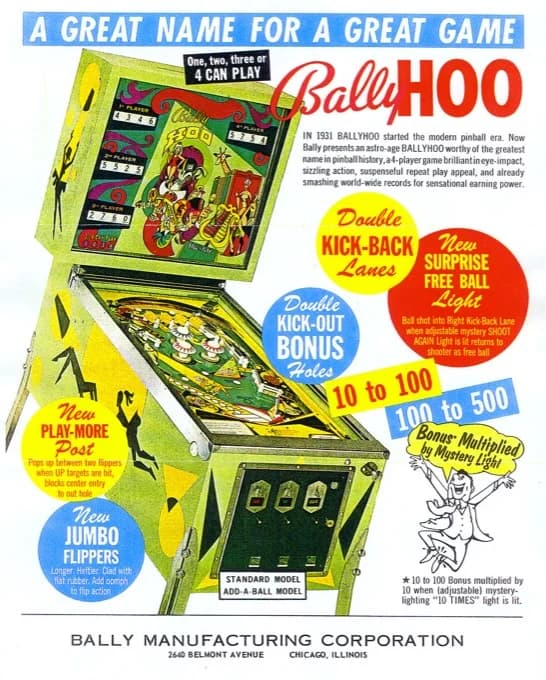
The Dawn of the 3-Inch Flipper: Bally Hoo (1969)
For basically the entire existence of flipper pinball prior to Bally Hoo, flippers were two inches long, regardless of era or manufacturer. Bally Hoo in 1969 dared to be different, offering new “jumbo” flippers — three inches long — for increased ball control and flip power. Additionally, Bally Hoo was the first Bally game with a standard up-post between the flippers, serving as a substitute for the zipper flipper mechanism seen on over a dozen games over the previous three years. Three inch flippers were interspersed with classic two-inch flippers on various games through the early 1970s, with the three inch version becoming the norm for the final years of the EM era.
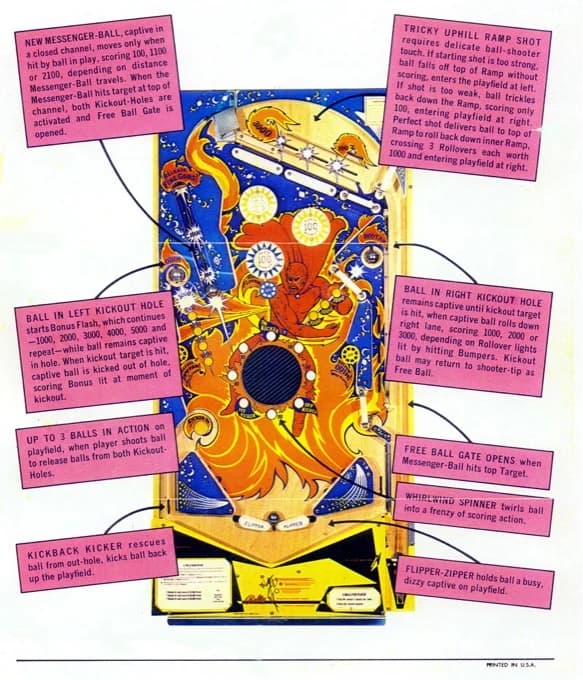
A Tournament Classic: Fireball (1972)
The wacky world of Ted Zale reached a fever pitch in 1972 with Fireball, one of the most infamous EMs of all time. Combining multiball, zipper flippers, an automatic kickback in the left out lane, and a massive spinning disk in the center of the playfield to affect ball movement, Fireball plays like no other electromechanical game. Fireball is very divisive as a game, with some people criticizing the lack of ball control allowed by the disk and the power of successful skill shots compared to the rest of the game’s rules, while others appreciate the unique experience offered and the skill set demanded. The spinning disk mechanism has occasionally been revived on games such as Whirlwind (1990), Twister (1996), and the modern Teenage Mutant Ninja Turtles (2020), and Fireball itself received a sequel in 1981’s Fireball II and a solid state remake as 1985’s Fireball Classic.
His Final Game: Nip-It (1973)
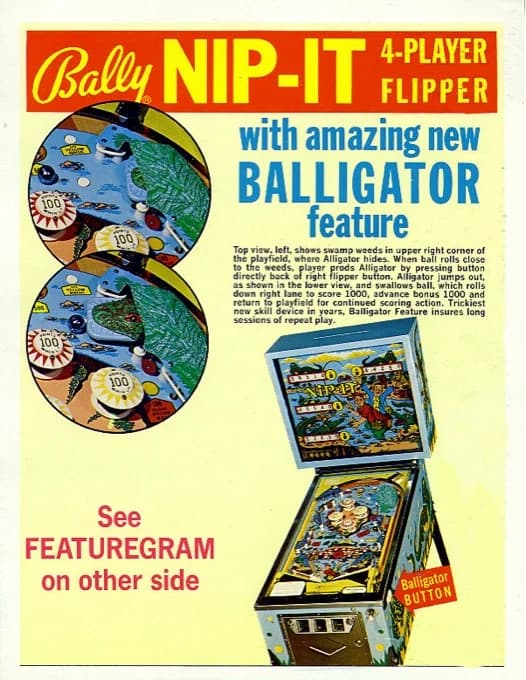
Nip-It’s most iconic feature is the Balligator, a mechanism where a player can press a second button on the right side of the cabinet to cause a metal hook to grab a ball at the top of the playfield and redirect it to an otherwise blocked off lane on the right for additional scoring. The original design for the mechanism involved grabbing the ball with a molded plastic alligator toy, but this was changed shortly into production due to how much the mech broke on location. Separately from the Balligator, Nip-It included zipper flippers and a 2-ball multiball, and was the last game from any manufacturer to include either of those features until well into the solid state era. Nip-It was the second-best-selling Ted Zale game at 4,580 copies, trailing only 1966’s Capersville at 5,120.
Later Career and Beyond
Little is known about many of the details of Ted Zale’s life outside of his pinball designs for Bally. He retired from Bally during or slightly before 1970, but continued to contribute playfield designs to them for a few more years. Ro Go, in 1974, is listed as being designed by Greg Kmiec, but Kmiec has gone on the record saying that the design was contributed by Zale as well. Zale is not believed to have worked on any solid state games, except for the layout of Fireball being reused for the solid state Fireball Classic by Bally Midway in 1985. Bally’s Spy Hunter, released in 1984 and also designed by Kmiec, is said to have been heavily inspired by Zale’s playfields, specifically Joust (1969), but did not include any input from Zale himself. There are no known surviving photos of Zale. The only available detail regarding Ted Zale’s passing is a single post on Pinside from 2018 where a user attempting to write a book about his life lists the year of his death as 1977, when he would have been 75 or 76 years old. Ted Zale was inducted posthumously into the Pinball Expo Hall of Fame in 2008 by his mentee Greg Kmiec, recognizing the many patents and innovations Zale provided to EM pinball that impact the game of today.
Sources: the Internet Pinball Database; The Ted Zale Story and Pinball Expo 2008 at Pinball News; and a Pinside thread on Zale.

Comments