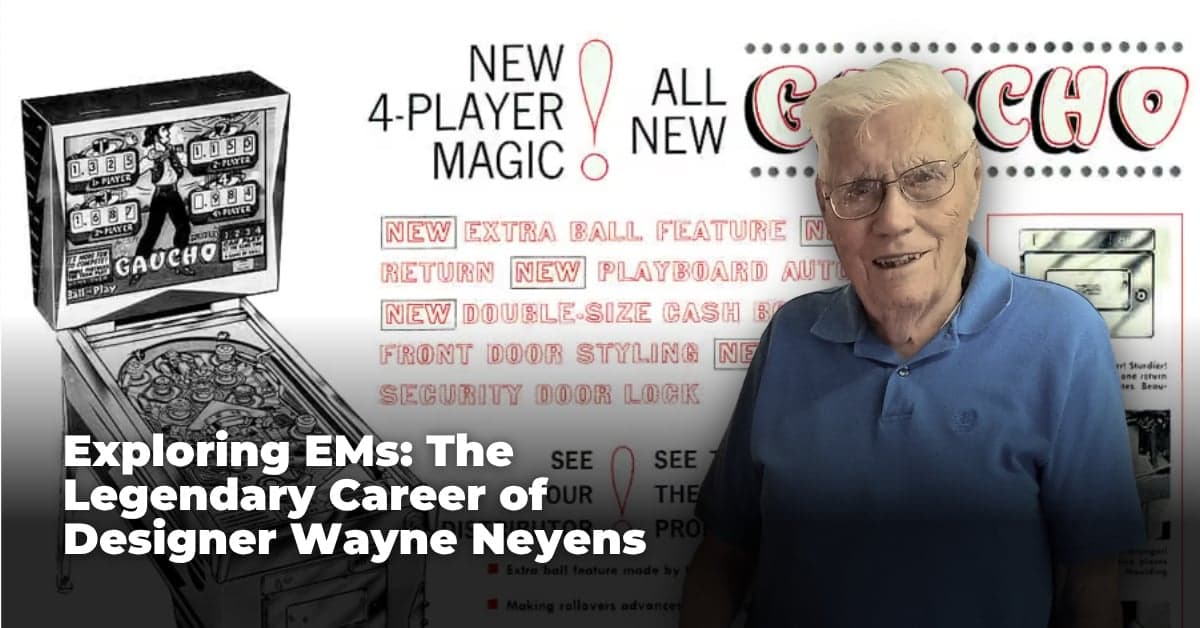
Born in 1918 in Mason City, Iowa, Wayne Neyens joined Western Equipment and Supply during high school before being hired by Gottlieb in 1939. With a brief intermission to serve in the U.S. Army Air Corps during World War II, Neyens would stay at Gottlieb for more than 40 years, designing many of the most well-respected games of the era and making innovations that modern players take for granted. Here, we look back at some of his most influential ideas and popular designs.
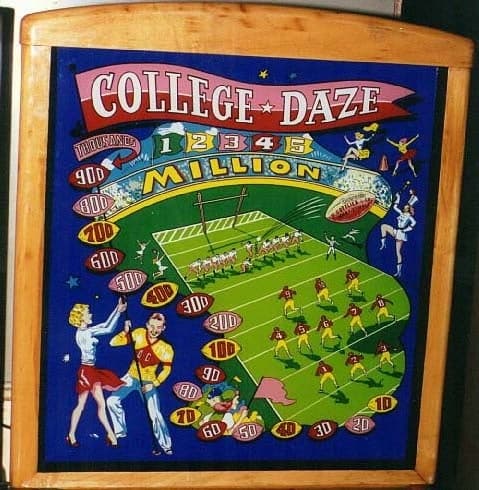
His First Design: College Daze (1949)
Wayne Neyens started as a designer for Gottlieb in 1947, but his first design to reach production was the American football-themed College Daze in 1949. According to Neyens himself, the game was originally spelled “College Days”, but was gently renamed by artist Roy Parker; the two found the new spelling whimsical, and kept it. None of College Daze’s features or rules are too far out of line for games in the very early years of the flipper, but they may be jarring to players only familiar with pinball games of the 1970s and onward. The two flippers, located at the bottom of the playfield, face outward, and are almost perfectly horizontal when not raised. The main object of the game is to hit 11 switches around the playfield—3 passive bumpers, and 8 wall switches—to form a football team, then collect them again or earn “points” (separate from the conventional score) to earn free games.
The Dreaded Gobble Hole: Queen of Hearts (1952)
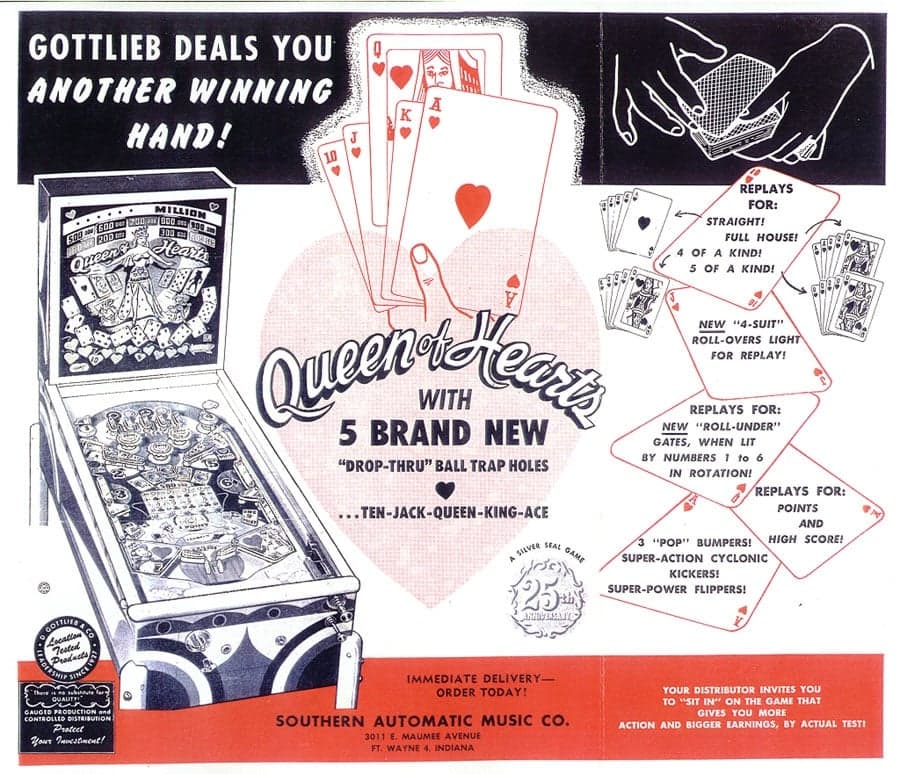
While Wayne Neyens didn’t introduce the gobble hole to pinball, he certainly made them rather mainstream during the 1950s and early 1960s. A gobble hole is a drain hole that ends your ball located somewhere other than the bottom of the playfield, often assigned a temptingly high point value or a relatively simple way to earn a replay. Gobble holes were seen as far back as flipperless games in the mid 1930s, but Queen of Hearts is one of the first flipper games to include them. Neyens threw 5 of ‘em on this game, each corresponding with a rank of playing card, with replays able to be earned for forming a straight, full house, or 4 of a kind by draining in specific gobble holes. Gobble holes went out of style in the early 1960s, and were completely extinct by 1964, as pinball began to take the “a game of skill” moniker more seriously and detach itself further from the gambling scene.
The First Multiplayer Flipper Game: Super Jumbo (1954)
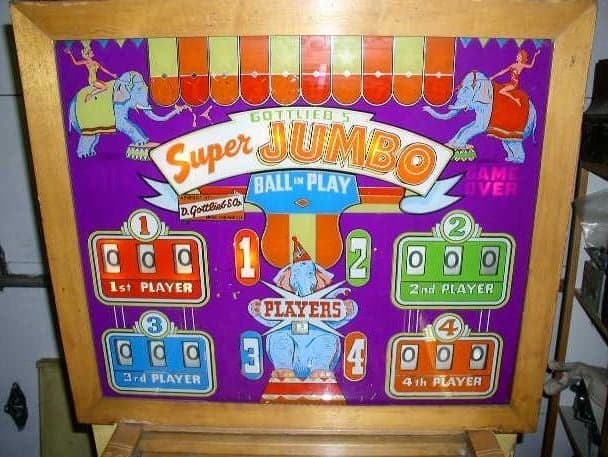
Through Super Jumbo, Wayne Neyens ushered in a new era for Gottlieb and for pinball, designing Gottlieb’s first game with score reels rather than “light-up” bulb scoring on the backglass, and the first game by any manufacturer to have flippers, support multiple players in one game, and reach full production. Super Jumbo was joined by Deluxe Jumbo, a version incapable of awarding replays, later in 1954, and was also followed by Duette as Gottlieb’s first 2-player game in 1955. 4-player and 2-player variants of games became a mainstay for the rest of the electromechanical era, and 4-players remains the standard in pinball to this day.
The First Disc Roto-Target: Majestic (1957)
Featuring 15 colorful panels of varying value, the roto-target introduced a dynamic never seen before in pinball. The sight, sound, and rules design appeal of these targets made them a recurring character in Gottlieb games for more than two decades, even on a handful of solid state games as late as 1980. While roto-targets occasionally get criticism for being difficult to maintain or, in modern contexts, adding too much luck to the value of scoring features, they are certainly one of pinball’s most unique and impressive mechanics.
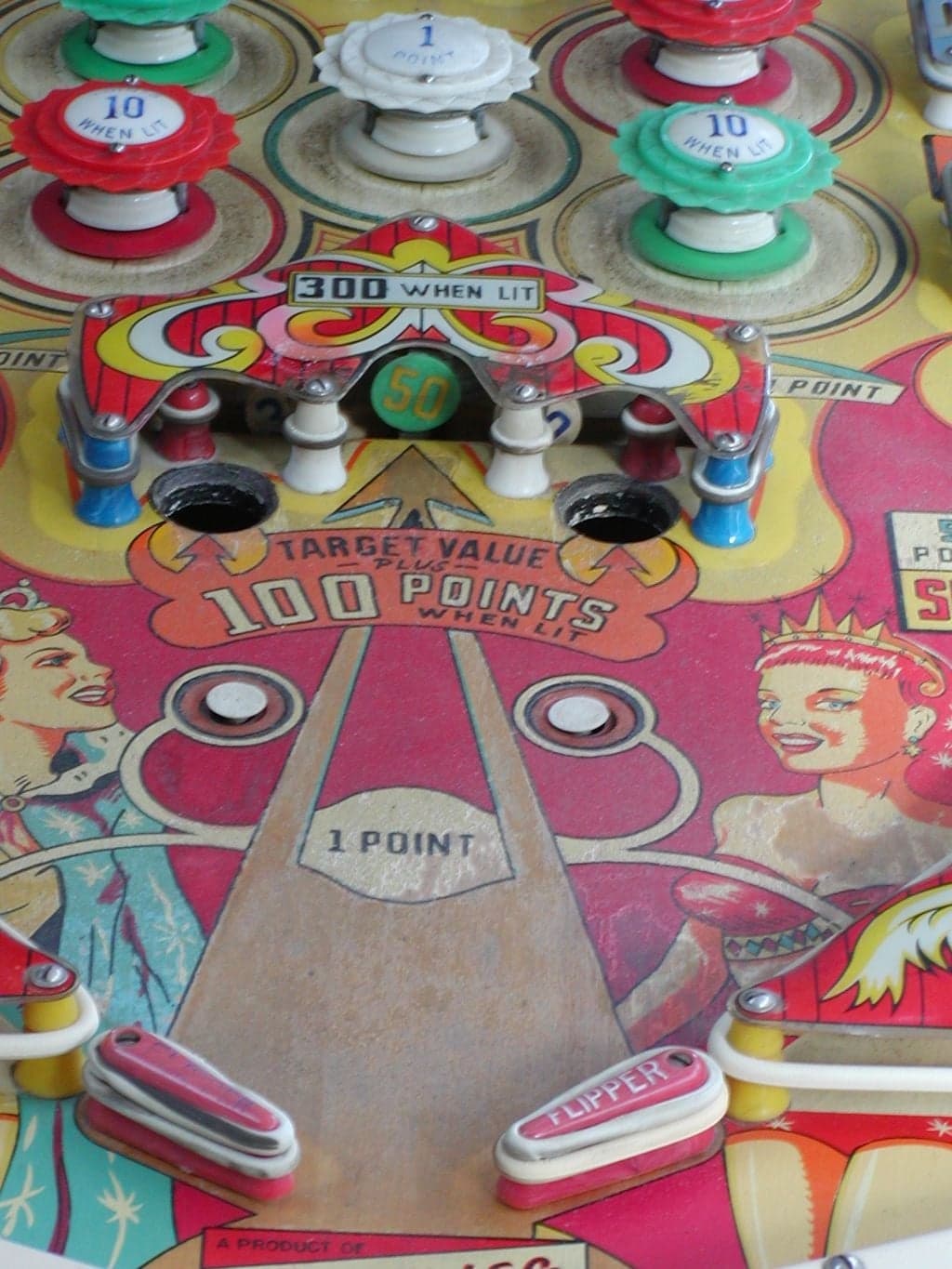
The First Wedge Head and First Add-a-Ball Game: Flipper (1960)
As far back as the introduction of the flipper on Humpty Dumpty in 1947, operators complained about the need to manually space machines apart to make room for hands in between. The added components and wiring required to make a multiplayer game operational meant those games had larger backboxes that alleviated the problem, but something had to be done for single player games, but Gottlieb didn’t want to spend extra money on larger back panels and backglasses for all of their single player games too. So, in the middle of the production run of Flipper, the “Wedge Head” backbox was adopted. The wedge head backbox is trapezoidal in shape, wider on the top than the bottom, discreetly increasing the game’s profile and giving the ability for Gottlieb to market a sleek new design for the 1960s. The design was a smash hit, even being almost directly copied by Williams with the “reverse wedge head” slightly later, and would cement Gottlieb’s place as the leader in EM pinball through the mid-1970s.
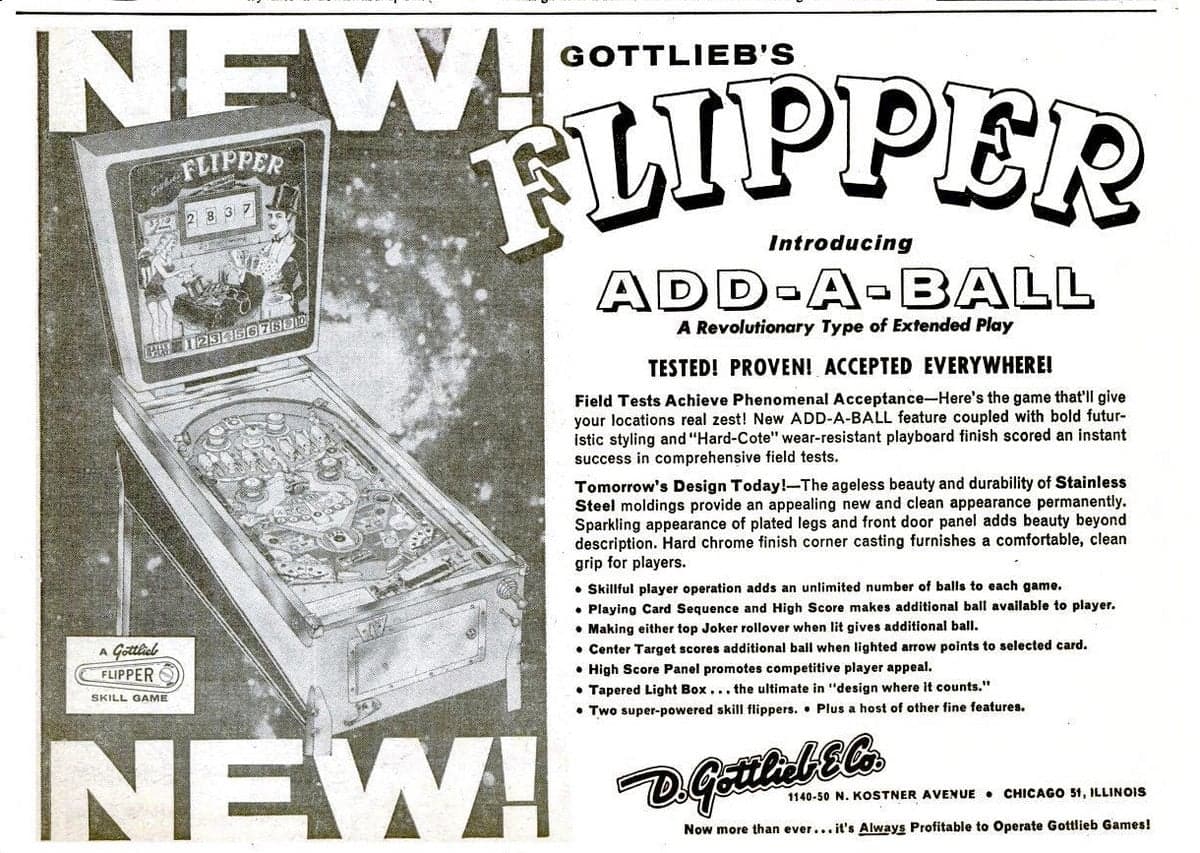
Perhaps even more noteworthy, though, was Flipper’s introduction of a whole new style of pinball reward. After several “extended play” prototypes from the late 1950s that really only served to cover up the awarding of replays by saying players had earned 5 more balls instead of 1 free game, Flipper pioneered the add-a-ball game as it is commonly thought of today. The game counts down balls to play, rather than counting up balls in play, and 1 extra ball can be added to the countdown at any time (up to a maximum of 10 balls to play). One common argument from legislatures who banned pinball claimed that since a free game award has a defined monetary value, the ability for pinball to award a replay made the game inherently a gambling device. The legal argument made by Flipper and other add-a-ball games that followed it was that a single ball of a game cannot have a set monetary value, since it is not a set fraction of a pinball game. This argument worked in places such as France, Italy, and Texas, allowing for the re-introduction of pinball in many locales. Flipper became the first in an add-a-ball series that also included Flipper Parade, Flipper Fair, Flipper Clown, and Flipper Cowboy across 1961-62, and making add-a-ball variants of replay games would be common practice well into the 1970s.
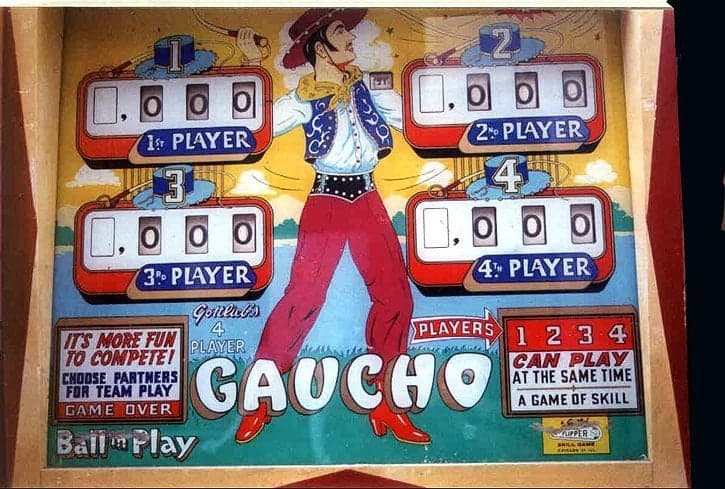
His Best-Selling Game: Gaucho (1963)
With a production run of 5,350 games across the first quarter of 1963, the Western-themed Gaucho was the most popular of Neyens’ designs upon its release. Featuring roto-targets, five pop bumpers, multiple skill shots, and an extra ball feature, Gaucho combines many of Neyens’ most famous contributions into one fast-paced game. Gaucho was also popular among operators for its increased cash box and the removal of screws holding the playfield in place, making it significantly easier to diagnose and repair issues and get games back on location quickly.
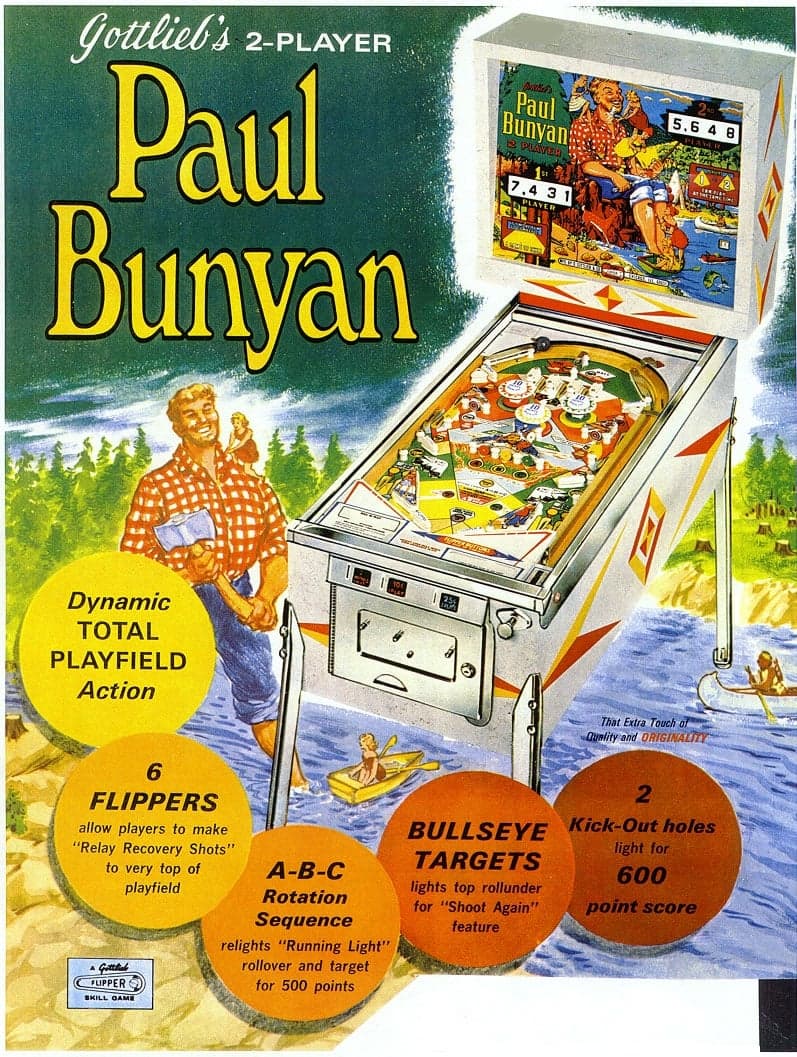
His Final Conventional Design: Paul Bunyan / Big Jack (1968)
The 2-player Paul Bunyan and its Italian-export add-a-ball cousin Big Jack were jointly designed by Wayne Neyens, Ed Krynski, and Steve Kirk, often considered three of the best designers ever to grace the world of pinball. Paul Bunyan’s abundance of rollover lanes, standup targets, and six (!) flippers give it a very compartmentalized design that incorporates some aspects of 1940s and 50s flipper usage with more contemporary progression and rules. Big Jack was Neyens’ most successful add-a-ball game, with 1,725 copies produced.
Later Career and Beyond
In 1970, alongside Alvin Gottlieb, Bob Smith, and Doc Garbark, Neyens patented the concept for and conceptualized Challenger, a 2-player-simultaneous competitive pinball machine where players flip the ball back and forth at each other on adjoining playfields. The concept did not prove popular, and only 110 copies were produced when the game was given the green light in 1971. Head-to-head pinball was tried several other times in the future with Joust (Williams, 1983) and the A.G. Soccer-Ball series (Alvin G. & Co., 1991-92), but has never really caught on.
Neyens was promoted to Chief Engineer at Gottlieb in 1971, moving him away from direct game design. The torch was passed to Ed Krynski, a former designer at Keeney who joined Gottlieb in 1964 and whose designs led to unprecedented success for Gottlieb throughout the 1970s. Neyens is sometimes credited for design on games in the mid-1970s such as “300” / Top Score (1975) and Spirit of 76 / Pioneer (1976), but it is likely that Krynski was the primary, or indeed sole, designer for these games.
After stepping into a consulting-only role at Gottlieb (which had recently come under the ownership of Columbia Pictures) in 1980, Neyens retired fully from the pinball profession in 1983 at the age of 65. Neyens had a long life after retirement, living well into the new millennium, making public appearances and giving interviews frequently. Wayne Neyens passed away on July 30, 2022, one day after his 104th birthday. We thank Mr. Neyens for using his creativity, engineering skill, and leadership to keep pinball thriving and bring joy to countless lives over the past 80-plus years.
Sources: the Internet Pinball Database; Wayne E. Neyens' obituary; Pinball Magazine #5; and Midwest Pinball.